
The Paradox of the Bedside Table
The nightstand occupies a peculiar position in domestic architecture: too small to command attention, too visible to ignore. It must accommodate the detritus of daily life—water glass, charging cables, half-read novels—while maintaining some semblance of compositional intent. At World Archi Design, we've observed that the introduction of open shelving into this typology fundamentally alters its performance. Where a drawer conceals, a shelf curates. Where a closed cabinet isolates function, exposed storage integrates it into the room's visual field.
What follows is an analysis of 26 contemporary and vintage approaches to the shelved nightstand, each representing a distinct strategy for balancing utility with aesthetic legibility. These are not product recommendations but design studies—examples of how material choice, proportion, and spatial logic can elevate a utilitarian object into something closer to furniture as argument.
Material Honesty and the Return to Wood Grain
Several of the strongest examples lean into materiality as their primary organizing principle. A whitewashed open-frame nightstand constructed from chunky vertical planks reads almost architectural in its directness—the wood's texture and joinery become the decoration. Similarly, a mid-century teak piece with tapered legs and a single open niche demonstrates how restraint in form can allow grain and color to carry the entire composition. The honey-toned warmth of aged teak requires no embellishment; the material itself provides enough visual interest to anchor a bedside tableau.
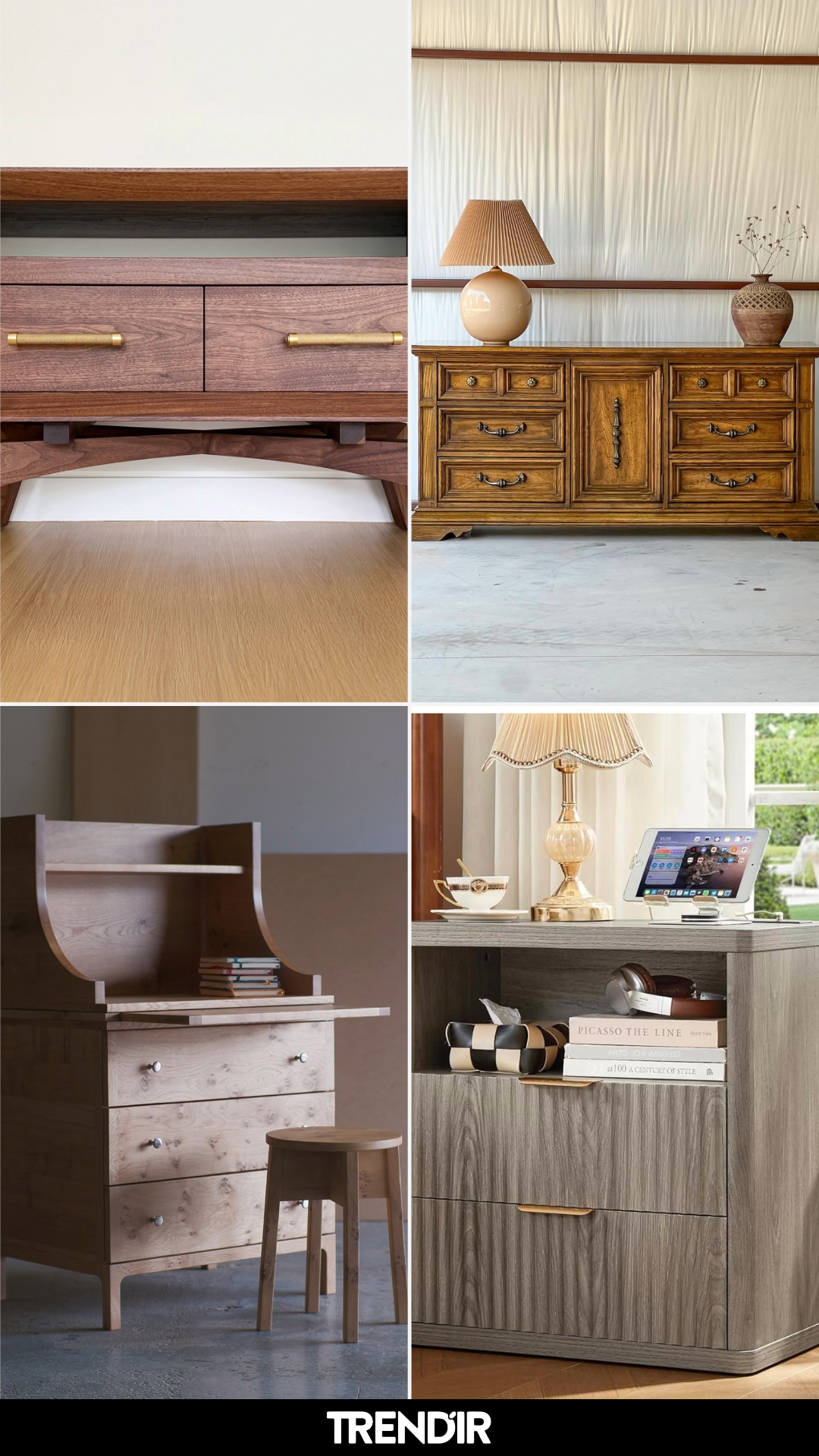
This approach finds a contemporary parallel in handmade walnut constructions featuring crossed arch bases and exposed joinery. One particularly compelling example pairs two stacked drawers with an open niche above, the entire piece held aloft by sculptural legs that seem borrowed from a design museum. The knurled brass bar handles provide the only interruption to an otherwise unbroken field of rich grain. Against a white wall on pale oak floors, such a piece operates as both functional object and sculptural intervention.
The Danish teak cube format represents the apex of this material-first philosophy. A pair of cube nightstands with softly rounded edges and flush drawers above single open shelves demonstrates how solid hardwood can eliminate the need for decorative hardware entirely. The grain does all the visual work; the form simply gets out of the way.
The C-Frame and Cantilevered Typologies
Space efficiency has driven the development of several cantilevered forms that challenge the traditional four-legged nightstand. The C-frame typology—where a rounded base slides beneath the bed frame—represents a notable evolution in bedside furniture. One warm white example with a natural wood edge demonstrates how this format can preserve floor area while maintaining a generous surface for books and morning coffee. The vertical shelf component hangs in space, visually light but structurally sound.
Wall-mounted floating configurations take this logic further. A pair of staggered oak nightstands with rounded corners and black knob pulls eliminates the floor plane entirely, each unit housing an open shelf above a single drawer. The asymmetric installation height introduces a subtle dynamism while freeing the floor for cleaning or visual breathing room. This approach has particular merit in compact bedrooms where every square foot of unobstructed flooring contributes to a sense of spaciousness.
For extremely narrow bedside conditions, the vertical tower format offers a viable alternative. A slim walnut double-drawer piece with a minimal tabletop surface demonstrates how height can compensate for width. The dark grain reads as substantial without occupying lateral space, and the tall profile allows for meaningful storage volume within a footprint that would otherwise accommodate only a lamp.
Lacquer, Rattan, and the Return of Decorative Craft
Not all contemporary nightstand design privileges minimalism. Several examples embrace ornament and finish as legitimate design strategies. A high-gloss cobalt lacquer cabinet on brass casters, for instance, makes no attempt to recede into the background. The lacquered surface reflects light aggressively, while the open shelf and pull-out drawer—lined in contrasting linen and burnt orange—introduce textural and chromatic complexity. Against tufted caramel leather and hand-painted chinoiserie wallpaper, such a piece participates in a larger conversation about maximalism and layered interiors.
Rattan paneling offers a softer decorative register. An oak cabinet with a woven rattan door panel demonstrates how natural fiber can break up what might otherwise read as a flat wooden surface. The low, wide proportions ground the piece, while the rattan front introduces a tactile dimension that invites closer inspection. A wavy brass-stem lamp and lit candle on top complete a vignette that feels considered without appearing overly styled.
Carved relief work represents the most explicit embrace of ornament. A sun-bleached mango wood cabinet with a door panel carved into abstract sculptural relief operates almost as a wall-mounted art object. The carving's dimensionality catches light differently throughout the day, animating the piece beyond its storage function. In a warm minimalist bedroom, such a nightstand can serve as the room's primary visual anchor.
Vintage Typologies and the Argument for Patina
Historical furniture forms continue to offer relevant solutions to contemporary bedside storage needs. A distressed black farmhouse set with ornate turned legs and circular brass pulls demonstrates how chippy-edged finishes—where paint has worn through to reveal warm wood beneath—can introduce temporal depth into a bedroom. The wear patterns are not decorative affectation but evidence of use, a material record of the furniture's life before its current installation.
Jacobean oak cabinets with deeply carved raised panel doors and bracket feet carry similar historical weight. The tobacco-toned wood and dimensional paneling represent a level of craftsmanship increasingly rare in contemporary production. These pieces anchor a room not through scale but through material density and the visual complexity of their surfaces.
Mahogany nightstands with rope-carved gallery rails and brass bail pulls occupy a similar register. The gallery rail—a detail borrowed from maritime furniture—prevents objects from sliding off while introducing a sculptural element at the piece's perimeter. In layered, collected bedrooms, such vintage finds contribute a sense of history and permanence that newly manufactured furniture struggles to replicate.
The Pallet Aesthetic and Material Economy
At the opposite end of the material spectrum, several examples embrace radical simplicity. A slatted pinewood ledge mounted flush with the mattress, with a vertical slat back panel against the wall, represents nightstand design stripped to its essentials. A phone charges on top, a tissue box and book sit within reach, and cables trail visibly to wall outlets. The whole assembly occupies minimal space and requires minimal material, yet it fulfills every functional requirement of a bedside table.
This approach has particular relevance in temporary living situations or for those prioritizing material economy over decorative ambition. The aesthetic is unabashedly utilitarian—there is no attempt to conceal construction or elevate the piece beyond its function. Yet in its directness, it offers a kind of honesty that more elaborate designs sometimes lack.
Scale Adaptation: From Adult Bedrooms to Children's Spaces
The shelved nightstand typology adapts readily to different scales and user needs. A wall-mounted unit in lime green and natural birch with multiple staggered shelves and warm LED backlighting demonstrates how the format can be scaled up for children's rooms. The generous compartments accommodate books, built projects, and the accumulated objects of childhood, while the confident color anchors an entire wall without additional decoration.
This approach recognizes that children's storage needs differ from adults'—more visible organization, more volume, more flexibility for objects of varying sizes. The LED backlighting transforms the piece into a nightlight, collapsing two functions into a single installation.
Dresser-Scale Hybrids and the Expanded Program
Several examples push beyond the traditional nightstand scale entirely. A wide vintage oak dresser with paneled drawers and a center cabinet door, styled with a round ceramic lamp and woven terracotta vase, demonstrates how a larger case piece can function as both nightstand and bedroom anchor. The honeyed wood tone and aged brass hardware carry enough visual weight to fill a wall, while the multiple drawers and cabinet provide storage volume far exceeding a typical bedside table.
This strategy has merit in bedrooms lacking dedicated dresser space or in situations where the bed wall can accommodate a more substantial piece. The risk is overwhelming the bedside zone; the reward is a single piece of furniture that consolidates multiple storage functions.
Open Shelving as Curatorial Opportunity
The consistent thread across all these examples is the way open shelving transforms the nightstand from a purely functional object into a site for display and arrangement. Where a drawer hides, a shelf exhibits. This shift introduces a curatorial dimension to bedside storage—what you choose to place on an open shelf becomes part of the room's visual composition.
A cherry nightstand with an arched gallery back and two open shelves packed with books demonstrates this principle. The reading collection is not hidden away but integrated into the furniture itself, the spines and covers contributing color and texture to the overall composition. A small bronze animal figure on top adds a note of personality that a closed cabinet could never accommodate.
Toward a More Considered Bedside
The nightstand with shelves represents not a trend but a typological evolution—a recognition that bedside furniture can perform multiple roles simultaneously. It can store and display, conceal and reveal, function and decorate. The 26 examples examined here span historical periods, material palettes, and formal strategies, yet all share a commitment to treating the bedside table as more than an afterthought.
At World Archi Design, we've long argued that the smallest furniture pieces often reveal the most about a designer's priorities. A nightstand must work within severe spatial and functional constraints while remaining visible every morning and evening. The introduction of open shelving into this typology doesn't solve those constraints—it simply makes them more interesting. It transforms a problem of storage into an opportunity for composition, a utilitarian requirement into a design decision worth considering carefully.
The bedrooms that get this right understand that the nightstand is not a supporting player but a central character in the room's narrative. It's the last thing you see before sleep and the first thing that greets you upon waking. Making it count—materially, formally, compositionally—is not indulgence. It's simply good design.
Save this story. A free account keeps your reading list and the 07:00 email in one place.
CREATE FREE ACCOUNT →SIGN IN