
A Palimpsest City
Not every city wears its indecision as openly as Birmingham. Walk through its center and you encounter a built environment that refuses to settle on a single narrative. Victorian pomp abuts mid-century concrete, which in turn gives way to contemporary glass and parametric facades. What emerges is not chaos but something rarer: an honest architectural record of changing values, economic cycles, and the recurring temptation to erase what came before.
At World Archi Design, we have long been interested in cities that treat their own fabric as provisional. Birmingham offers a particularly vivid case study. Its architecture is less a curated collection than an argument conducted across centuries, with each generation willing to demolish the previous one's certainties.
The Industrial Foundation
Birmingham's wealth came early. As one of the first industrial centers in England, it generated capital that translated directly into civic ambition during the nineteenth century. The Victorian era left behind buildings designed to announce permanence: neoclassical temples, grand civic halls, institutions meant to outlast their patrons. Birmingham Town Hall, modeled explicitly on Roman precedent, exemplifies this impulse. Positioned at Chamberlain Square, it anchors what remains the city's civic heart, flanked by the Birmingham Museum and Art Gallery. The massing is confident, the fenestration ordered, the message clear: this is a city that intends to matter.
Yet permanence proved elusive. Heavy bombardment during the Second World War shattered much of the urban fabric. What survived the war often did not survive the reconstruction that followed.
The Brutalist Interlude
Rapid rebuilding in the 1950s through the 1970s introduced a new architectural language: rational modernism with Brutalist tendencies. Concrete became the dominant material, and the morphology shifted toward megastructures, elevated walkways, and buildings that expressed their program through form. The Ringway Centre and the Rotunda, both completed in the early 1960s, belong to this moment. So does the former Birmingham Central Library, an inverted ziggurat finished in 1974 that became, for better or worse, an icon of the era's ambitions.
These projects were not timid. They proposed an urban experience organized around separation: pedestrians elevated above traffic, civic functions consolidated into monumental complexes, the street as residual space. The tectonic language was uncompromising, the spatial logic legible from a distance. Whether one admires or critiques this approach, it represented a coherent vision, one that rejected pastiche in favor of a architecture that announced its own modernity.
Erasure as Policy
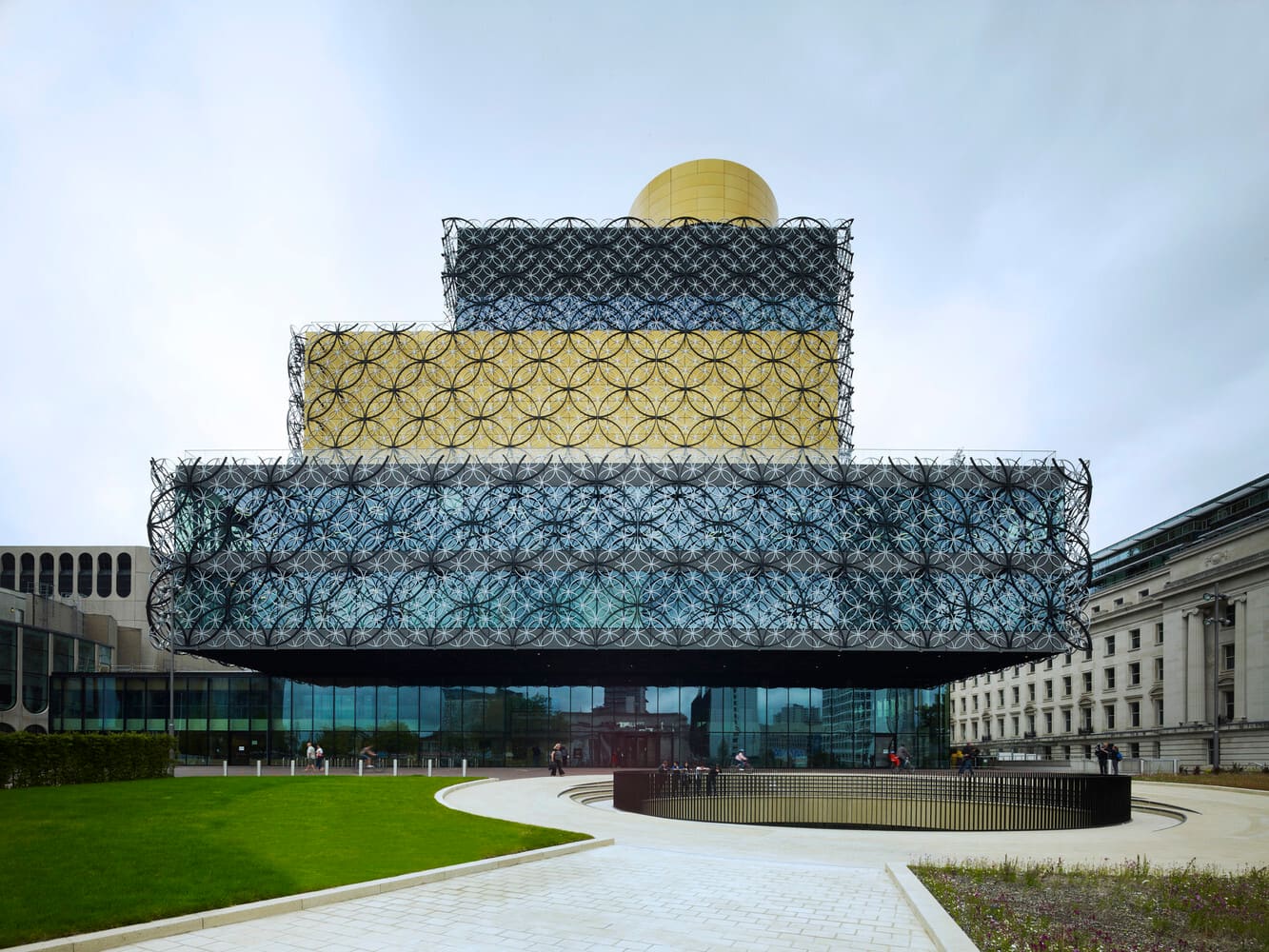
Then came the reconsideration. By the late twentieth century, Birmingham had begun to view its mid-century inheritance with skepticism. The Bullring Centre, a shopping complex completed in the 1960s, was demolished to make way for a new retail development. The 1974 library, despite vocal defense from preservationists and Brutalism advocates, met the same fate. In its place rose the Library of Birmingham, completed by Mecanoo in 2013.
The new library is instructive. Its design draws explicitly on the city's jewelry-making heritage, translating filigree and metalwork into a façade of interlocking circles and perforated screens. The building is light where its predecessor was heavy, transparent where the ziggurat was opaque. It is also, unmistakably, a rebuke: a deliberate inversion of the values that produced the structure it replaced.
This pattern of demolition and replacement is not incidental to Birmingham's identity; it is constitutive of it. The city has proven remarkably willing to treat its own architecture as expendable, a willingness that complicates any simple narrative of preservation or progress.
The Contemporary Layer
Recent interventions have added further complexity. Centenary Square, adjacent to Chamberlain Square, has become a locus for contemporary work. Brindleyplace, a former industrial district along the canals to the west, has been redeveloped into a mixed-use quarter dense with bars, restaurants, and residential blocks. The canalside setting offers a rare moment of continuity: the infrastructure of the industrial past repurposed rather than erased.
In the Bullring area, east of New Street station, the Selfridges department store opened in 2003. Designed by Future Systems, its parametric skin of aluminum discs presents a stark contrast to the orthogonal geometries of the surrounding Brutalist structures. The building has been praised and criticized in equal measure, but it succeeds in one respect: it refuses to defer to context. Like the Victorian town hall and the Brutalist library before it, it insists on its own terms.
What Birmingham Reveals
Birmingham's architectural history raises uncomfortable questions about permanence and taste. If a building can be iconic in one decade and intolerable in the next, what does that say about the judgments we make in the present? The 1974 library was once celebrated as forward-thinking; thirty years later, it was deemed obsolete. The Victorian structures, spared by circumstance and shifting aesthetics, now appear untouchable. But their survival owes as much to luck and timing as to any intrinsic superiority.
This is not to argue for or against preservation. It is to observe that Birmingham's willingness to demolish and rebuild has produced a built environment unusually rich in contradiction. The city does not present a unified aesthetic, and it does not aspire to one. Instead, it offers a record of successive attempts to articulate what a city should be, each layer partially erasing the last.
For architects and urbanists, Birmingham is worth studying precisely because it resists easy conclusions. It is a city that has chosen reinvention over continuity, and in doing so, has created an architectural landscape that is as unsettling as it is revealing. The question is not whether Birmingham made the right choices, but what those choices illuminate about the values embedded in our own work.
Save this story. A free account keeps your reading list and the 07:00 email in one place.
CREATE FREE ACCOUNT →SIGN IN