
Material Intelligence as Design Strategy
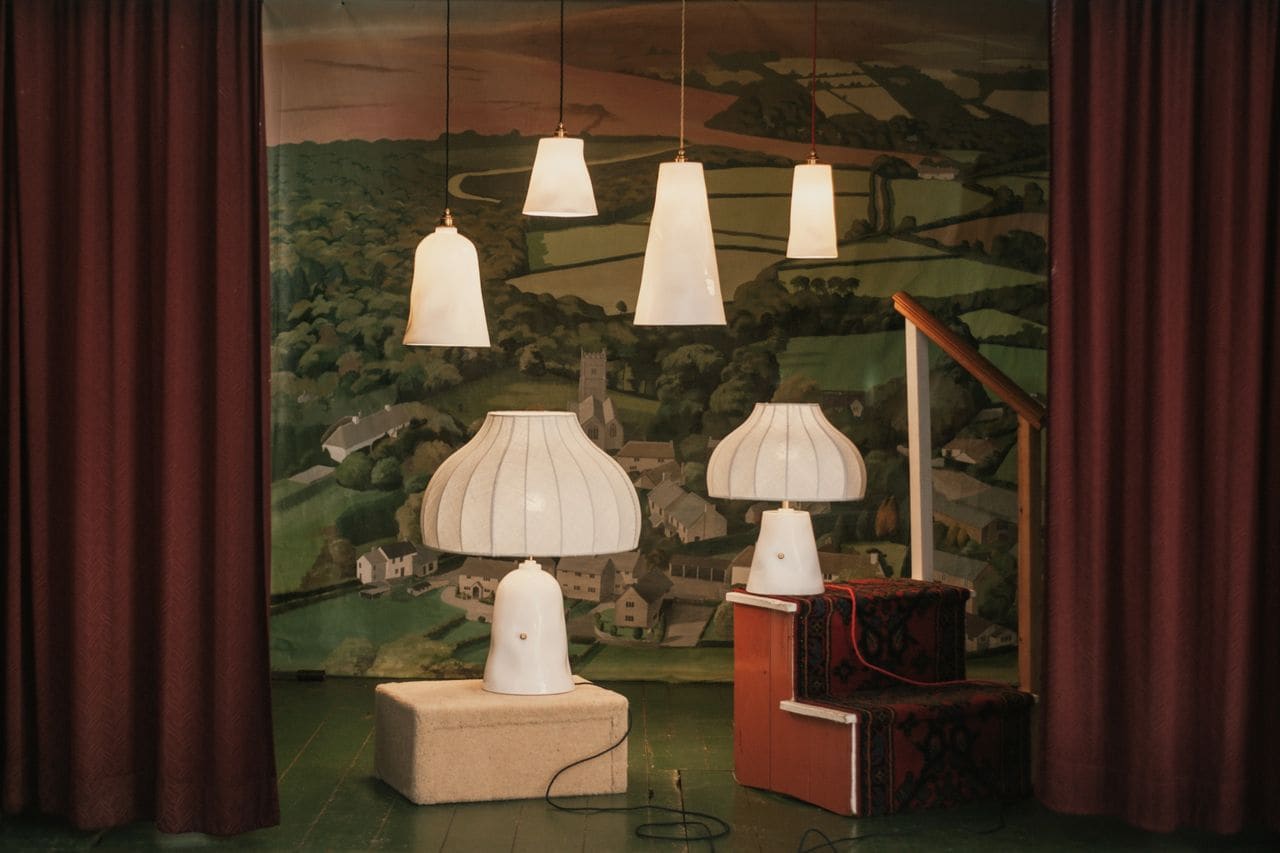
There is a particular quality to bone china that most people encounter only at the dining table: its paradoxical opacity. Hold a teacup to the window and the material reveals itself as something between solid and screen, dense enough to contain yet thin enough to transmit. Jeremy and Cath Brown, founders of the Devon-based studio Feldspar, have built their latest collection around this exact property, engineering a series of pendant and table lamps that exploit the ceramic's ability to shift character depending on ambient light.
Working from their workshop in a 500-year-old cider farm, the Browns have spent the better part of a decade refining a design language rooted in domestic necessity. Their output spans tableware, homewares, lambswool textiles, and since 2025, furniture. The lighting range represents a logical extension of this trajectory, but also a technical departure. Where earlier work could rely on the compressive strength of thicker ceramic forms, luminaires demand a different calculus: the wall thickness must be minimal enough to allow light transmission, yet robust enough to survive thermal cycling and mechanical stress during installation.
According to the studio, the primary challenge lay in achieving this balance. Cast too finely, and the forms risk structural failure; cast too heavily, and the glow is lost. The result is a suite of six pieces, four pendants and two table lamps, each calibrated to a specific domestic context.
A Typology Rooted in Domestic Scale
The collection divides into two typological families. The pendants, named Big Slim and Big Bell among others, are designed to occupy vertical space in rooms with generous ceiling heights. Big Slim, as its name suggests, extends vertically to anchor zones above dining tables or kitchen islands. Big Bell takes its formal cues from the studio's Merrivale table base, a piece introduced in the 2025 furniture range that pushed the physical limits of their kiln capacity. The pendant version echoes that bell-shaped profile, translating a horizontal massing into a suspended volume.
The table lamps, Merrivale and Burra, adopt a more conservative geometry. Their bases are cast from thicker bone china than the pendants, prioritising structural stability over translucency. The shades, by contrast, are fabricated in pale-blue and grey linen by Eloise Scotland, a Bath-based designer whose work employs traditional hand-stitching methods. Scotland's construction technique eliminates the need for binding tape or trim, leaving raw edges that reinforce the material honesty of the assembly. Hidden within each shade is a cobalt-blue rib, a chromatic reference to the pigment Feldspar uses across its ceramic output.
The tactile resolution extends to the hardware. Each lamp is fitted with a hand-carved brass dimmer switch, a detail that privileges haptic engagement over the frictionless interfaces typical of contemporary lighting.
Translucency as Temporal Shift
What distinguishes these pieces from adjacent ceramic lighting, such as the porcelain pendants by Established & Sons or the slip-cast work of Mud Australia, is the Browns' deliberate oscillation between day and night states. During daylight hours, the bone china reads as opaque white, a matte surface indistinguishable from painted metal or plaster. At dusk, when the lamps are illuminated, the material transforms into a warm, diffuse screen, approximating the quality of traditional paper lanterns but with none of the fragility.
This shift is not incidental. It is the organising principle of the collection. The Browns have spoken about designing objects that feel "tasteful, yet lived in", a phrase that gestures towards the tension between formal restraint and domestic legibility. The lighting range operationalises this idea through materiality: the same object occupies two perceptual registers depending on the time of day, functioning as sculpture in ambient light and as luminaire after dark.
The reference to paper lanterns is instructive. Where Japanese chōchin or Noguchi's Akari series achieve diffusion through layered mulberry paper, Feldspar's pendants rely on the vitreous phase of bone china, the glassy matrix that forms during high-temperature firing. This phase scatters light at the microscopic level, producing a glow that is softer and more uniform than that of fabric or paper. The effect is closer to alabaster, another material with a long history in lighting, though bone china offers greater tensile strength and can be cast with more geometric precision.
Craft Infrastructure and Regional Context
Feldspar's production model is deliberately localised. All ceramic components are made in their Devon workshop, while the linen shades are produced 120 kilometres east in Bath. This arrangement mirrors the studio's broader philosophy, articulated in their choice of name: feldspar is the mineral that imparts strength to ceramic bodies, and by extension, the studio positions itself as a proponent of durability and longevity.
The Browns have cited the material culture of previous generations as a reference point, particularly the idea that domestic objects were once expected to endure across decades. This is not nostalgia for its own sake. It is a deliberate counterpoint to the planned obsolescence embedded in much contemporary product design. In the context of lighting, where LED modules and electronic drivers have finite lifespans, the Browns' emphasis on replaceable components and repairable construction reads as a quiet form of resistance.
The decision to work from a 500-year-old cider farm is not incidental to this ethos. The building itself is a case study in adaptive reuse, its stone walls and timber framing repurposed for a function far removed from agricultural production. The studio's output, in turn, reflects this layering of use and meaning. The lighting collection is not presented as a radical formal departure but as an incremental expansion of an existing material vocabulary, one that has been refined over years of serial production.
Precedents and Parallels
Ceramic lighting occupies a specific niche within the broader field of contemporary design. Unlike metal or glass, which dominate industrial and high-design contexts respectively, ceramic carries associations with craft, domesticity, and regional making traditions. Feldspar's work sits alongside practitioners such as Michael Anastassiades, whose porcelain shades for Flos explore similar questions of translucency, and the Swedish studio Claesson Koivisto Rune, whose ceramic pendants for Örsjö balance minimalist form with material warmth.
Where Feldspar diverges is in its commitment to a single material system. The Browns do not mix ceramics with blown glass or spun metal; the collection is resolutely mono-material, with the exception of the textile shades and brass hardware. This restraint amplifies the expressive range of bone china itself, foregrounding its thermal, optical, and structural properties rather than subordinating it to a more complex assembly.
The dimpled surface texture, a signature of Feldspar's tableware, recurs here as a subtle modulation of the pendant forms. These indentations are not decorative appliqué but integral to the casting process, a direct record of the mould surface. They introduce a haptic dimension that distinguishes the lamps from the smooth, uninfected volumes typical of Scandinavian or Japanese minimalism. The effect is closer to the pitted surfaces of Hans Coper's ceramics or the tactile glazes of Lucie Rie, though without the same degree of autographic gesture.
Longevity as Design Brief
At World Archi Design, we have been tracking the resurgence of material-first design practices, particularly those that resist the dematerialisation logic of digital fabrication. Feldspar's lighting collection is exemplary in this regard. It does not pursue novelty through algorithmic form-finding or parametric variation. Instead, it extracts maximum design intelligence from a single, well-understood material, asking what happens when the functional requirements of lighting intersect with the material capacities of bone china.
The result is a collection that feels both familiar and specific. The forms are not radical; they draw from established typologies of pendant and table lamps. But the material execution, the careful calibration of wall thickness, the exploitation of translucency as a temporal variable, and the integration of traditional craft techniques elevate the work beyond generic production. These are objects designed to occupy a room for years, not seasons, and in that sense, they align with a broader shift towards durability and repairability in the design field.
The Browns have described the collection as "staples", a term that underscore their ambition to create a foundational lighting vocabulary rather than a one-off statement. Whether the market rewards this kind of incremental, material-focused work remains to be seen. But as a case study in how regional craft infrastructure can support contemporary design practice, Feldspar's lighting offers a model worth studying.
Save this story. A free account keeps your reading list and the 07:00 email in one place.
CREATE FREE ACCOUNT →SIGN IN