
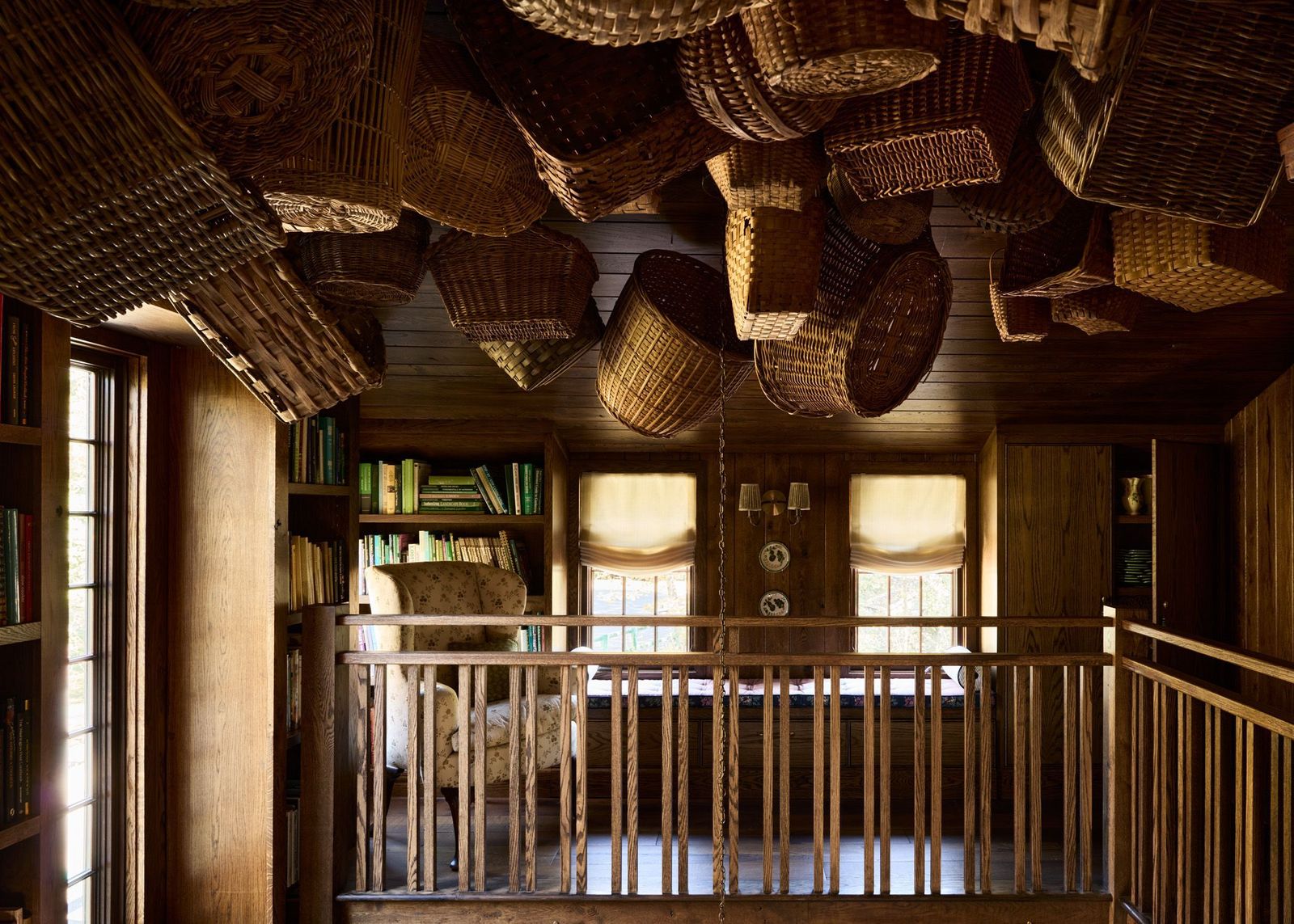
The Quiet Return of the Utilitarian Object
When did the basket stop being background furniture and start commanding attention? Somewhere between the decline of the mass-manufactured accent piece and the rise of craft-as-status, the woven vessel—once relegated to laundry duty or farmers' markets—has reappeared as a spatial anchor in homes that prize material honesty over catalog uniformity. At World Archi Design, we've watched this shift unfold across the interiors we cover: tobacco baskets mounted above headboards, winnowing sieves hung as wall sculpture, rattan trail carriers positioned like objets d'art on console tables. The basket, it turns out, is having a moment—but not for the first time.
What distinguishes this iteration from earlier waves of "rustic chic" is the specificity of provenance. Today's basket enthusiast doesn't want generic wicker; she wants a crivo Calabrese from southern Italy, a Gullah sweetgrass rice fanna from South Carolina, a Bora tribe wedding tray from the Amazon. The appeal lies not in rusticity for its own sake, but in the legibility of craft—the visible record of human hands, regional technique, and material culture. In an era of algorithm-generated interiors and dropshipped decor, the basket offers something increasingly rare: an object with a story that predates its purchase.
Storage as Spatial Strategy
The basket's first and most pragmatic role remains containment. But even here, the design calculus has shifted. Where mid-century storage systems prioritized concealment—think built-in cabinetry, hidden hampers, closet organizers engineered to disappear—the contemporary basket makes storage visible, even decorative. A Bolga basket from northern Ghana, with its leather-wrapped handles and dyed grass stripes, doesn't hide laundry so much as frame it as part of the room's material palette. A Shaker splint basket, woven from black ash and fastened with copper rivets, transforms blanket storage into a lesson in early American joinery.
This visibility matters. In spatial terms, the open-weave basket introduces negative space into a room's mass—a porous boundary rather than a solid one. Unlike upholstered ottomans or lacquered bins, woven storage reads as permeable, allowing light and sightlines to pass through. The effect is particularly pronounced in smaller interiors, where a seagrass basket can corral throw pillows without adding visual weight. Functionally, the basket's flexibility—its lack of rigid structure—makes it adaptable to irregular objects: rolled yoga mats, umbrellas, the sprawl of charging cables. It's storage that accommodates entropy rather than demanding order.
Handle design becomes critical here. The Bolga's leather strap, the Shaker basket's steam-bent ash loop, the splint basket's double-woven rim—all telegraph mobility. A basket with handles is furniture that refuses to stay put, an acknowledgment that domestic storage is never static. Compare this to the fixed cabinetry of a Josef Hoffmann interior or the built-in credenzas of mid-century Eichler homes: those systems assume permanence. The basket, by contrast, assumes flux.
The Wall as Display Field
If storage baskets solve a spatial problem, hanging baskets solve a perceptual one: how to occupy wall area without resorting to framed prints or mirrors. The flat, circular winnowing basket—originally used to sort grain in Mediterranean and West African agricultural contexts—has become a fixture in interiors that seek texture over image. Mounted above a bed or flanking a doorway, these sieves function as low-relief sculpture, their concentric weave patterns creating radial geometry that shifts with ambient light.
The precedent here is less about basketry than about the broader history of craft-as-art. Consider the way mid-century collectors displayed pre-Columbian ceramics or African masks—not as ethnographic specimens, but as formal compositions. The hanging basket operates in a similar register, though with less fraught colonial baggage (when sourced ethically). A Calabrian crivo, for instance, reads simultaneously as agricultural tool and as abstract composition—its loose, irregular weave a counterpoint to the rectilinear planes of drywall and door frames.
Scale matters enormously. A 36-inch winnowing basket commands roughly the same visual territory as a large-format photograph, but at a fraction of the cost and with none of the glare issues that plague glazed prints. The basket's matte, fibrous surface absorbs rather than reflects light, making it particularly effective in rooms with large windows or multiple light sources. And unlike a framed work, the basket's dimensionality—the way it projects several inches from the wall—creates shadows that change throughout the day, a kind of passive kinetic sculpture.
There's also an argument to be made about cultural specificity. A Gullah sweetgrass rice fanna, woven by descendants of enslaved West Africans in South Carolina's Lowcountry, carries a different weight than a mass-produced rattan disc from a big-box retailer. The former connects a room to a centuries-old tradition of coil weaving; the latter connects it to a supply chain. For designers interested in provenance—in objects that locate a space within a broader material history—the distinction is non-negotiable.
Baskets as Sculptural Accent
When a basket is freed from utilitarian duty entirely, it enters the realm of pure form. The Ethiopian gambella canoe basket, shallow and elongated, makes an ideal coffee table centerpiece precisely because it does nothing—it simply is. Placed atop a glass or lacquered surface, it introduces organic irregularity into an otherwise controlled composition. The same logic applies to Ikebana baskets, those Japanese bamboo vessels designed to hold flower arrangements: even empty, their asymmetrical frames and exposed joinery read as sculptural gestures.
This is where the basket intersects with the broader discourse around biophilic design—the idea that interiors benefit from organic forms and natural materials. But unlike potted plants or raw-edge wood furniture, the basket doesn't mimic nature so much as evidence human negotiation with it. The weave pattern of a Pakurigo basket from Baba Tree, for instance, is a record of how rattan responds to tension and repetition; the coil structure of a Native American basket documents how sweetgrass or willow can be spiraled into stable, load-bearing form. These are not natural objects—they are crafted objects, and that distinction matters.
In spatial terms, decorative baskets function as counterpoints to hard surfaces and rectilinear furniture. A lidded Adirondack coil basket on a shelf breaks up the horizontal monotony of books; a rattan stair tote leaning against a wall softens the rigid geometry of a staircase. The basket's inherent irregularity—the slight wobble of a hand-coiled rim, the variation in weave density—introduces what architects call "controlled imperfection," a quality increasingly valued in interiors that reject the machine-perfect finish.
Craft Economies and the Taste Hierarchy
The basket's resurgence coincides with a broader revaluation of craft labor. When a studio like Underwater Weaving—founded by a former fashion executive—places rattan trail baskets alongside luxury footwear at Moda Operandi, it signals a shift in what constitutes "luxury." The basket, historically a vernacular object made for subsistence economies, now circulates in the same commercial channels as high-end fashion and design. Jeremy Frey's 2025 MacArthur Fellowship (the so-called "Genius Grant") for his basket work further cements this repositioning: craft is no longer folk art's lesser cousin, but a discipline worthy of institutional recognition.
Yet this elevation raises questions. When a Gullah sweetgrass rice fanna retails for $1,800—reflecting the hundreds of hours required to coil and stitch it—who can afford to participate in this aesthetic? The basket's new cultural capital risks replicating the exclusions it ostensibly resists. A Pottery Barn utility basket at $41 offers accessibility, but at the cost of the very qualities—hand-weaving, regional specificity, material integrity—that make the basket architecturally interesting in the first place.
The design challenge, then, is not simply to incorporate baskets into interiors, but to do so with attention to sourcing and context. A vintage Iroquois splint basket purchased from a dealer like Nickey Kehoe carries different ethical and aesthetic weight than a new-production seagrass basket from a mass retailer. The former connects a space to a specific craft lineage; the latter connects it to a trend. Both have their place, but only one advances the conversation about how interiors might honor—rather than merely consume—material culture.
The Basket as Spatial Archive
What the basket ultimately offers is a way to inscribe time and place into an interior without resorting to explicit narrative. A winnowing basket on the wall doesn't tell you about agrarian labor; it shows you the formal result of that labor. A Bolga basket in the corner doesn't explain Ghanaian weaving traditions; it embodies them. This is the basket's real power: it turns craft history into spatial presence.
In a design culture increasingly dominated by digital fabrication and parametric modeling, the basket stands as a reminder of what analog making can achieve. Its irregularities are not flaws but proof of human agency; its variations are not errors but evidence of improvisation. For interiors that aspire to more than stylistic coherence—that seek, instead, to situate themselves within longer arcs of material practice—the basket is not decoration. It's documentation.
Save this story. A free account keeps your reading list and the 07:00 email in one place.
CREATE FREE ACCOUNT →SIGN IN