
A Design Rooted in Research, Not Stereotype
There is a world of difference between referencing a culture and understanding it. When Odami co-founders Arancha González Bernardo and Michael Fohring began work on Shinji, a Japanese steakhouse in Toronto's financial district, they had just returned from their own trip to Japan. The timing aligned with Brandon Marek's own cross-country research journey, during which the managing partner of Harlo Entertainment hospitality group, alongside executive chef Jia Zou, refined the restaurant's culinary vision. The confluence of these experiences allowed the team to move beyond the predictable visual shorthand of cherry blossoms and sliding screens. Instead, Shinji emerged as a space built on quieter, more tactile references: the deep blue of indigo-dyed denim, the warm grain of locally sourced ash wood, and the soft glow of neon corridors that recall Tokyo's late-night streets.
At World Archi Design, we've observed a growing fatigue with surface-level cultural borrowing in hospitality interiors. The projects that resonate are those that engage with material history and spatial ritual, not just aesthetic motifs. Shinji offers a case study in how designers can honor a tradition without reducing it to décor.
Stone, Wood, and the Primacy of Craft
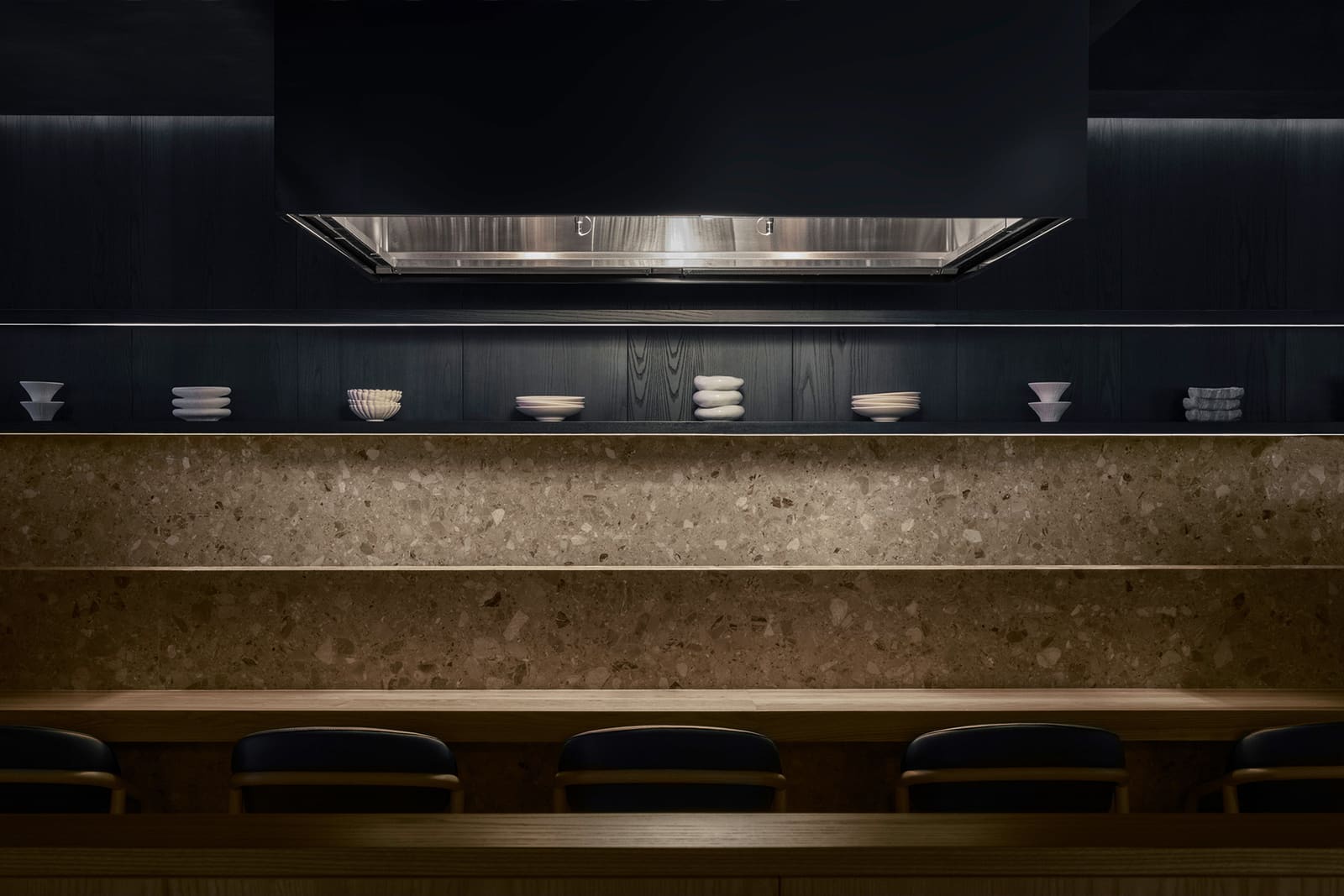
The spatial hierarchy at Shinji inverts the typical steakhouse layout. Instead of relegating the kitchen to the back or tucking it behind glass, Odami placed a long stone chef's table at the center of the dining room, where the bar would normally sit. This move foregrounds the labor of the chefs, who prepare everything from nigiri to striploin in full view of diners. The choice of natural stone over engineered composite reinforces a commitment to material honesty that extends throughout the space. Locally sourced ash wood appears in the dining tables, bench seating, and chairs, its unmatched grain patterns a deliberate departure from the uniformity of veneer.
Marek recounts a moment when a contractor flagged the inconsistency in the wood grain, concerned it was a mistake. His response captures the ethos of the project: real trees are not identical. In an era when digital fabrication and engineered materials dominate commercial interiors, this insistence on natural variation is both a design statement and a pedagogical one. It asks diners to recalibrate their expectations, to see irregularity not as flaw but as evidence of authenticity.
This approach aligns with the Japanese concept of wabi-sabi, though Odami never leans on the term explicitly. The studio's restraint is instructive. Rather than invoking philosophy as branding, they let the materials speak for themselves.
Indigo Walls and the Language of Wear
The most pervasive material gesture at Shinji is color. Indigo limewash coats the walls, a reference to Japan's storied denim industry. Odami describes denim as a fabric equally suited to workwear and couture, deriving its richness from wear, time, and repeated use. This metaphor extends to the restaurant's spatial experience. The entryway is saturated in the inky blue, creating a buffer zone that absorbs the noise and pace of Bay Street outside. A long, gently sloped hallway maintains the indigo treatment, stretching the arrival sequence and building anticipation before guests reach the main dining room.
Once inside, the contrast between the deep blue walls and the pale ash furnishings establishes a dynamic that is both grounding and airy. The indigo continues in the upholstery and acoustic baffling, unifying the space without overwhelming it. This is not the monochromatic minimalism of mid-century Scandinavian interiors, nor is it the saturated maximalism of postmodern design. Instead, Odami crafts a middle ground, where a single hue does multiple kinds of work: acoustic, atmospheric, and symbolic.
The choice of limewash over flat paint is significant. Limewash has texture and depth; it ages visibly, developing a patina that synthetic finishes cannot replicate. In this sense, the walls themselves become a kind of denim, changing subtly over time with exposure and use.
Light, Circulation, and the Glow of Nightlife
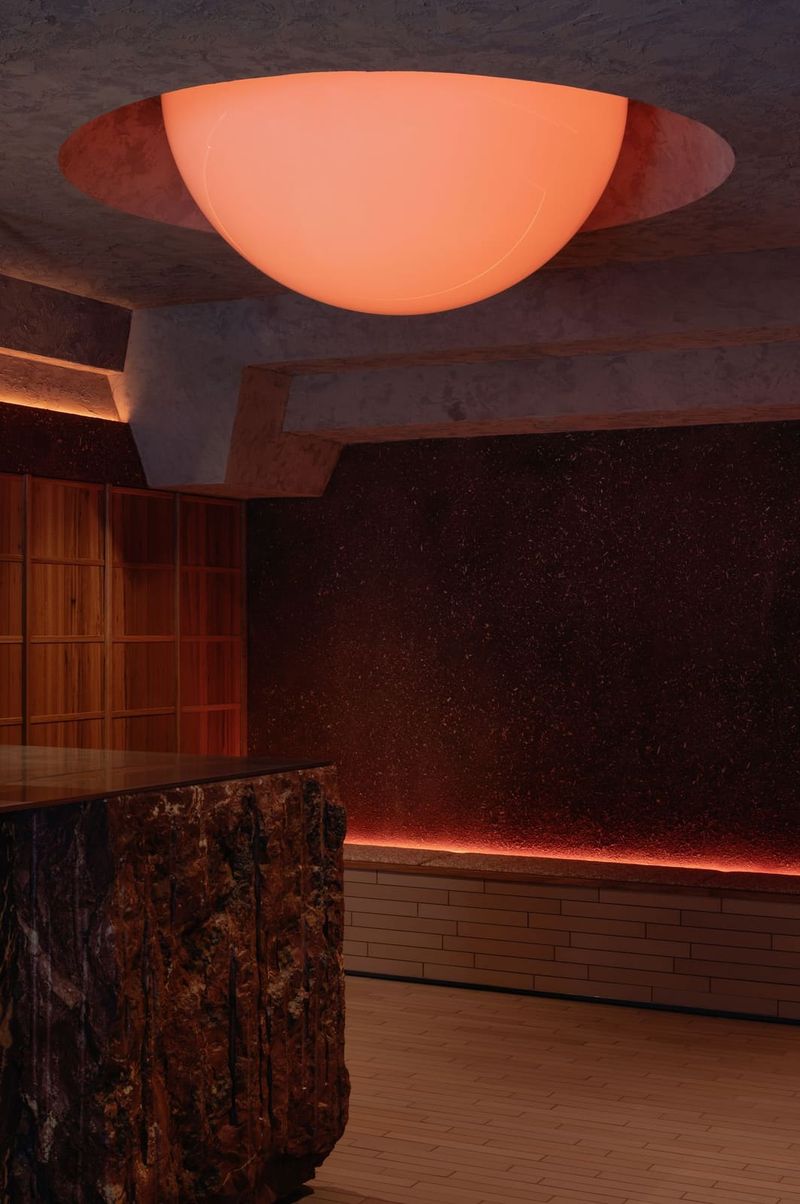
Rows of slender linear pendant lights run along the spine of the dining room, guiding the eye toward the glowing orange bar at the rear. The lighting strategy is restrained, avoiding the theatrical spotlighting common in steakhouse design. Instead, the pendants provide ambient illumination that keeps circulation routes intuitive while maintaining an intimate scale at each table.
The corridor leading to the restrooms introduces a shift in tone. Here, Odami lines the walls with glowing tubes that cycle through various neon hues, evoking the luminous signs that define Japanese nightlife. The reference is to karaoke bars in particular, those ubiquitous social spaces where formality dissolves and strangers become collaborators. This playful interlude prepares diners for the restroom experience itself, which Marek has conceived as a kind of analog radio station.
Inspired by the music he heard in Japanese washrooms during his research trip, Marek recreated a playlist that moves from Elvis Presley to the Beatles, narrated by a Japanese voice actor hired to serve as Shinji's own disc jockey in a looped recording. Each stall is equipped with a Toto smart toilet, the kind found ubiquitously in Japan, from high-end hotels to roadside gas stations. Marek's observation underscores a broader point about design culture: in Japan, everyday infrastructure is treated with care. The democratic availability of comfort and cleanliness is not seen as extravagance but as baseline expectation.
Humor, Humility, and the Limits of Seriousness
Shinji's restrooms also feature anime posters and a plush stuffed animal perched on a shelf behind the central grill. These touches might read as kitsch in a different context, but here they serve as counterweights to the meticulous material palette and spatial choreography. They signal that sophistication need not be solemn, that a space can be both considered and approachable.
This balance between rigor and levity is difficult to achieve. Too much playfulness risks undermining the integrity of the design; too much restraint can feel austere or exclusionary. Odami navigates this tension by embedding humor in moments of transition, the hallway, the restroom, the small details that punctuate the primary dining experience without dominating it.
In Japan, the best craftspeople are known for their humility. Mastery is demonstrated through quiet precision, not through self-aggrandizement. Shinji extends this principle to hospitality design, where the architecture and interiors support the ritual of dining without demanding attention for their own sake. The space is confident enough to be understated, refined enough to tolerate a stuffed animal on the shelf.
Material Precedent and the Problem of Authenticity
Shinji's approach invites comparison with other recent projects that engage Japanese design traditions outside of Japan. Studio Tack's work on The Rivertown Lodge in Hudson, New York, for example, drew on Japanese joinery techniques and natural materials to create a sense of quietude in the Hudson Valley. Similarly, David Thulstrup's interiors for Noma in Copenhagen referenced Japanese ceramics and textural restraint, though in service of Nordic culinary philosophy rather than Japanese cuisine.
What distinguishes Shinji is its willingness to engage not only with high craft traditions but also with vernacular culture: the karaoke bar, the roadside restroom, the everyday denim jacket. This democratizing impulse prevents the design from becoming rarefied or inaccessible. It acknowledges that culture is not only transmitted through museums and monographs but also through pop music, public infrastructure, and the worn fabric of daily life.
The risk in any cross-cultural design project is that it will collapse into pastiche or, worse, appropriation. Odami mitigates this risk through specificity. Rather than deploying generalized "Japaneseness," the studio identifies discrete references, denim, neon, ash wood, natural stone, and explores their material and cultural dimensions. The result is a space that feels informed rather than imitative, respectful rather than reverential.
The Long View on Hospitality Design
Shinji arrives at a moment when hospitality design is reckoning with its own clichés. The industrial loft aesthetic that dominated the 2010s has given way to a hunger for warmth, texture, and narrative. Diners increasingly expect spaces that tell a story, that situate themselves within a broader cultural or material context. At the same time, there is a growing skepticism of design that feels overly curated or Instagram-optimized, spaces that prioritize photogenicity over lived experience.
Shinji threads this needle by prioritizing sensory richness over visual spectacle. The indigo walls absorb light and sound. The ash wood tables invite touch. The neon corridor glows without glaring. The looped radio narration in the restroom unfolds over time, rewarding repeat visits rather than offering instant gratification. These are design decisions that resist flattening into a single image or hashtag. They require presence, attention, and a willingness to engage with space as an unfolding experience rather than a static backdrop.
As hospitality continues to grapple with questions of authenticity, sustainability, and cultural sensitivity, projects like Shinji offer a model for how designers can engage deeply with a tradition without claiming ownership of it. The space honors Japanese craft and culture not by replicating them wholesale but by identifying the principles that animate them: honesty in materials, humility in execution, and a recognition that the everyday and the exceptional are not mutually exclusive.
In the end, Shinji is less a Japanese restaurant in Toronto than it is a conversation between two design cultures, mediated through stone, wood, indigo, and light. It is a space that understands that the best way to honor a tradition is not to freeze it in time but to allow it to inform something new.
Save this story. A free account keeps your reading list and the 07:00 email in one place.
CREATE FREE ACCOUNT →SIGN IN