
The Question of Translating Movement
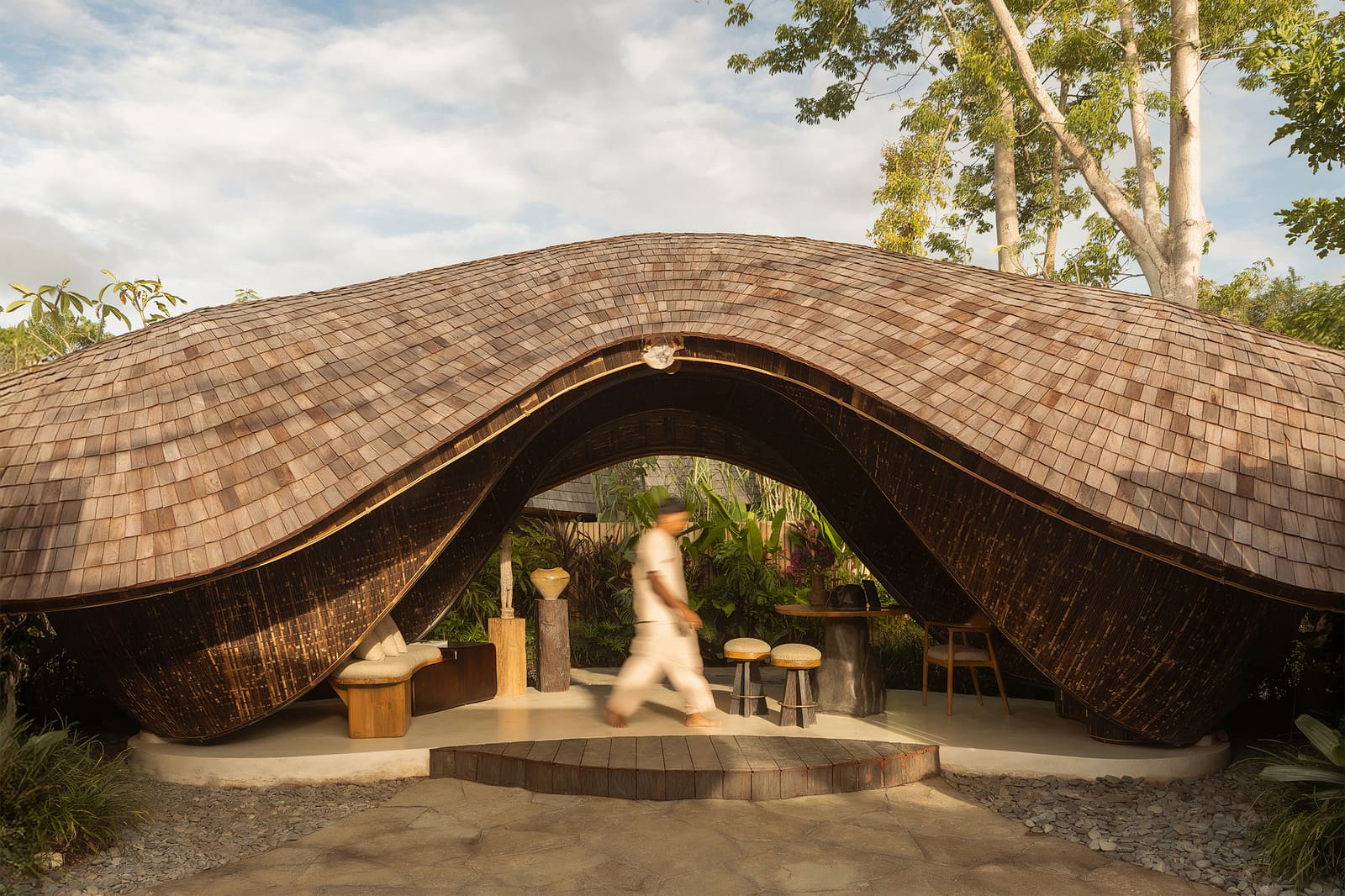
How does one freeze motion without losing its essence? This is the challenge Pablo Luna Studio confronted when designing a reception pavilion for the Kaymana development in Uluwatu, Bali. Rather than resort to decorative gestures or surfboard-shaped ornament, the design team pursued a more fundamental question: can the experience of watching a wave crest and curl be translated into architectural enclosure?
The result is a 22-square-meter structure that reads as a single, flowing gesture. Lead architect Dolores Giribone, working with a team that included Alvaro Garcia, Ganda, Ni'mal Abdu P, Tania Sekar, and Yusron Saputra, approached the brief not as an opportunity for mimicry but as an exercise in capturing rhythm and energy through form. The pavilion's defining move is its continuous curved shell, a cocoon-like volume that wraps visitors in a protective embrace while maintaining visual and spatial connection to the surrounding landscape.
Material and Tectonic Strategy
The architectural language here is deliberately restrained. Where many coastal projects in Bali default to heavy timber framing or exposed concrete, the Wave Reception opts for a lighter touch. The structure's curved envelope relies on a system engineered by civil consultant Pak Kutut Yasa, allowing the thin shell to span without interruption. This decision, to prioritize continuity over segmentation, reinforces the design's central metaphor: a wave does not pause or articulate itself in discrete sections; it flows.
Interior design by Studio Ayni complements this strategy by keeping material choices subdued. Surfaces are smooth, finishes understated. The goal is not to compete with the form but to allow the curvature itself to define the spatial experience. In this sense, the project recalls earlier experiments in fluid, monolithic design, from Eero Saarinen's TWA Terminal to more recent work by practices like Zaha Hadid Architects, though at a far more intimate scale. The difference here is one of restraint: where those precedents often amplify drama through scale and complexity, the Wave Reception achieves its effect through compression and simplicity.
Scale and Context
At just 22 square meters, the pavilion operates at the threshold of what can be considered a building. It is more akin to a furniture-scale intervention, a piece of inhabitable sculpture that marks a point of arrival. This compactness is strategic. Uluwatu's coastline is defined by dramatic cliffs, open sky, and the constant presence of the ocean. A larger structure would risk overwhelming the site or competing with its natural drama. Instead, the pavilion functions as a counterpoint: a small, human-scaled gesture that offers momentary shelter before visitors step into the larger landscape.
The site's proximity to the water also informs the design's protective quality. Coastal environments demand resilience, both in material terms and in the way architecture mediates between exposure and enclosure. The curved form does both, deflecting wind and sun while framing views selectively. It is a building that acknowledges its vulnerability, accepting that it will be shaped by salt, humidity, and the relentless Balinese climate.
Precedent and Influence
The impulse to derive architectural form from natural phenomena is hardly new. From Antonio Gaudí's study of catenary curves to Frei Otto's experiments with minimal surfaces, architects have long looked to nature for structural and formal inspiration. What distinguishes the Wave Reception is its specificity of reference. This is not a generic invocation of "organic form" but a deliberate engagement with a particular coastal condition. The wave as motif carries with it associations of impermanence, energy, and transformation, qualities that resonate with the hospitality program and the transient nature of tourism.
At World Archi Design, we have observed a growing interest among emerging practices in this kind of site-specific formalism, particularly in Southeast Asia, where rapid development often erases local character. Projects like the Wave Reception suggest an alternative: rather than impose universal design languages, they propose that architecture can emerge from close attention to place, whether that means studying the geometry of breaking surf or the way light filters through palm canopy.
The Limits of Metaphor
Still, the question remains: when does metaphor clarify, and when does it constrain? A wave is dynamic, constantly reforming, never static. A building, by contrast, is fixed. The tension between these two states is inherent in any project that seeks to capture movement in built form. The Wave Reception navigates this tension by emphasizing experience over representation. The curve does not depict a wave so much as it evokes the sensation of being enveloped by one, the momentary disorientation and shelter that comes from standing within a breaking swell.
This approach has its risks. If the metaphor becomes too literal, the building risks reading as kitsch, a theme-park version of coastal architecture. If it becomes too abstract, the connection to place weakens. Pablo Luna Studio threads this needle by keeping the formal language clear but not didactic. The curve is legible, but it does not announce itself. It invites interpretation rather than dictating it.
A Threshold, Not a Destination
Ultimately, the Wave Reception functions as a threshold, a moment of pause between arrival and immersion. It is not designed to hold visitors for long; its small footprint and open edges encourage movement through rather than occupation. This transience is appropriate. Reception spaces, by definition, are transitional. They mediate between outside and inside, between arrival and belonging. The best of them do this work quietly, without fanfare.
In this sense, the project succeeds not because it is radical or unprecedented but because it is attentive. It understands its role within a larger sequence of spaces and experiences. It recognizes that architecture, particularly at this scale, can operate more like punctuation than narrative, a brief inflection that shapes how we read what comes next. The wave, after all, is not the ocean. It is a momentary expression of it, a gesture that appears, crests, and dissolves. The pavilion, in its small way, does the same.
Save this story. A free account keeps your reading list and the 07:00 email in one place.
CREATE FREE ACCOUNT →SIGN IN