
The Problem of the Viewless Site
Not every hospitality project arrives with a coastline or a mountain range. Some sites - steep, forested, hemmed in by topography - offer no borrowed scenery, no ready-made postcard. For architects, these are the projects that demand invention rather than framing.
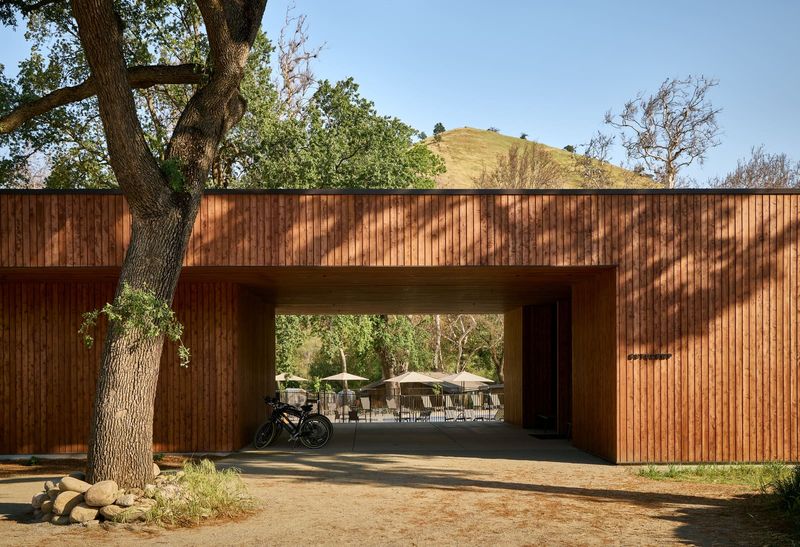
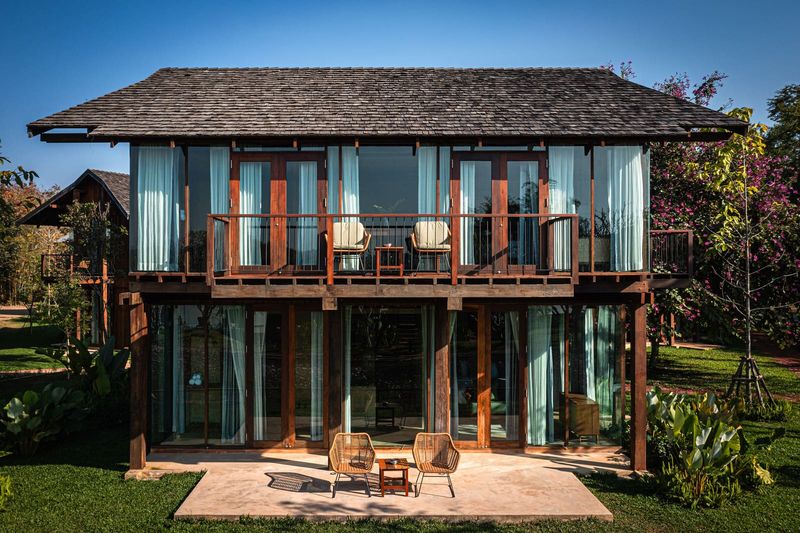
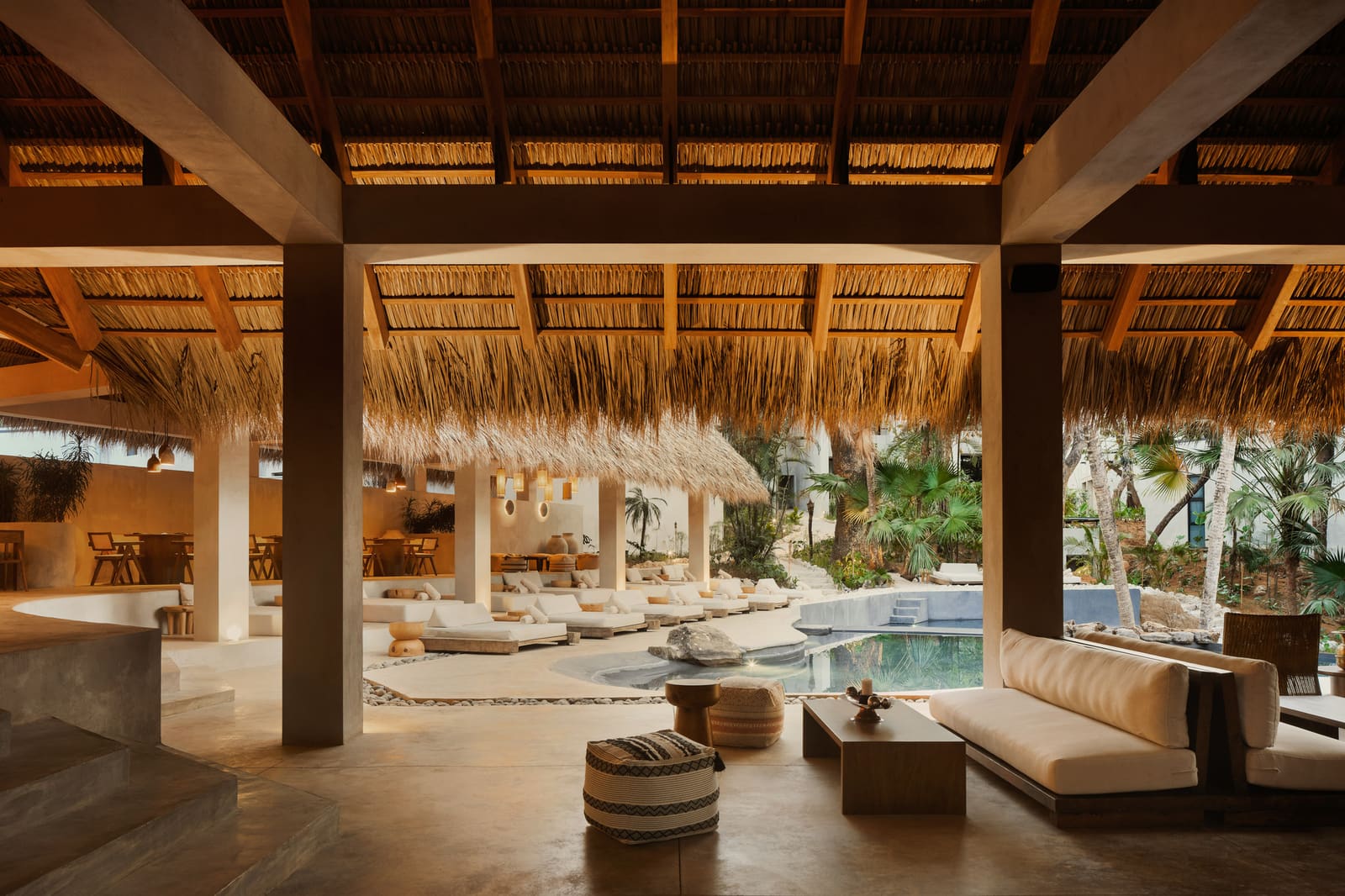
ESH Hotel & Spa, completed in 2024 by FAMM Arquitectura in collaboration with Sulkin Askenazi, sits on a sloping parcel in Nosara, Costa Rica. The site's defining characteristic was not what it offered but what it lacked: long views. There was no Pacific horizon to orient the guest experience, no elevated vantage point to anchor the design parti. Instead, the 3,700-square-meter, 29-room development had to construct its own sense of arrival, orientation, and repose from the materials at hand - an existing creek, mature trees, and the terrain itself.
The response was to build inward. Rather than gesture toward a distant landscape, the architecture organizes itself around a sequence of interior courtyards, preserved vegetation, and carefully choreographed transitions between shade and light, enclosure and openness. The result is a hotel that feels less like a viewing platform and more like an inhabited garden.
Massing as Landscape Strategy
The first move was volumetric. On a sloping site, the temptation is often to terrace aggressively or to elevate the program for height. FAMM Arquitectura chose neither. The hotel's massing follows the contours, stepping down the hillside in a series of low-slung volumes that nestle into the grade rather than dominate it. This terracing is subtle - more concerned with minimizing cut-and-fill than with creating drama.
Each guest room block is positioned to maintain sightlines to planted courtyards or preserved trees. The sectional strategy ensures that no room looks primarily at another room; instead, views are directed laterally into vegetation or downward into water features. The architecture becomes a lens for the landscape it has chosen to foreground.
This approach recalls the courtyard hotels of Luis Barragán - not in palette or materiality, but in the conviction that enclosure can be as powerful as exposure. By refusing the outward gaze, the design asks guests to attend to what is near: the texture of bark, the sound of water moving over stone, the shifting quality of dappled light.
Preserved Vegetation as Structural Element
One of the most consequential decisions made early in the design process was to retain as many existing trees as possible. This is not uncommon in eco-resort rhetoric, but it is rare to see it executed with the rigor evident here. Trees are not simply preserved in leftover zones; they are integrated into the spatial sequence. Courtyards are carved around trunks. Walkways bend to accommodate root systems. The architecture defers.
This deference is not sentimental. It is structural. The preserved canopy provides shade, reduces heat gain on facades, and creates a sense of temporal depth - the feeling that the site predates the intervention, which of course it does. In a region where new development often announces itself with clearing and grading, this restraint reads as both ecological and aesthetic intelligence.
The planted courtyards extend this logic. Native species are clustered in zones that double as stormwater retention areas, allowing runoff to infiltrate rather than sheet off the hillside. The landscape is not ornamental; it is part of the building's environmental performance.
Water as Organizing Principle
A natural creek runs through the site, and rather than channelize or hide it, the design makes it legible. Bridges cross it. Terraces overlook it. In the spa area, the sound of moving water becomes a kind of acoustic ceiling - constant, but not intrusive.
Water appears again in the form of shallow reflecting pools and lap features that punctuate the courtyards. These are not decorative gestures. In a humid climate, evaporative cooling from open water can lower ambient temperatures by several degrees. The pools also serve a perceptual function: they reflect the canopy overhead, doubling the presence of vegetation and reinforcing the sense that the hotel is embedded in a forest clearing rather than imposed upon it.
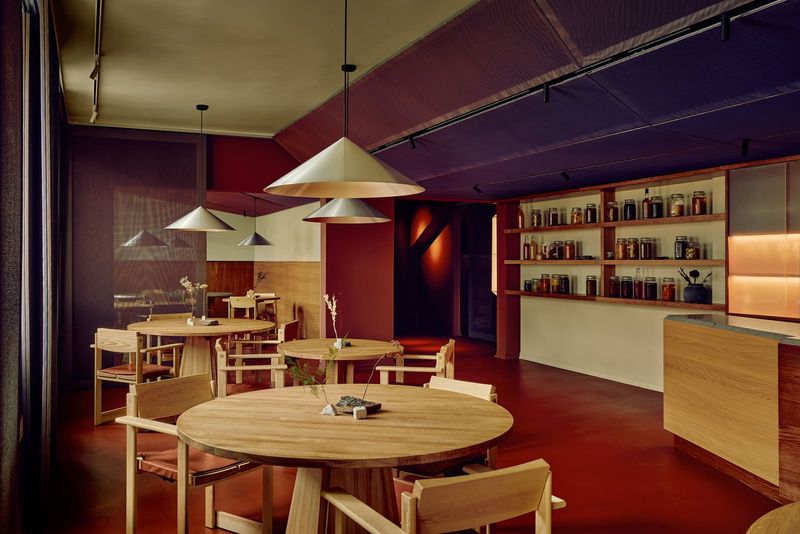
The interiors, developed by Sulkin Askenazi, extend the material palette established by the architecture - stone, timber, plaster - but with a softer hand. Furnishings are low and neutral, allowing the landscape beyond to remain the visual anchor. There is little competition for attention.
Circulation as Narrative
Movement through the hotel is not linear. Paths diverge, reconnect, and loop back. This is partly a response to topography - there is no single datum line - but it is also a deliberate narrative choice. The lack of a clear axis means that guests encounter the landscape from multiple angles, at different times of day, under varying conditions of light.
This kind of choreography is difficult to execute without becoming labyrinthine. ESH manages it by using vegetation and water as wayfinding devices. A particular tree, a specific pool, a glimpsed courtyard - these become landmarks in the guest's mental map. The architecture recedes; the landscape orients.
A Model for Constrained Sites
What makes this project instructive is not its program - boutique hotels are well-trodden typological ground - but its willingness to accept a constraint and build from it. The absence of views could have been treated as a deficit. Instead, it became the premise.
This is not a universal strategy. There are sites where the correct move is to elevate, to cantilever, to frame the distant. But there are far more sites - sloping, forested, overlooked, or simply ordinary - where the logic of ESH applies. Where the architecture must create its own context. Where the landscape is not a backdrop but a collaborator.
At World Archi Design, we have been tracking a broader turn toward this kind of inward-looking hospitality - projects that prioritize immersion over spectacle, enclosure over panorama. ESH Hotel & Spa is a lucid example of that shift. It suggests that a hotel need not command a view to command attention. Sometimes, the view is what you build.
Save this story. A free account keeps your reading list and the 07:00 email in one place.
CREATE FREE ACCOUNT →SIGN IN