
Beyond the Boardroom Sky
The private jet interior has long been trapped in a narrow typology: the airborne boardroom, the executive mancave at altitude, the singular principal's domain. Yet the assumption that wealth travels alone, or purely for business, increasingly fails to capture how entrepreneurial families actually move through the world. PriestmanGoode's new cabin concept, Ways of Seeing / 观 Guān, poses a different question entirely: what happens when an aircraft becomes a shared domestic environment for three generations?
The London studio developed the design through extended research into the patterns of Chinese ultra-luxury buyers, working alongside a cultural consultant rather than applying decorative motifs post-hoc. The result, visualised here on a Boeing 737 narrow-body long-range platform (though the design language could translate to domestically produced aircraft such as the Comac C919), reconfigures the cabin around family cohabitation rather than solitary executive function.
A Spatial Programme for Multi-Generational Use
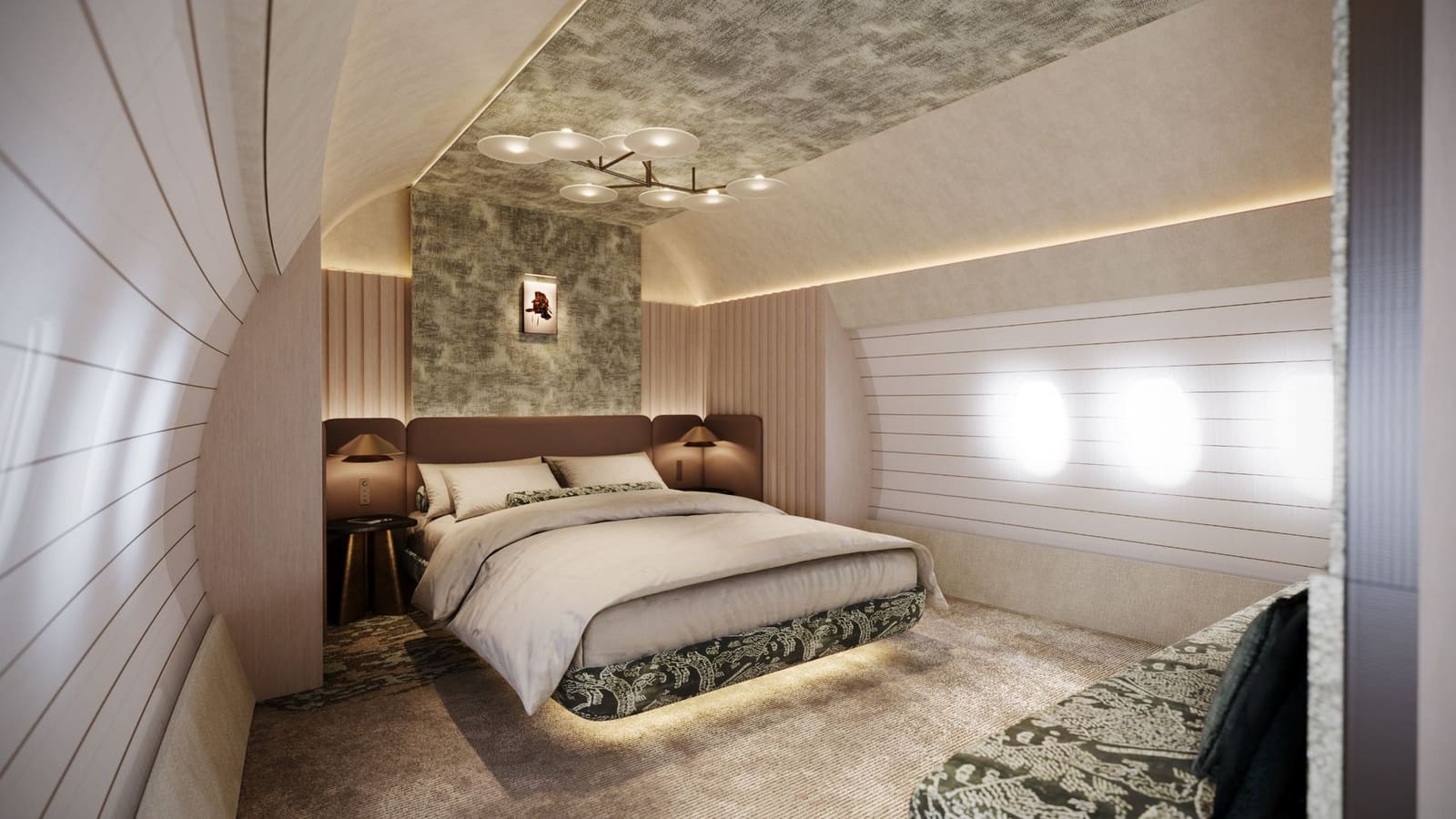
The layout diverges sharply from conventional business aviation templates. At the rear, a private retreat comprises a bedroom, en-suite bathroom and study area that can serve as office, meditation space or wellbeing suite. A second bedroom sits adjacent. This zoning acknowledges the need for withdrawal and rest without surrendering the entire cabin to one person's hierarchy.
Forward of these private quarters, the main space functions as shared lounge and dining area. A multifunctional table accommodates meals, games and social gathering, screened by woven metal panels that provide visual layering without hard enclosure. The design privileges fluidity: the dining surface becomes a place for tea and conversation, the study converts to workspace, the sofa reconfigures for rest. Modularity here is not a technical flourish but a practical acknowledgement that family life resists fixed programming.
Craft as Cultural Translation
Authenticity in design often collapses into surface styling, a problem PriestmanGoode sought to avoid through craft collaborations embedded in the programme from the outset. Tai Ping created bespoke carpeting for the bedroom, drawing on traditional Chinese geometric motifs; in shared areas, organic patterned carpet by Andre Fu softens circulation paths. These are not decorative gestures but material choices that signal cultural continuity without pastiche.
The lacquer work represents a deeper engagement with Chinese craft lineages. Supplied by The Gallery by SOIL in Hong Kong, the pieces include work by Erke Gan, a National Master of Crafts whose marbled "rhinoceros hide" texture appears on table surfaces alongside standalone vases. In the bedroom, lacquer artwork by Shi Yuguang provides a counterpoint to the clean lines elsewhere. Jade-toned stone veneer in the bathroom and patterned fabric in sleeping quarters extend this vocabulary of natural materials and restrained palette.
Technology, by contrast, recedes: screens and speakers remain concealed until required, an intentional decision to prioritise human warmth and tactile interest over digital omnipresence.
Design Driven by Lived Patterns
What distinguishes this concept from generic luxury is its foundation in observed behaviour rather than aspirational fantasy. The studio's research identified a shift among Chinese entrepreneurs towards combining business and family time within a single journey, grandparents and children travelling alongside the principal decision-maker. This multi-generational model requires spatial flexibility that conventional jet interiors, optimised for meetings and solo work, simply cannot provide.
Ben Rowan, creative director at PriestmanGoode, notes that the studio resisted defaulting to a house style or inflecting an existing template with Chinese motifs. Instead, the cabin emerged from understanding how specific people actually live and travel. The cultural consultant's insight sits at the centre of the brief, not layered on at the end, a methodological distinction that manifests in every spatial decision.
The result is a cabin that moves fluidly between purposes over the course of a shared journey. The rejection of "single principal's use" strategy opens space for genuine domestic cohabitation, a rare ambition in business aviation where hierarchy typically dictates layout. Here, the aircraft becomes less a tool for individual mobility and more a vessel for family cohesion across distance, acknowledging that wealth increasingly travels in clusters, across generations, with competing needs for privacy, connection and rest.
Implications for Ultra-Luxury Aviation
Ways of Seeing / 观 Guān remains a concept, yet it points toward a broader rethinking of how ultra-luxury aviation might serve emerging markets. The Chinese buyer cohort, with distinct cultural sensitivities and multi-generational family structures, demands spatial programmes that Western templates cannot easily accommodate. As locally manufactured platforms such as the Comac C919 gain traction, the need for culturally specific interior design languages will intensify.
The concept also challenges the assumption that business aviation must prioritise work over living. By embedding craft authority and cultural research into the design process, PriestmanGoode demonstrates that authenticity in luxury interiors requires more than applied decoration. It demands a fundamental reconsideration of who travels, why they travel together, and what activities a cabin must support when three generations share the same pressurised tube at 40,000 feet.
Save this story. A free account keeps your reading list and the 07:00 email in one place.
CREATE FREE ACCOUNT →SIGN IN