
The Social Architecture of Gathering
The Victorian parlour occupies a curious position in domestic history. Derived from the French verb parler, meaning to speak, these rooms served as the stage upon which 19th-century middle and upper classes performed their social identities. Reserved for Sundays and occasions of significance, the parlour was less a space for daily life than a carefully curated display of taste, wealth and cultural refinement. Its disappearance from contemporary floor plans reflects broader shifts in how households organise intimacy and formality, yet the underlying desire for dedicated gathering spaces persists.
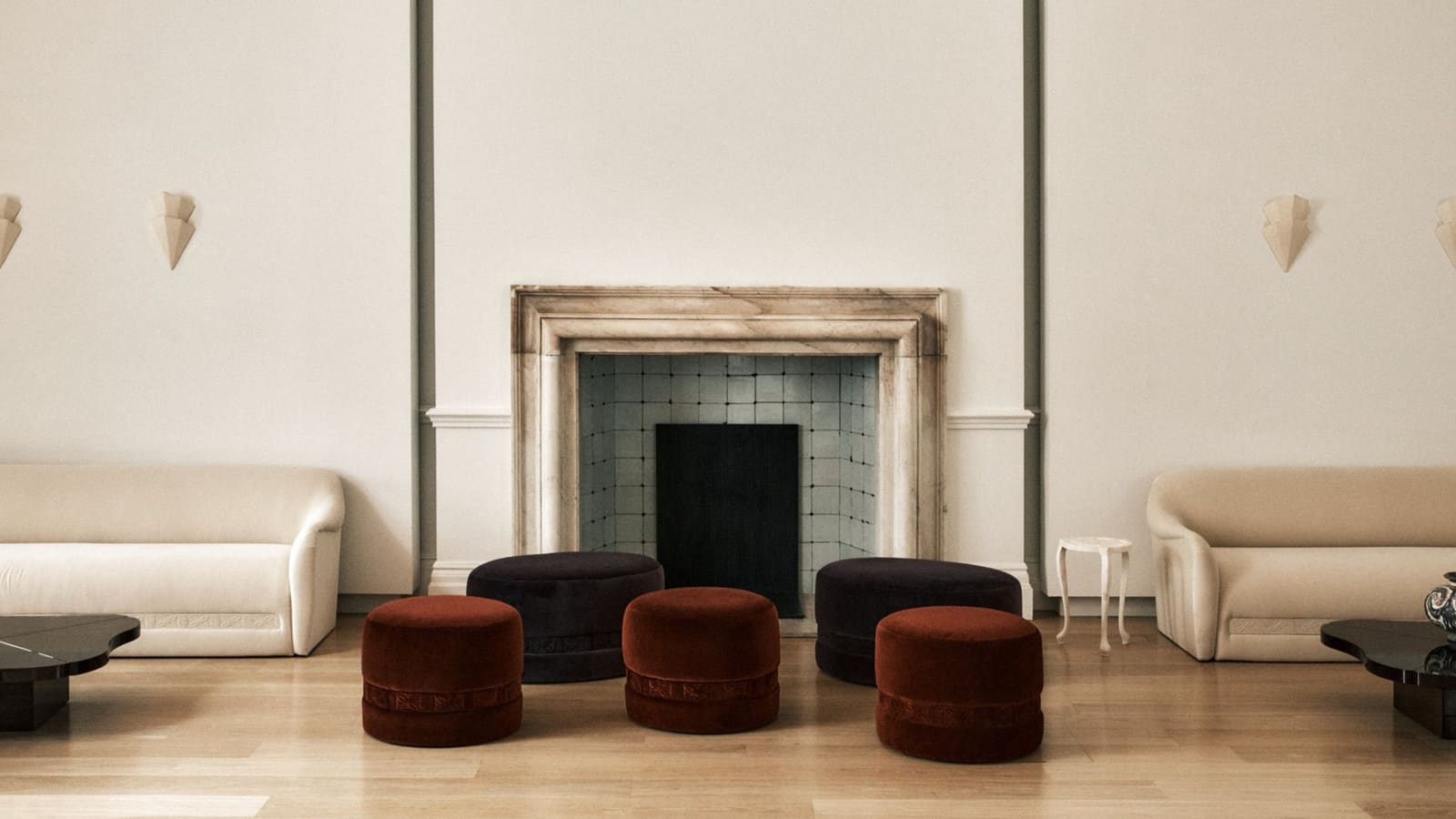
Kevin Frankental, co-owner and creative director of Cape Town and Amsterdam-based studio Lemon, has long been drawn to the spatial logic of the parlour. "I love the idea of it being a specific place for gathering," he explains. "The idea that there's multiple places to sit, and be together, you can do so many things in a room like this." That fascination underpins Lemon's first British showcase, staged last week in a listed South Kensington townhouse built in 1858 and formerly occupied by Irish painter Sir John Lavery. The two grand Victorian rooms, most recently used as restaurant dining spaces, became the setting for a contemporary interpretation of parlour culture, populated by furniture, lighting and objects designed by Frankental and his long-term collaborator Yaniv Chen.
Reinterpretation as Method
Founded in 2007 by Frankental and Jaco van Staden, Lemon has built its reputation on furniture that occupies an ambiguous temporal zone. The pieces feel simultaneously new and familiar, drawing on 20th-century design vocabularies without resorting to pastiche. Frankental describes the studio's approach as using architecture, decorative arts and domestic forms as "a point of departure, not for reproduction but for reinterpretation". Achieving that balance, he admits, is difficult. The studio agonises over the threshold between homage and imitation, seeking designs that carry historical resonance without collapsing into nostalgia.
The latest collection, produced almost entirely in the UK and Ireland, demonstrates that method across a range of typologies. Frankental's Josef desk takes its name from Austrian architect and designer Josef Hoffmann, whose geometric rigour and attention to craft inform the piece's swooping profile and concealed velvet-lined drawers. Yaniv Chen's Haines dining table, a circular design with a routed beech surface lacquered white, channels the optimism and theatricality of 1950s Hollywood Regency interiors, specifically the work of decorator Billy Haines. The table's surface treatment recalls the glossy, stage-set quality of postwar American domesticity, a period when interior design became a vehicle for aspirational narratives.
Chen's Ventola sconces and ceiling lamps draw inspiration from Victorian fans, their scalloped forms incorporating delicate Leavers lace sourced from one of Britain's last remaining producers. The use of this particular lace, a product of intricate bobbin-work machinery, anchors the collection in a specific material tradition while acknowledging the fragility of that tradition's survival. The lamps function as both illumination and commentary on craft continuity.
Craft Ambition and Material Provenance
The decision to manufacture the collection primarily within the UK and Ireland represents a deliberate engagement with regional making cultures. Yaniv Chen's Palladian sofa, produced in Norfolk, features sleek lines and upholstery so smooth it appears almost liquid. Running along its length is a floral relief pattern created by pressing fabric over a 3D-printed panel, a technique the studio developed specifically for this piece. The method hybridises digital fabrication with traditional upholstery, embedding ornament beneath the surface rather than applying it as afterthought.
The Boule coffee table and credenza, also by Chen, employ chunky glass tops made from recycled Irish crystal, balanced on slender brass frames designed to develop patina over time. Suspended within the glass are ghostly swirls of grey pigment, achieved through a technique called veiling. Frankental notes that this process is unique to the Cork glassworks Lemon collaborates with, a detail that ties the collection to a specific site of production and a particular set of technical capabilities. The veiling effect transforms the glass from inert surface into something more atmospheric, a material that holds light and shadow in suspension.
Frankental's Phantom dining table, a vast oak piece with honey-coloured stain and undulating edges, takes its formal cues from Gothic English architecture, particularly the intricate chantry chapels of Tewkesbury Abbey. The table's scale and presence make it a natural focal point, the kind of object around which social rituals organise themselves. Its edges, irregular and flowing, resist the orthogonal geometry typical of dining furniture, suggesting a more organic relationship between object and space.
Ornament as Narrative Device
Decorative details proliferate across the collection, each carrying its own referential weight. A circle of Egyptian hands is carved into the top of a Roman travertine side table, a motif that collapses geographical and temporal distance into a single surface. The Farfalla coffee table, named after the Italian word for butterfly, features book-matched walnut veneer arranged to evoke the symmetry of butterfly wings. The table appears to hover above the floor, its base recessed to create the illusion of weightlessness. Frankental's Valute rug, hand-knotted in Nepal, incorporates an Art Deco motif woven into soft green silk, a textile that functions as both ground and ornament.
Chen's Piove lamps draw inspiration from a French parasol dating to the 1860s, translating the parasol's structural logic into a lighting typology. The lamps extend the collection's engagement with Victorian material culture, treating historical objects not as static artefacts but as generative forms capable of migration across categories. The Parlour sofas and ottomans, also by Chen, feature curved forms designed to encourage conversation, their geometry subtly directing bodies towards one another rather than towards a single focal point such as a television or fireplace.
Spatial Strategy and Market Positioning
The showcase opened a month after PAD London, deliberately outside the compressed schedule of the city's design fairs. Frankental explains that the independent timing allowed for sustained conversation with visitors, many of whom are UK-based interior designers working on projects in the United States. The Lavery townhouse, with its parquet floors, lofty ceilings and ornate plasterwork, provided a backdrop that reinforced the collection's historical dialogue without overwhelming it. The furniture was arranged in conversational groupings, echoing the spatial organisation of the original parlour typology.
Serendipitously, Joe Sweeney's exhibition at TIWA gallery opened next door the day before Lemon's showcase, creating an impromptu design cluster in South Kensington. The proximity allowed visitors to move between two distinct curatorial propositions within a single neighbourhood, a condition more common in cities with denser design ecologies such as Milan or New York.
The collection represents Lemon's first release since April 2025, a gap that reflects the time required to develop and refine the pieces. Frankental and Chen's working method prioritises iteration and material experimentation over rapid production cycles, a stance that positions the studio within a slower, more deliberate mode of practice. The emphasis on British and Irish manufacture also signals a strategic alignment with clients seeking provenance and traceability, particularly in markets where the narrative of making carries as much weight as the finished object.
The Parlour as Contemporary Proposition
The Victorian parlour's decline can be attributed to multiple factors: the democratisation of domestic space, the rise of open-plan living, the erosion of formal social rituals. Yet the desire for rooms dedicated to gathering, for spaces that hold and structure social interaction, has not disappeared. It has simply migrated into other typologies: the kitchen island, the media room, the co-working lounge. Lemon's project suggests that the parlour's spatial intelligence, its understanding of how furniture can choreograph conversation and display, remains relevant.
By staging the collection within a historic townhouse rather than a gallery or showroom, Lemon emphasised the furniture's relationship to architecture and the rituals that architecture frames. The pieces were not presented as isolated objects but as components of a larger spatial proposition, one in which the act of gathering is given physical form. The parlour, in this reading, is less a nostalgic fantasy than a typological resource, a tested model for how rooms can facilitate the overlapping activities of sitting, speaking, displaying and observing.
The collection is now available for purchase, extending the showcase's temporal frame beyond the single-day event. Whether the parlour as a concept can be successfully reintroduced into contemporary domestic programmes remains an open question, one that depends as much on shifting cultural attitudes towards formality and leisure as on the quality of the furniture itself. What Lemon has demonstrated, however, is that the historical vocabulary of the parlour, when subjected to rigorous reinterpretation, can yield designs that feel neither derivative nor detached from their sources. The studio's work occupies a productive middle ground, one in which history functions as a design tool rather than a constraint.
Save this story. A free account keeps your reading list and the 07:00 email in one place.
CREATE FREE ACCOUNT →SIGN IN