
Reversibility as Preservation Strategy
When a historic building becomes a cafe, the typical renovation involves drilling, anchoring, and embedding contemporary services into centuries-old masonry. Tant A Temps Design rejected that approach entirely for Laibei 1087, a new hospitality space inside Xi'an's Beilin Museum. The building dates to 1087, erected to house stone steles bearing Confucian texts and celebrated calligraphy. Rather than treat its timber columns and beams as obstacles, the Xi'an practice made them the organising principle of the interior, suspending furniture from overhead structures and positioning tables around vertical supports to eliminate any direct attachment to the original fabric.
Every intervention is detachable. Chairs, counters, display units and service modules can be disassembled and removed, leaving the eleventh-century framework intact. This "zero damage" doctrine extends beyond conservation ethics; it reframes adaptive reuse as a temporary occupation rather than a permanent alteration, a distinction that matters in buildings of this cultural weight.
Material Continuity and Structural Reference
The studio's furniture pieces echo the building's tectonic language. Tables and seating reference the proportions of dougong brackets, the interlocking timber clusters that transfer load in traditional Chinese architecture. Display cabinets mirror the rhythm of columns and beams, translating structural spans into storage modules. The effect is not pastiche but a kind of material conversation, where new elements acknowledge their context without mimicking it.
Lightweight prefabricated components dominate the fit-out. Modular systems allow rapid assembly and future reconfiguration, a pragmatic choice given the project's reversibility mandate. The materials themselves are contemporary, timber veneers and metal frames, but their dimensions and joinery logic derive from the building's existing framework. This approach avoids the trap of historicist reproduction while maintaining formal coherence with the host structure.
Colour as Historical Reconstruction
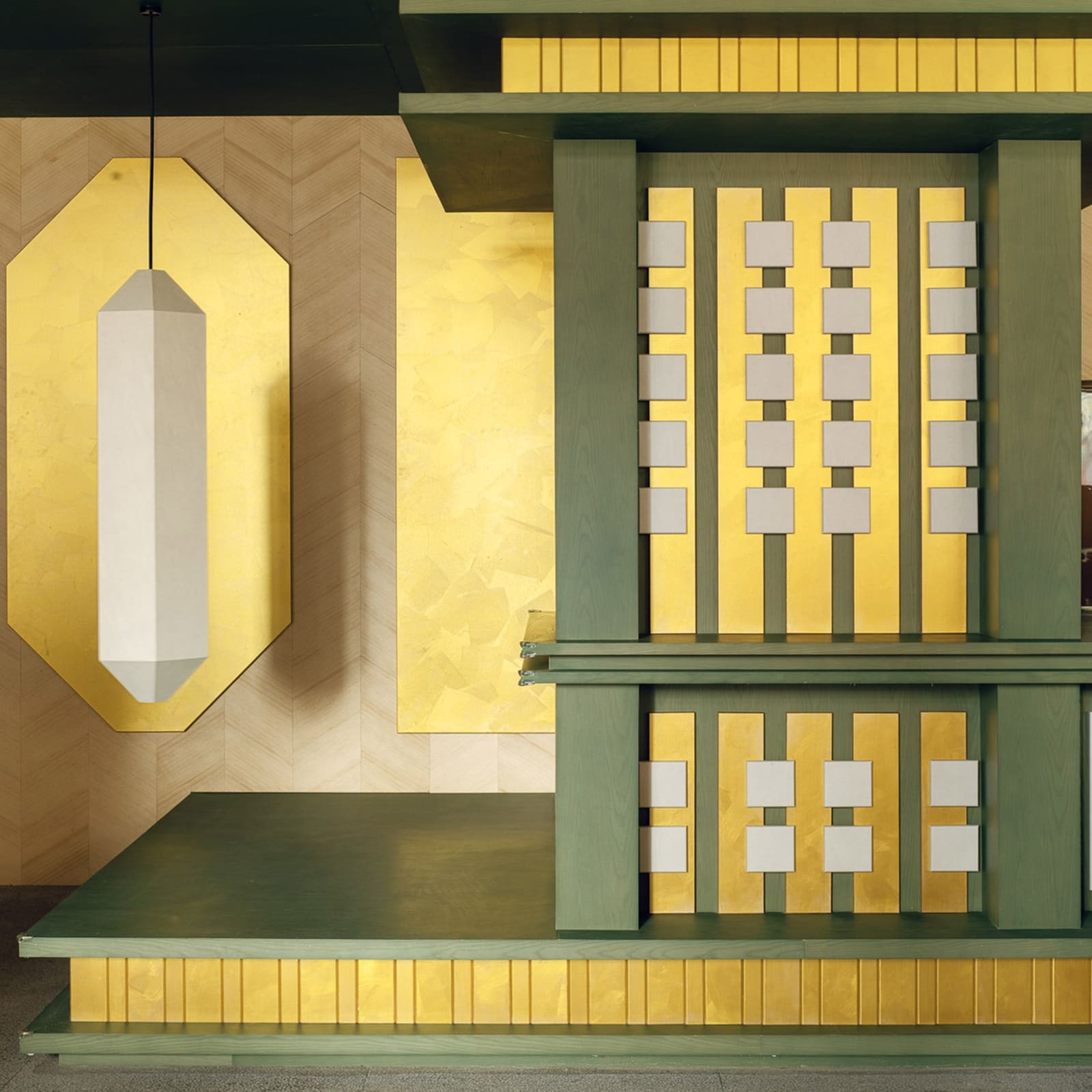
Tant A Temps Design selected a palette of pale green with gold accents, a deliberate evocation of Tang Dynasty architectural polychromy. The studio describes the intention as restoring "the visual characteristics of Tang architecture: robust, imposing and richly coloured." The choice is historically informed but not archaeologically literal. Tang-era buildings were often painted in saturated mineral pigments, vermilion, malachite green, azurite blue, applied to timber and plaster surfaces. The cafe's muted greens and metallic highlights compress that chromatic intensity into a contemporary register, legible to visitors unfamiliar with eighth-century colour conventions.
The palette also serves a spatial function. Light green walls recede, allowing the dark timber columns to assert their structural presence. Gold detailing, applied to furniture edges and joinery, catches ambient light and delineates functional zones without requiring additional partitions. The result is a space that feels both serene and layered, qualities the studio associates with Tang and Song aesthetic ideals. Whether this constitutes a "restoration" of visual characteristics is debatable; it is more accurately a translation, filtering historical precedent through minimalist spatial language.
Concealed Infrastructure and the Functional Island
The central challenge in any heritage adaptive reuse is accommodating contemporary services, air conditioning, plumbing, electrical distribution, exhaust ventilation, without compromising historic fabric. Tant A Temps Design concentrated all these systems into a single integrated bar counter, a freestanding island that functions as both service hub and spatial anchor. Water lines, power conduits, HVAC ducts and lighting circuits run through the counter's top and base, eliminating the need to chase cables into walls or suspend ductwork from ceilings.
This consolidation has architectural consequences. The bar counter becomes the project's only overtly modern element, a discrete volume that contrasts with the building's timber frame rather than attempting to blend in. Its autonomy reinforces the reversibility strategy: remove the counter, and the building's original spatial configuration re-emerges. The approach also offers a template for similar projects. By treating infrastructure as a detachable insert rather than an embedded system, designers can upgrade heritage buildings for contemporary use without irreversible modification.
Programme and Public Access
The cafe occupies part of a 220-square-metre intervention that includes a rest area, retail zone and stone-rubbing workshop. The latter functions as an educational space, allowing visitors to learn traditional techniques for transferring inscriptions from stone to paper, a practice central to the museum's original purpose. This programmatic mix transforms the building from a storage facility for artefacts into an active cultural venue, a shift that aligns with broader trends in museum design toward participatory engagement.
The stone-rubbing workshop is particularly significant in this context. The Beilin Museum's collection comprises more than 3,000 steles, many inscribed with texts that have shaped Chinese philosophy, literature and governance. Stone rubbing, or tàběn, has been the primary method of disseminating these inscriptions since the Han Dynasty, predating woodblock printing. By incorporating a working studio into the cafe complex, Tant A Temps Design links contemporary hospitality with historical craft, making the building's heritage legible through practice rather than display alone.
Regional Context and Adaptive Reuse Precedents
Xi'an's status as the ancient capital of multiple dynasties, including the Tang, places particular pressure on adaptive reuse projects. The city contains numerous heritage structures, many underutilised or inaccessible to the public. Converting these buildings into cafes, shops or cultural centres can generate revenue and foot traffic, but poorly executed interventions risk erasing the architectural qualities that justify preservation in the first place.
Tant A Temps Design's reversibility strategy offers a middle path. By avoiding permanent alterations, the project demonstrates that heritage buildings can accommodate contemporary functions without sacrificing their structural or spatial integrity. This approach contrasts with more invasive renovations elsewhere in China, where historic interiors are often gutted and rebuilt behind retained facades, a practice that preserves appearance but destroys fabric.
The project also responds to evolving conservation philosophy. International charters, including the Burra Charter and the Nara Document on Authenticity, emphasise minimal intervention and respect for all phases of a building's history. Tant A Temps Design's detachable furniture and concealed services align with these principles, treating the 1087 structure as a living document rather than a static monument.
Materiality, Craft and Contemporary Interpretation
The furniture and joinery throughout Laibei 1087 reflect a careful calibration between craft tradition and industrial fabrication. Timber components are CNC-milled for precision, but their profiles reference hand-hewn beams and mortise-and-tenon joints. Metal brackets and fasteners are exposed rather than concealed, acknowledging the contemporary nature of the intervention while maintaining visual lightness.
This honesty of assembly distinguishes the project from more scenographic approaches to heritage interiors, where modern materials are disguised to mimic historical finishes. Tant A Temps Design makes no such pretence. The cafe's furniture is recognisably new, but its formal language derives from the building's tectonic logic. The distinction matters: the project does not attempt to fool visitors into believing they are experiencing an eleventh-century interior, but rather invites them to observe how contemporary design can coexist with, and even amplify, historic architecture.
Implications for Cultural Heritage Buildings
Tant A Temps Design describes the project as "a new paradigm for the adaptive reuse of similar cultural heritage buildings." The claim is not hyperbolic. By demonstrating that a fully functional cafe, complete with modern services, retail space and educational programming, can be installed in a tenth-century building without a single irreversible alteration, the project challenges assumptions about what preservation permits.
The reversibility principle has particular relevance in contexts where heritage regulations are strict or where future uses remain uncertain. A detachable fit-out allows buildings to evolve as institutional needs change, accommodating different programmes without requiring successive rounds of demolition and reconstruction. This flexibility is both economically and environmentally advantageous, reducing material waste and construction impact.
The project also reframes the relationship between old and new. Rather than treating the historic building as a backdrop for contemporary design, Tant A Temps Design positions the 1087 structure as an active participant in the spatial composition. Columns dictate furniture placement; beams support suspended elements; the building's proportions inform the dimensions of new components. The result is an interior where past and present are interdependent, each legible on its own terms but fully coherent only in combination.
Conclusion
Laibei 1087 demonstrates that adaptive reuse can be both ambitious and restrained. By prioritising reversibility, concealing infrastructure within freestanding elements, and drawing formal inspiration from the host building's tectonic language, Tant A Temps Design has created a contemporary cafe that enhances rather than compromises a tenth-century structure. The project's success lies not in its visual appeal alone, though the pale green palette and suspended furniture create a striking spatial sequence, but in its methodological rigour. Every design decision reinforces the principle that heritage buildings can accommodate new uses without permanent alteration, a lesson applicable far beyond Xi'an.
Save this story. A free account keeps your reading list and the 07:00 email in one place.
CREATE FREE ACCOUNT →SIGN IN