
A Question of Origin
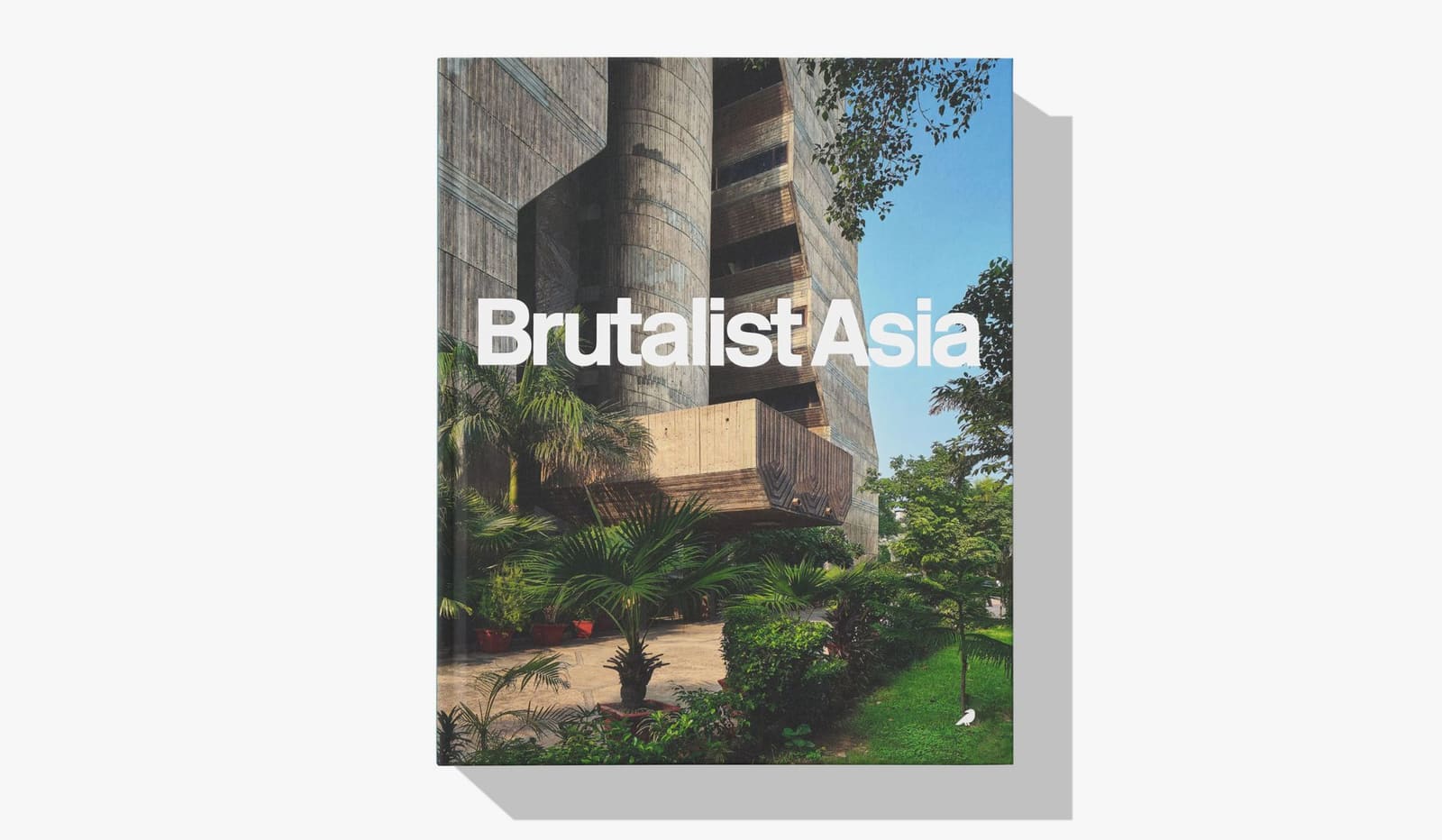
Architectural historiography has long treated brutalism as a linear export, a style born in post-war Europe and shipped outward. Yet that framing obscures a more complex reality: across Asia, architects working in concrete during the same decades were not merely imitating Western models but solving fundamentally different problems. The new volume Brutalist Asia, compiled by Bob Pang and Derek Lamberton and designed by Tuomi, argues for a parallel evolution rather than a cultural relay race. Spanning 140 buildings across twenty-eight countries, the monograph positions Asian brutalism as a simultaneous, regionally rooted phenomenon shaped by climate, material availability, and distinct programmatic demands.
Published by Blue Crow Media, the book joins the house's ongoing series of brutalist gazetteers that have previously covered Paris, London, and Berlin. But where those volumes documented the movement's canonical heartlands, this edition shifts the lens eastward and, crucially, adopts a local point of view. The result is not a catalogue of influence but a reassessment of agency.
Climate as Formal Driver
One of the volume's most persuasive threads is its attention to environmental constraints. Concrete in tropical and subtropical Asia was not merely an aesthetic choice but a pragmatic response to heat, humidity, and monsoon cycles. Deep overhangs, ventilated façades, and massive thermal mass became formal strategies embedded in the language of the architecture itself.
Ong-ard Satrabhandhu's 1969 Physics Building at Kasetsart University in Bangkok exemplifies this approach. The structure's heavy horizontal brise-soleil and recessed fenestration are not decorative gestures but calibrated responses to solar gain. Similarly, the unfinished 1963 Aquarium by Nicolas Yazigi in Beirut, now host to Jad El Khoury's installation Manchafet El Baher, reveals how concrete's plasticity allowed architects to negotiate coastal exposure and salt corrosion while maintaining sculptural ambition.
At World Archi Design, we have long observed how brutalism's reputation for monolithic severity often obscures its environmental intelligence. In Asia, that intelligence was not incidental but foundational.
Local Practitioners, Regional Vocabularies
The book features eight essays by Christele Harrouk, Soroush Mohajery and Amirhosein Rad, Bhawna Dandona, Pinai Sirikiatikul, Caryn Paredes-Santillan, Bob Pang, Kyung Taek Lee, and John Barr, each unpacking the regional context and cultural specificity of the movement. Western pioneers such as Paul Rudolph and Le Corbusier appear, inevitably, in the form of projects like Corbusier's 1962 Palace of Assembly (Vidhan Sabha) in Chandigarh, India. Yet the volume deliberately centres local practitioners whose work has received far less international attention.
Balkrishna V. Doshi, Raj Rewal, Charles Correa, Kim Swoo Geun, and Leandro V. Locsin are given prominence, alongside numerous lesser-known architects whose contributions have been marginalised in Eurocentric accounts. Tao Ho's 1981 St Stephen's College Special Room Block and Tang Shiu Kin Hall in Hong Kong, for instance, demonstrates how brutalism could be adapted to the density and vertical constraints of the territory's urban fabric. Khalil Khoury's Interdesign Building in Beirut, completed in phases between 1973 and 1997, shows how concrete allowed incremental construction amid political instability.
These are not derivative works. They represent distinct architectural lineages, shaped by local building cultures, craft traditions, and political economies. The book's strength lies in its refusal to flatten this diversity into a single narrative.
Tectonic Diversity and Material Ingenuity
Across the projects documented, the materiality of concrete itself emerges as a site of experimentation. Board-marked surfaces, exposed aggregate, pre-cast panels, and in-situ pours all appear, reflecting varying levels of industrialisation and labour availability. In some contexts, brutalism's rough finishes were a deliberate rejection of colonial-era polish; in others, they were simply the most economical means of achieving monumental scale.
Takamasa Yoshizaka's 1965 Inter-University Seminar House in Hachioji, Japan, illustrates the latter. The building's textured concrete surfaces and interlocking volumes recall traditional Japanese timber joinery translated into a modern idiom. This is not pastiche but a tectonic conversation, one in which material and method are inseparable from cultural identity.
The volume also addresses concrete's dynamic ageing. Unlike steel or glass, which degrade predictably, concrete weathers in ways that are highly site-specific. In humid climates, biological growth stains surfaces; in coastal zones, salt accelerates spalling. The book does not romanticise this decay but presents it as part of the material's lifecycle, a reminder that brutalism's permanence was always provisional.
A Framework Under Threat
Many of the structures documented in Brutalist Asia are endangered. Rapid urbanisation, shifting aesthetic preferences, and the high cost of maintaining ageing concrete have made these buildings vulnerable to demolition. The book functions, in part, as an archival project, recording works that may not survive another generation.
This urgency lends the volume a preservationist edge, though it stops short of polemic. Instead, the editors allow the architecture to argue for itself. The sheer variety of forms, scales, and contexts presented makes a compelling case that Asian brutalism constitutes a rich and under-recognised chapter of twentieth-century architecture, one that merits both scholarly attention and conservation resources.
Precedent and Parallel
The inclusion of over 300 pages of visual documentation allows for comparative reading. Placed side by side, buildings from India, Lebanon, Japan, Thailand, Hong Kong, and South Korea reveal both shared formal strategies and striking regional divergences. This is where the book's design, handled by Tuomi, proves essential. Generous photography and consistent graphic treatment enable the reader to trace typological patterns across borders without flattening the specificity of individual projects.
For practitioners and historians alike, the volume offers a corrective to the canonical brutalist narrative. It insists that concrete's global spread was not a one-way transmission but a series of simultaneous, locally grounded responses to modernity's demands. In doing so, it challenges the discipline to reconsider how architectural influence operates and whose stories have been excluded from the historical record.
Reframing Modernism's Geography
Brutalist Asia arrives at a moment when the discipline is grappling with questions of authorship, attribution, and epistemological bias. By foregrounding local agency and regional variation, the book participates in a broader effort to decentralise architectural history. It does not dismiss Western contributions but refuses to treat them as the sole point of origin.
The result is a more textured understanding of brutalism's reach and resonance. Concrete, it turns out, was never a neutral medium. Its adoption across Asia was shaped by colonial legacies, post-independence nation-building projects, Cold War geopolitics, and the pragmatic realities of construction in diverse climates. The architecture that emerged from these conditions deserves to be understood on its own terms, not as a footnote to European modernism.
At over 300 pages and featuring 140 buildings, the volume is both a reference work and a provocation. It asks readers to look again at structures that have been overlooked, misunderstood, or dismissed, and to recognise in them a parallel modernism as rigorous and inventive as any produced in the West. Whether that recognition translates into preservation action remains to be seen, but the book ensures that the architecture, at least, will not be forgotten.
Save this story. A free account keeps your reading list and the 07:00 email in one place.
CREATE FREE ACCOUNT →SIGN IN