The Architecture of Obsession
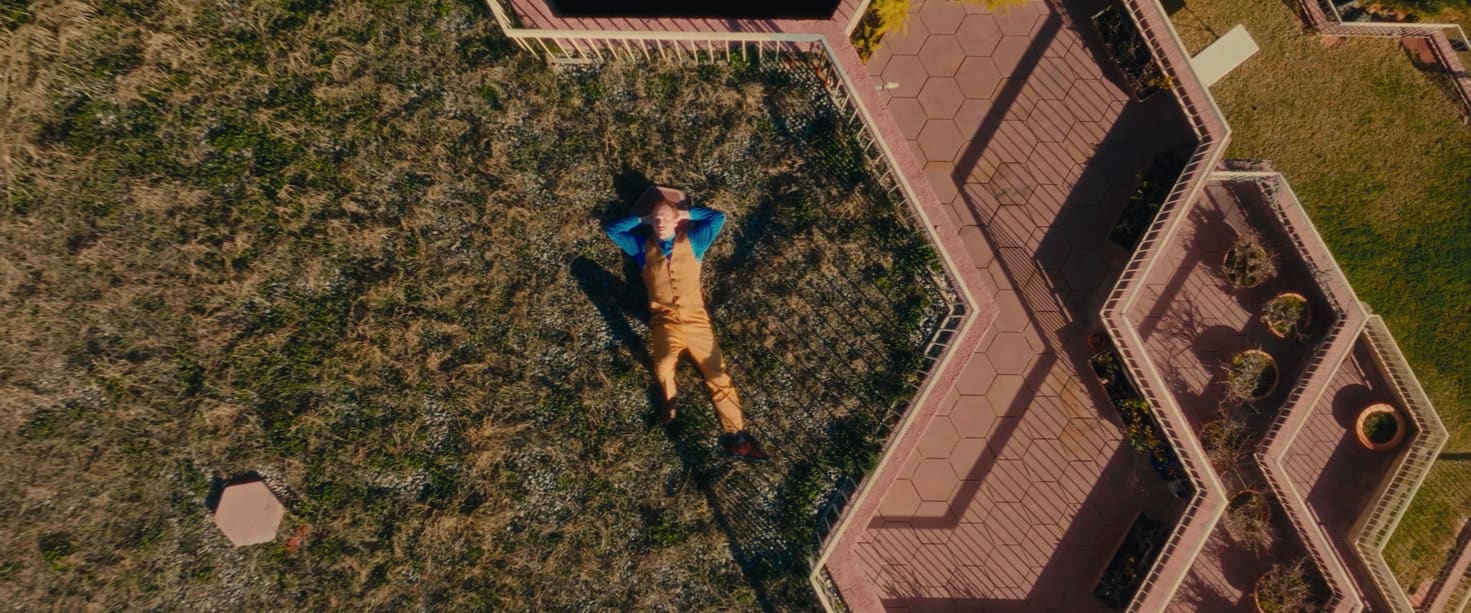
There is a particular kind of mind that sees the world as a catalogue of angles. For such a person, every corner, every junction, every alignment becomes a small satisfaction or a minor disturbance. Matilda Vidal de Llobatera's "Caçador de Geometries" (Geometry Hunter) begins with this premise: a character consumed by straight lines, symmetry, and the reassuring logic of pure forms. The setting is Les Feixes, a brutalist housing cluster perched on a steep hillside in L'Estartit, on Spain's Costa Brava. The building itself becomes both stage and co-author of the narrative, a spatial argument rendered in concrete and hexagons.
Produced by Simon to mark the launch of the sixth Living Places - Simon Architecture Prize, the short film premiered in May at La Casa de la Llum in Barcelona. The prize, curated by Fundació Mies van der Rohe since 2016, is the only architecture award that privileges video as a medium for understanding how buildings are inhabited. This year's edition coincides with Barcelona's designation as 2026 World Capital of Architecture, a convergence that underscores the city's ongoing dialogue with spatial storytelling.
A Beehive on a Slope
Designed by architect Josep Maria Pla i Torras in the 1970s, Les Feixes was commissioned by a group of friends and families seeking a shared summer retreat. Pla had recently returned from the United States, where he encountered the work of Mies van der Rohe and Frank Lloyd Wright. The influence is legible but not literal; rather than borrowing forms, Pla absorbed an attitude toward site and material. The plot he chose was challenging: steeply sloped, facing the Mediterranean, and demanding an unconventional spatial solution.
The result is a cluster of hexagonal modules, each unit interlocking with the next like cells in a honeycomb. Terraces wrap the perimeter, allowing light and landscape to infiltrate the interiors throughout the day. The hexagon, as a parti, is both pragmatic and poetic. It maximizes usable area while minimizing shared walls, a geometric principle observed in beehives, basalt columns, and the compound eyes of insects. Pla's decision to adopt this configuration was not merely formal; it was a tectonic response to the constraints of the site and the social structure of the commission.
Geometry as Narrative Device
Vidal de Llobatera, who won the prize's Best Audiovisual Narrative award in the previous edition for "Quinze Decibels," approaches Les Feixes not as documentation but as a kind of spatial fable. The film's protagonist is a geometry hunter, someone who seeks order in the built environment and finds it in the repeating hexagons of Pla's design. The visual language echoes Wes Anderson's meticulous compositions: centered frames, saturated color, and a quiet humor that emerges from the gap between expectation and reality.
But the film is not content to remain within the rigid logic of its opening premise. As the character moves through the building and its surroundings, the camera begins to notice other patterns. Birds' wings describe parabolas. Vegetation fractures into self-similar forms. The hexagon, initially a symbol of human control, reappears in the natural world, suggesting that architecture and ecology might share a common grammar.
This is where the film earns its place in the discourse we've been tracking at World Archi Design: the slow erosion of the boundary between the designed and the emergent. Les Feixes, with its modular clarity, becomes a lens through which to observe the fractal complexity of the coast. The straight line, venerated by the protagonist, gives way to a new curiosity about curves, asymmetry, and the organic intelligence that governs growth and adaptation.
Precedent and Context
Pla i Torras is not widely known outside Spain, but Les Feixes deserves comparison to other experiments in modular residential design from the same period. Moshe Safdie's Habitat 67 in Montreal, completed in 1967, similarly employed a honeycomb logic, though Safdie's units were stacked in a more vertical, brutalist expression. Paul Rudolph's Colonnade Condominiums in Singapore (1980) also explored hexagonal aggregation, though with a more tropical sensibility toward ventilation and shade.
What distinguishes Les Feixes is its integration with the landscape. The building does not sit on the site so much as grow from it, each module stepping down the slope in response to topography. The terraces function as thresholds, mediating between the enclosed domesticity of the interior and the wildness of the Mediterranean scrub. This adaptive strategy anticipates contemporary discussions around biophilic design and site-specific massing, even if Pla himself would not have used those terms.
The Prize and the Medium
Living Places - Simon Architecture Prize has received over 750 submissions from more than 34 countries since its inception. The 2026 edition is open until mid-September to projects from across Europe, as well as Mexico, Brazil, and, for the first time, Morocco. Entries are divided into two categories: Personal Places and Collective Places. This year's jury includes Fernanda Canales as chair, alongside Benjamín Iborra of Mesura, Sesi Bergeret, Wojciech Mazan of RZUT and PROLOG, and Salvi Plaja, Simon's Global Chief Design Officer. Two winners will each receive €10,000 and a trophy carved from volcanic basalt by designer Andreu Carulla.
The prize's insistence on video as the primary medium is not incidental. Architecture photography, for all its power, tends to freeze buildings in an idealized state, absent of inhabitants and the contingencies of use. Video, by contrast, can capture duration, movement, and the small rituals that define habitation. Vidal de Llobatera's work exemplifies this approach: the film is less interested in documenting Les Feixes than in inhabiting it, allowing the building's spatial logic to shape the narrative structure.
Previous winners include Kontigo by Manuel Cervantes Estudio in Acapulco (Personal Places) and Coconut Harvester Center by Estudio Flume in Maranhão, Brazil (Collective Places). Both projects demonstrate the prize's range, from intimate domestic interventions to infrastructure that serves entire communities.
What the Hexagon Knows
At its core, "Caçador de Geometries" is a film about learning to see. The protagonist's journey from rigidity to curiosity mirrors a broader shift in architectural thinking, one that values responsiveness over control, pattern over prescription. The hexagon, far from being a static form, becomes a bridge between disciplines: mathematics, biology, architecture, and film.
We've observed across the projects we've covered this year that the most compelling work often emerges at these intersections, where technical precision meets ecological awareness, where the vernacular informs the contemporary. Les Feixes, designed half a century ago, offers a case study in this kind of synthesis. Pla's building is neither purely rational nor purely organic; it is both, and the film recognizes this duality.
The Living Places prize, by commissioning a new film each year to inaugurate its call for entries, positions architecture as a narrative art. Buildings are not endpoints but ongoing stories, shaped by the people who inhabit them and the landscapes they occupy. Vidal de Llobatera's work extends this logic, suggesting that even a brutalist housing block can become a site of wonder if we approach it with the right kind of attention.
As the 2026 edition opens, the prize continues to expand its geographic reach and its conceptual ambitions. The inclusion of Morocco signals a recognition that the Mediterranean basin, with its shared climate and vernacular traditions, constitutes a coherent architectural region. The hexagon, after all, knows no borders. It appears in the basalt of the Atlas Mountains, the honeycomb markets of Fez, and the modular housing experiments of postwar Europe. The geometry hunter, wherever they are, has much to discover.
Save this story. A free account keeps your reading list and the 07:00 email in one place.
CREATE FREE ACCOUNT →SIGN IN