
The Brief: A Street-Side Museum in Brutalist Skin
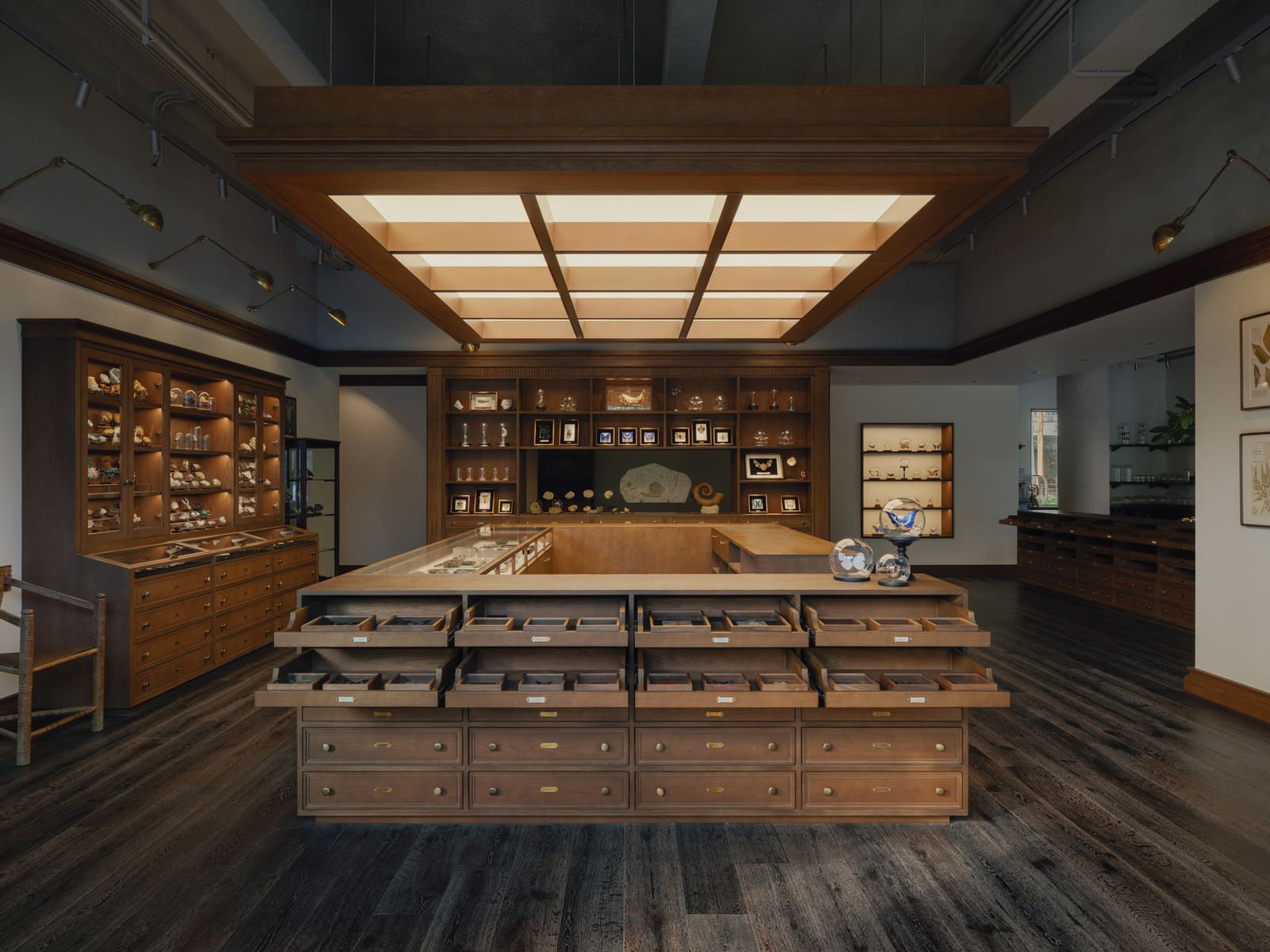
There is something quietly radical about asking a retail space to behave like a museum. Not the white-cube variety, sterile and reverent, but something closer to the Victorian naturalist's cabinet: tactile, curious, layered with the sediment of collected wonder. That was the provocation handed to Offhand Practice when they began work on Wild's Collection, a 155-square-meter wilderness natural history discovery hub embedded within Aranya Guangzhou Jiulong Lake, the developer's first semi-open park commercial complex.
The host building, completed in 2025, speaks in the vocabulary of site-cast concrete: raw, bold, unapologetically modernist. It is architecture that does not whisper. Within that assertive shell, the brief called for something counterintuitive, a space that could hold the delicate, the organic, the specimen-worthy, without surrendering to twee nostalgia or Instagram-friendly whimsy.
At World Archi Design, we have been tracking the growing appetite for retail environments that resist the frictionless browse-and-buy model. Wild's Collection sits squarely in that lineage, one where the act of shopping is reframed as discovery, and the interior itself becomes an artifact worth examining.
Spatial Parti: The Fold and the Frame
Offhand Practice, led by Yuan Yuan, Nie Xuan, Wen Xiaohui, Li Yue, Gao Sizhuo, and Chen Jieying, approached the project not as a conventional storefront but as a series of nested thresholds. The design concept pivots on what they describe as "a fold of time," a spatial gesture that compresses the timeline of natural history, from fossilized epochs to contemporary wilderness advocacy, into a single, ambulatory sequence.
The plan eschews the open-floor retail typology in favor of a more labyrinthine arrangement. Visitors move through a succession of carefully framed vignettes, each calibrated to foreground a different category of specimen or interpretive display. This is not the forced march of the department store aisle; it is closer to the experience of wandering through the back rooms of a provincial natural history collection, where each turn yields something unexpected.
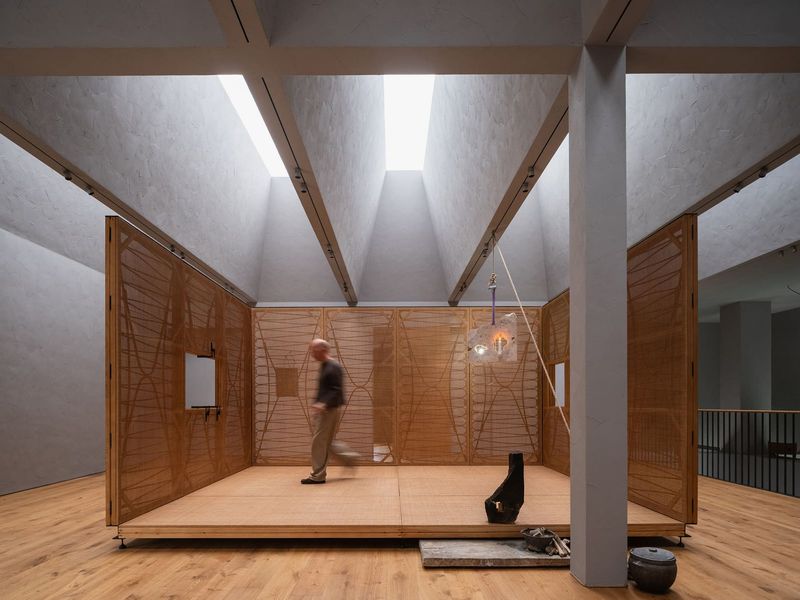
The materiality reinforces this reading. Offhand Practice retained the raw concrete of the building envelope, allowing it to serve as both backdrop and conceptual anchor. Against that neutral, almost geological surface, the studio introduced a restrained palette of warm-toned timber, blackened steel vitrines, and diffused natural light. The result is a space that feels simultaneously archival and alive, a quality difficult to achieve without tipping into pastiche.
Display Logic: Specimen as Protagonist
The design's most successful move lies in its display strategy. Rather than treating products as merchandise to be arrayed on conventional shelving, Offhand Practice borrows heavily from museum exhibition design. Individual specimens, whether taxidermied fauna, botanical samples, or geological fragments, are given the spatial dignity typically reserved for fine art or ethnographic artifacts.
Custom steel-and-glass vitrines punctuate the interior, each one a discrete micro-environment. The proportions are generous; the frames are spare. This is not the maximalist clutter of the curiosity shop but the edited precision of the curated collection. Lighting, developed in collaboration with Shanghai Tangsi Lighting Design Co., is calibrated to individual objects, with narrow-beam spots highlighting texture and form without flattening them into two-dimensional silhouettes.
The precedent here is less Aesop or Byredo, more Sir John Soane's Museum: a space where the act of looking is slowed, where the visitor is invited to linger over detail. It is a gamble in a retail context, where dwell time is typically engineered to maximize transaction velocity. But for a brand like Wild's Collection, whose identity hinges on environmental storytelling and educational mission, the gamble appears calculated.
Material Restraint and the Question of Scale
One of the more nuanced challenges in small-format retail is avoiding visual cacophony. At 155 square meters, Wild's Collection does not have the luxury of grand gestures or sweeping vistas. Offhand Practice resolves this through a strategy of material restraint and careful scalar modulation.
The concrete envelope, left largely untreated, provides continuity and calm. Timber elements, used sparingly for benches and display plinths, introduce warmth without veering into rustic sentimentality. The blackened steel vitrines, thin-profiled and precisely detailed, read as lines in space rather than mass. This economy of means allows the specimens themselves to command attention, a hierarchy that feels appropriate given the project's pedagogical ambitions.
Scale is also handled deftly. The ceiling height, inherited from the building shell, is generous enough to avoid claustrophobia but not so lofty as to overwhelm the intimacy of the displayed objects. Display units are varied in height and depth, creating a rhythm that guides circulation without resorting to overt wayfinding graphics. The effect is one of intuitive navigation, a quality often sacrificed in more didactic retail environments.
Context and Precedent: Retail as Cultural Infrastructure
Wild's Collection is part of a broader shift in how we conceptualize commercial space, particularly within mixed-use developments like Aranya Guangzhou. The project aligns with a lineage that includes Studio Mumbai's work for Aesop in Kochi, where vernacular materiality and artisanal craft were foregrounded, and David Chipperfield's Valentino flagship in Rome, where the architecture of the host building was allowed to speak with equal authority to the brand narrative.
What distinguishes Offhand Practice's approach is the explicitness of the museum analogy. This is not simply a beautiful shop; it is a space that positions retail as a form of cultural infrastructure, a place where objects are not only sold but contextualized, interpreted, and, ideally, valued beyond their transactional function.
The Aranya Guangzhou site itself amplifies this reading. As a semi-open park commercial complex, it blurs the boundary between public and private, between leisure and consumption. Wild's Collection, positioned as a "street-side museum," leverages that ambiguity, inviting passersby to engage with natural history content without the friction of entry fees or institutional gatekeeping.
The Tension Between Commerce and Contemplation
Of course, the project is not without its inherent contradictions. A retail space, no matter how thoughtfully designed, ultimately exists to sell. The museum language, however earnestly deployed, can risk aestheticizing consumption, lending an aura of intellectual seriousness to what remains, at its core, a commercial transaction.
Offhand Practice navigates this tension with some success, largely by refusing to over-design. There is no heavy-handed theming, no faux-Victorian taxidermy parlor, no forced narrative arc. The space is direct, almost austere, allowing the specimens and the visitor's own curiosity to do the work. Whether that restraint will translate into commercial viability remains an open question, one that will be answered not by architectural critics but by foot traffic and sales data.
Forward Implications: Retail as Pedagogy
Looking beyond the specifics of Wild's Collection, the project raises broader questions about the role of design in shaping how we encounter the natural world within urban contexts. As cities densify and access to wilderness becomes increasingly mediated, spaces like this, hybrid retail-educational environments, may become more common.
The success of such projects will hinge on their ability to resist the twin pitfalls of didacticism and commodification. Offhand Practice's design suggests a possible path: one where spatial quality, material honesty, and curatorial rigor are not afterthoughts but foundational principles. Whether other retailers, and other architects, will follow that path remains to be seen. But for now, in a 155-square-meter fold of concrete and glass in Guangzhou, the experiment is underway.
Save this story. A free account keeps your reading list and the 07:00 email in one place.
CREATE FREE ACCOUNT →SIGN IN