
The Body as Blueprint
There is a particular challenge in designing retail space for a brand whose entire identity revolves around the human form. When that brand is SKIMS, launched in 2019 by Kim Kardashian and CEO Jens Grede, the question becomes: how do you translate shapewear's intimate relationship with the body into architecture?
Rafael de Cárdenas, the New York-based designer behind the London flagship, answers by making the space itself feel anatomical. Occupying a two-level corner site on Regent Street, the store adopts the fleshy beige and cream tones that have become inseparable from SKIMS' visual language. But this is not mere colour-matching. The interiors read as an extension of the garments themselves, walls swelling and receding in soft, continuous curves that suggest musculature beneath taut fabric.
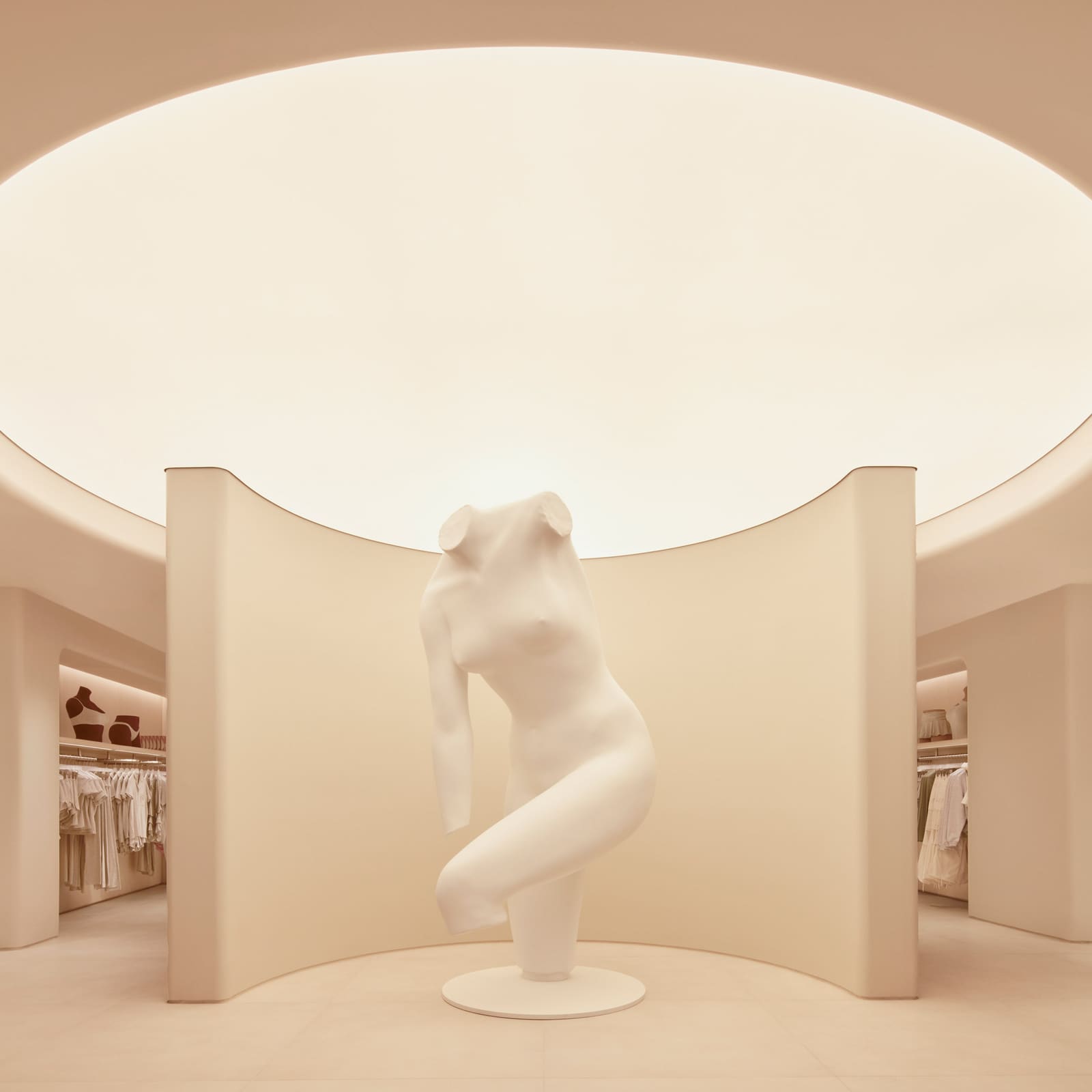
At the entrance, visitors encounter a monumental female nude sculpture by Vanessa Beecroft, an artist who has collaborated with SKIMS on multiple occasions. The figure is lit from above by an oversized circular disc embedded in the ceiling, a gesture that feels both gallery-like and clinical. A rounded partition in that same signature nude tone frames the sculpture, establishing the visual grammar that governs the rest of the space: volume, softness, and an unapologetic focus on the body.
Spatial Syntax and the Language of Curves
De Cárdenas has structured the store as a sequence of open-plan zones, each distinguished by sinuous partitions rather than hard boundaries. This approach recalls the work of mid-century designers like Frederick Kiesler, whose "Endless House" proposed architecture as a continuous, organic surface. Here, the effect is less utopian and more commercial, but the underlying principle holds: space flows, walls bulge, and the eye is never allowed to settle on a right angle.
The changing rooms, illuminated by another large disc light, feature floor-to-ceiling mirrors that multiply the effect of a smooth pink ottoman and the brand's inflated logo carved into the wall. The logo itself, rendered in relief, becomes a sculptural element, its exaggerated letterforms echoing the plump contours of the architecture.
Throughout the store, minimalist cabinetry holds merchandise while doubling as display plinths for cross-legged mannequins. The mannequins perch rather than stand, their poses casual and almost conversational. This choice subtly undermines the clinical precision of the space, introducing a note of informality that aligns with SKIMS' positioning as both aspirational and accessible.
Precedent and Repetition
This is not de Cárdenas' first foray into SKIMS retail. In 2024, he designed the brand's Fifth Avenue flagship in New York, which established many of the same visual tropes: the oversized lighting discs, the curvilinear partitions, the restrained palette. The London store reads as a refinement rather than a departure, tightening the spatial language and leaning further into the somatic metaphor.
Before de Cárdenas' involvement, SKIMS experimented with temporary retail through a 2021 pop-up in Paris designed by Willo Perrin. That project featured glossy partitions and chunky changing rooms, a more explicitly playful take on the brand's aesthetic. The evolution from Perrin's pop-up to de Cárdenas' permanent flagships suggests a shift from novelty to consolidation, from brand experimentation to brand architecture.
The question of visual consistency across SKIMS stores raises broader issues about retail design in the age of Instagram. When a brand's identity is so tightly bound to a specific aesthetic, how much variation is possible before coherence fractures? De Cárdenas' solution is to treat each store as a variation on a theme, maintaining the core vocabulary while adjusting scale and proportion to suit the site.
Material and Metaphor
The palette, drawn from a spectrum of skin tones, is both the store's most distinctive feature and its most contentious. SKIMS has built its reputation on offering shapewear in an unusually wide range of nude shades, a response to an industry that historically defined "nude" as a single, light beige. By extending this logic into architecture, de Cárdenas amplifies the brand's inclusivity messaging, but also risks flattening it into decoration.
The materials themselves are resolutely contemporary: smooth plaster, polished surfaces, and integrated lighting that eliminates shadow. There is no texture, no grain, no evidence of craft in the traditional sense. This is architecture as rendering, space designed to photograph as cleanly as the garments it houses. In this, it reflects a broader trend in luxury retail toward environments that function as much as content studios as they do as shopping venues.
Yet there is something quietly radical in the store's refusal of ornamentation. Where many fashion flagships lean into maximalism, piling on marble, brass, and bespoke fixtures, SKIMS strips back to form and colour alone. The result is a space that feels both futuristic and strangely timeless, as if the brand has bypassed historical reference entirely.
London as Context
Kardashian has described London as one of the most inspiring fashion cities in the world, and the choice of Regent Street as the site for SKIMS' first European store is deliberate. The street, with its sweeping curve and neoclassical facades, has long been a retail destination, home to both heritage British brands and international flagships. SKIMS' arrival marks another chapter in the street's ongoing evolution, a shift from traditional department stores toward experiential brand environments.
The London flagship also signals SKIMS' ambitions beyond the North American market. Since its launch, the brand has expanded rapidly, moving from direct-to-consumer online sales to a growing network of physical stores. The London opening, paired with earlier flagships in New York and Los Angeles, positions SKIMS as a global player rather than a celebrity vanity project.
At World Archi Design, we have been tracking the convergence of fashion and spatial design, particularly as brands seek to create environments that feel less like stores and more like destinations. SKIMS' London flagship sits squarely within this shift, offering an architecture that is inseparable from the brand identity it houses. Whether this approach will age well remains to be seen. For now, it stands as a confident articulation of a brand that has, in just over five years, moved from startup to cultural fixture.
Save this story. A free account keeps your reading list and the 07:00 email in one place.
CREATE FREE ACCOUNT →SIGN IN