
The Language of Threat
There are moments when an architect's vocabulary shifts from the technical to the mortal. In 1958, at ninety years old, Frank Lloyd Wright began describing white paint as a killer. He wrote to Harry Guggenheim in March of that year, calling the colour "devastating" and a "menace." He invoked shrouds, graves, and destruction. The building, in his view, was alive, and white paint was poised to end it.
This was not hyperbole for effect. Wright had spent more than a decade watching the Guggenheim Museum rise in Manhattan, and now, with construction nearing completion, the museum's new director James Johnson Sweeney proposed painting the interior bright white. Wright's reaction was visceral. He described the plan as tearing "the inside from the outer walls of the organic building," a phrase that suggests not renovation but vivisection.
At World Archi Design, we have tracked countless disputes over materials, massing, and programme, but few have centred so intensely on a single pigment. Wright's objection was not aesthetic whimsy. It was rooted in a belief that architecture operates as a unified organism, and that colour - far from being decorative - is structural to its integrity.
The Architect's Case Against White
Wright's argument against white paint began with optics. He insisted that white, being the sum of all colours, overwhelmed everything placed against it. In his letter to Harry Guggenheim, he called it "the loudest color of them all," unsuitable for framing art or sculpture. He pointed to nature, which he said used white "most sparingly for accent only," as evidence that the colour was never meant to dominate an interior.
But his critique extended beyond the visual. Wright believed that white paint represented a kind of ideological surrender, a retreat to convention. He called it "makeshift," a term suggesting expedience over thought. In an April letter, he referred to a white-painted room as a "sepulchre," asking pointedly: "Human sepulchre is white. Why?" The implication was clear. To paint the museum white was to entomb it.
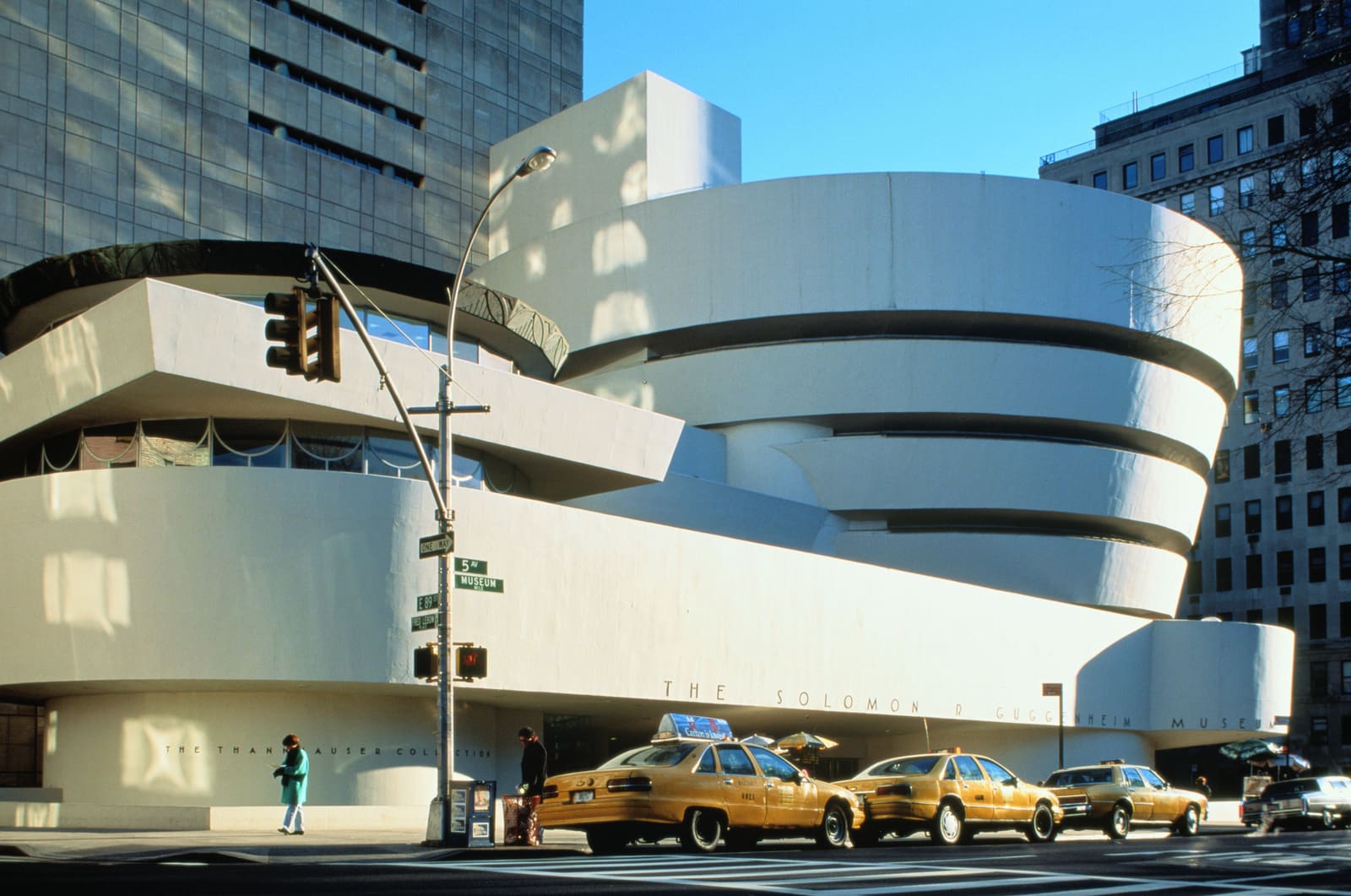
What Wright was defending was architectural coherence. For him, the Guggenheim's spiral form was not simply a container for art but a sculptural work in its own right. The building's exterior and interior were meant to read as continuous, carved from a single conceptual mass. To paint the interior a different colour than the exterior was to fracture that unity, to deny the building's tectonic logic.
The Director's Vision
Sweeney, more than three decades younger than Wright, had a different mandate. Appointed director in 1952, he inherited a museum that had been conceived by Hilla Rebay as a temple to non-objective art. Rebay's original gallery on East 54th Street featured fabric-draped walls, ornate frames, and an atmosphere described as "theatrical" by early critics. She spoke of "cosmic vision" and "spiritual joy," framing abstraction as a transcendent experience.
Sweeney dismantled that narrative. He broadened the collection to include representational works, acquired sculpture, and championed a curatorial approach that prioritised the art over the architecture. His choice of white paint was deliberate. He believed it would neutralise the space, allowing viewers to focus on the exhibitions rather than on Wright's spiralling walls.
This was not ignorance. Sweeney understood that Wright's design posed challenges for display, the curved walls chief among them. Rebay had suggested replicating the fabric treatment from the earlier gallery, but Sweeney rejected it. He wanted clarity, not atmosphere. White paint, in his view, was the most effective tool for achieving that.
Dead-White and Its Histories
The term "dead-white" carried specific meaning in the mid-twentieth century. It referred to paints with no undertone, no warmth or coolness to soften their brightness. The name echoed "white-lead," a pigment prized for its opacity and smooth finish but notorious for its toxicity. Lead-based paints had been linked to severe health consequences since the late nineteenth century, including brain swelling, convulsions, and death.
In England, workers in paint factories, particularly young women, bore the brunt of exposure. They handled vessels of liquid white-lead, which splashed onto their clothing and hardened. Most could not afford multiple garments, so their dresses accumulated layers of the substance. Factory doctors noted that even in well-regulated facilities, workers inhaled enough dust to suffer grave effects. Cats in these factories, which ingested lead while grooming, rarely survived. Rats, by contrast, thrived.
Wright's use of the term "dead-white" was not accidental. He was invoking both the colour's visual finality and its historical associations with harm. Whether he was aware of the full scope of lead paint's industrial legacy is unclear, but his rhetoric suggests he understood white paint as something that imposed itself, that colonised space rather than harmonising with it.
The Stakes of Organic Architecture
Wright's philosophy of organic architecture rested on the idea that a building should express unity between its site, form, and materials. Colour was not incidental to this unity - it was foundational. He favoured natural tones, pigments that felt inherent to the landscape rather than applied from without. For the Guggenheim, he envisioned a palette that would allow the interior to flow seamlessly from the exterior, so that the spiral read as a continuous form whether viewed from Fifth Avenue or from within.
This was not a new preoccupation. Throughout his career, Wright had insisted on controlling every aspect of his buildings, from furniture to finishes. His clients often found this overbearing. But Wright believed that architecture could not function as intended if its elements were chosen piecemeal. A white interior in a building designed to be read as monolithic was, to him, a contradiction that undermined the entire project.
Sweeney, meanwhile, represented a different architectural ideology, one that positioned the building as a neutral backdrop. This approach, which would come to dominate museum design in the latter half of the twentieth century, treats the gallery as a frame that should recede. Wright's vision was the inverse: the building was the work, and the art existed within it, not against it.
The Letter to Aline Saarinen
In May 1958, Wright escalated. He wrote to Aline Saarinen, an architecture critic who had previously profiled him favourably. The letter opened with "S.O.S!" and described Sweeney as "a picture-hanger" authorised to "barge in on the architect" and destroy the building's integrity. He asked Saarinen to "get into [her] fighting clothes" and intervene with the museum's trustees.
This appeal reveals Wright's desperation. He had lost the argument with Sweeney and Harry Guggenheim. His only recourse was to appeal to the press, to frame the dispute as a public matter rather than an internal one. It was a tactic he had used before, leveraging his celebrity to pressure clients and institutions. But this time, it did not work.
The Guggenheim Museum opened in October 1959, six months after Wright's death in April of that year. The interior was painted white.
What Wright Was Really Defending
Wright's battle over white paint can be read as a final assertion of authorial control. But it also points to a deeper question about what architecture is meant to do. For Wright, a building was not simply a functional object but an environment that shaped experience. Colour, light, and form were inseparable. To alter one was to alter the whole.
Sweeney's position, by contrast, reflected a growing belief that museums should serve the art they house, not compete with it. This tension - between architecture as autonomous work and architecture as service infrastructure - has defined museum design ever since. We see it in the debate over Zumthor's Kolumba Museum, where materiality is foregrounded, and in the white cube galleries that proliferated in the decades after the Guggenheim opened.
What makes Wright's objection compelling is not that he was right, but that he understood what was at stake. He saw that painting the interior white was not a minor adjustment but a philosophical shift, one that redefined the building's purpose. Whether that shift was necessary is still debated. But Wright's letters, with their mortal language and urgent tone, remind us that colour is never neutral. It carries meaning, history, and power.
The Afterlife of the Argument
The Guggenheim has been repainted many times since 1959. The current interior is still white, though the shade has varied. Wright's spiral remains one of the most recognisable works of twentieth-century architecture, and the tension he identified - between building and collection - continues to animate discussions about the museum's function.
In recent years, some curators have experimented with coloured walls in temporary exhibitions, a gesture that nods to Wright's original vision. But the default remains white, a testament to Sweeney's influence and to the broader shift in museum practice that his approach represented.
Wright did not live to see his building completed, but his argument survives. It asks us to consider what we lose when we prioritise one element of architecture over another, and whether unity of vision is a principle worth defending - or an obstacle to evolution.
Save this story. A free account keeps your reading list and the 07:00 email in one place.
CREATE FREE ACCOUNT →SIGN IN