
Starting With the Building
There's a curatorial principle that rarely gets articulated but shapes every museum's programme: the architecture speaks first. At the Groninger Museum, this isn't just theory. It's unavoidable. Roos Gortzak, who took on the role of artistic director in early 2025, has made the building itself her starting point, extracting from its postmodern fabric a set of values that feel less like historical artifacts and more like a manifesto for the present.
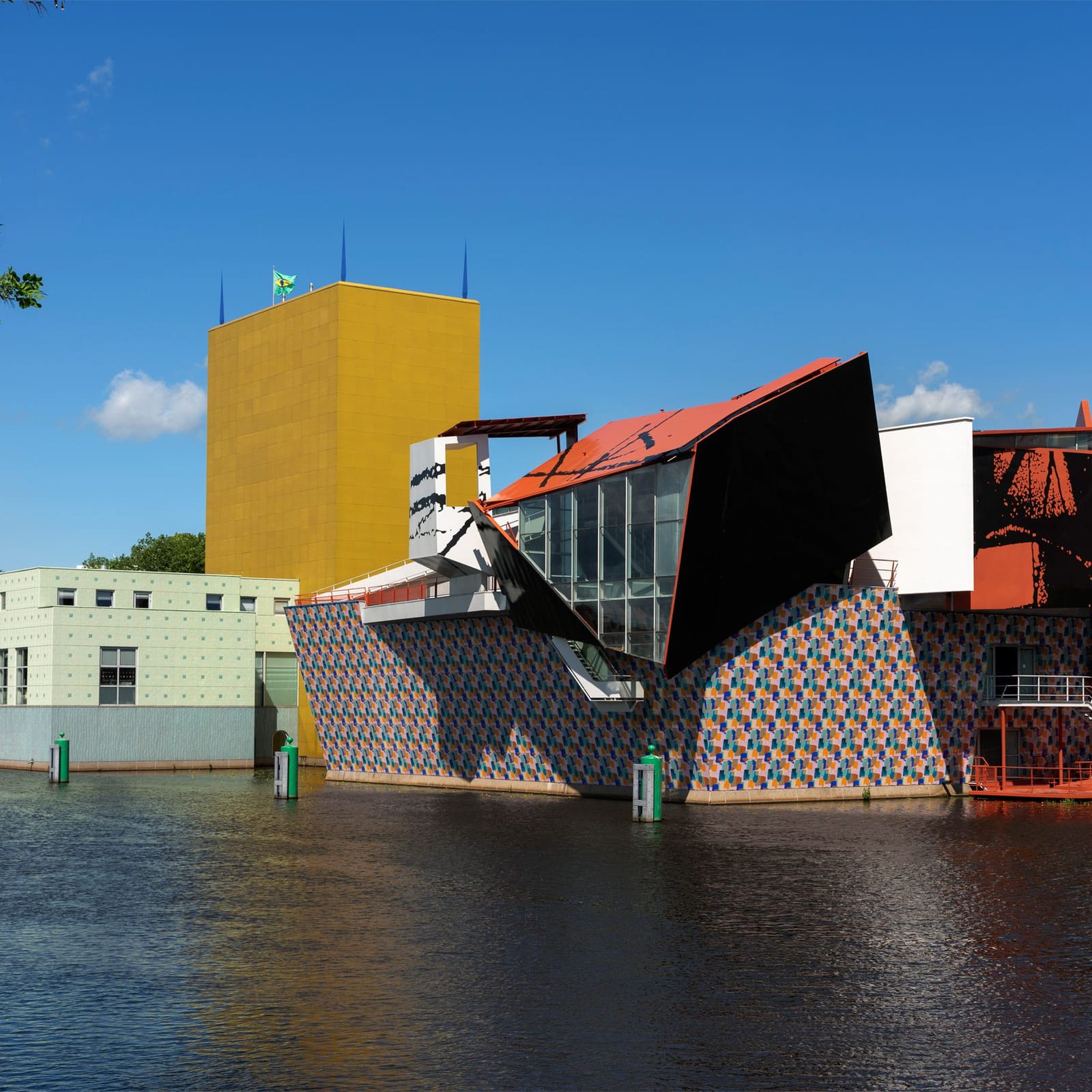
The structure, completed in 1994, occupies an island site between Groningen's central station and the historic core. Alessandro Mendini coordinated the project, but the real story lies in its disaggregation: three pavilions linked by bridges, each designed by a different architect with considerable autonomy. Mendini contributed a windowless yellow tower flanked by pink and green volumes. Philippe Starck added a low-rise metallic cylinder perched on a brick plinth by Michele De Lucchi. Coop Himmelb(l)au delivered a deconstructivist explosion of colour and form that refuses to sit still.
It's a building that announces plurality before you walk through the door. And for Gortzak, that announcement is the point.
Reading Architecture as Ideology
Gortzak's curatorial approach begins with close reading. She identifies three core values embedded in the museum's design: experimental, interdisciplinary, collective. These aren't aspirational add-ons. They're structural facts. The building was conceived as a collaboration among four designers who brought radically different aesthetics and methods to the table. It was built to challenge the idea of a singular architectural voice, and by extension, a singular curatorial voice.
This matters now more than ever. Many institutions are grappling with how to become more inclusive, how to platform voices that have been historically marginalized. Gortzak argues that the Groninger Museum's architecture already models this inclusivity. It's a physical argument against monolithic authority, against the idea that one perspective defines what architecture or art should be.
The building's backstory reinforces this ethos. The Coop Himmelb(l)au pavilion was originally intended for Frank Stella, who spent over a year developing a design entirely clad in Teflon. The plan was abandoned due to cost. Gortzak sees this not as a failure but as a necessary part of experimentation. Museums, she argues, need to create space for projects that don't work out, for creative risks that don't pay off. Contemporary art demands it.
Spatial Narratives and Curatorial Intent
The Groninger Museum doesn't follow the typology of the grand staircase ascending from an entrance hall into exhibition galleries. Instead, visitors descend. Gortzak reads this as a deliberate inversion of the traditional museum hierarchy, where art is something you must be elevated to appreciate. Here, the spatial narrative suggests that art exists at ground level, in everyday life, accessible without ceremony.
The building is also intentionally disorienting. Navigating its interior requires attention, even tolerance for confusion. Gortzak draws a parallel to the experience of engaging with challenging contemporary art. Discomfort, she suggests, is productive. Not everything needs to be immediately understood or liked. The museum's architecture models this kind of encounter, where being lost or unsettled is part of the process.
Mendini's colour palette further distinguishes the Groninger from the white-cube orthodoxy. He specified 22 colours for exhibition walls, a decision that predates the recent trend among galleries to move away from clinical neutrality. But at the Groninger, colour isn't decorative. It's conceptual, woven into the building's DNA. Gortzak sees this as another instance where the architecture was ahead of its time, anticipating debates that are only now becoming mainstream.
Relevance in a Difficult Moment
Museums face structural challenges: declining attendance, tightening budgets, competition for attention in an era of infinite digital distraction. Gortzak acknowledges this without pessimism. The question isn't whether museums remain self-evidently relevant. It's how they can earn relevance by offering something that can't be found elsewhere.
For the Groninger, that something is tied to its architecture. The building embodies values that resonate with contemporary anxieties: the need to encounter difference, to find common ground across divides, to experiment without the guarantee of success. Gortzak believes these qualities should be shared more widely, that the museum deserves greater recognition not for its own sake but because it offers a model for how cultural institutions can function in a polarized, uncertain moment.
This isn't about fame. It's about influence. The Groninger has never achieved the iconic status of Frank Gehry's Guggenheim Bilbao, which opened three years later and became shorthand for architecture-driven urban regeneration. But Gortzak argues that the Groninger's collaborative, pluralistic approach offers lessons that are more urgent now than the spectacle-driven Bilbao effect ever was.
Programming as Architectural Response
Gortzak's curatorial vision, set to launch in September, involves recommitting to contemporary art as the museum's core focus. This represents a return to the institution's original programming in the 1990s, when the building was new and contemporary practice was central. She describes it as "radically remembering," a phrase that captures the dual movement of looking back and pushing forward.
Part of this involves addressing historical imbalances. The museum was designed by four men. Its programming has historically reflected similar gender disparities. Gortzak's acquisition strategy prioritizes work by women and non-binary artists, voices she describes as sorely missing from the conversation. She frames this not as a corrective imposed from outside but as an extension of the building's existing logic. If the architecture already says "your difference is welcome here," then the programming should follow through.
The inaugural exhibition under the new programme will explore power dynamics in domestic and creative labour, using the figures of the architect and the housewife as points of departure. The show will include a model of Zaha Hadid's Music Video Pavilion, created for a 1990 festival in Groningen, and a collection of 98 vases by Mendini, some of which he decorated under a female pseudonym. The curatorial premise asks who is allowed to think big, and how creative ambition intersects with the demands of everyday life.
Architecture as Argument
What Gortzak is doing at the Groninger Museum is less about imposing a new vision than about amplifying what the building already argues. Postmodern architecture, at its best, was a critique of singular authority, a refusal of the idea that one style or one voice could define the field. It embraced contradiction, collaboration, and formal experimentation. These principles, often dismissed as stylistic excess, turn out to have enduring conceptual weight.
The Groninger Museum's architecture is loud, colourful, and unapologetically strange. It's also, Gortzak suggests, deeply aligned with the challenges and opportunities of the present. In an era when museums are rethinking their role, when inclusivity and experimentation are no longer optional, a building that already embodies those values offers more than aesthetic interest. It offers a blueprint.
The question isn't whether the Groninger Museum will achieve the fame of other landmark institutions. It's whether other museums will learn from what it's already demonstrating: that architecture can be a form of curatorial argument, and that the best programmes are the ones that listen to the buildings they inhabit.
Save this story. A free account keeps your reading list and the 07:00 email in one place.
CREATE FREE ACCOUNT →SIGN IN