
A Practice Built on Questions
Most designers accept the chair as a solved problem. Nanna Ditzel spent her career asking why. Why four legs when a ceiling could bear weight? Why rigid upholstery when foam could be rearranged by hand? Why straight lines when the natural world offered none? Her furniture, textiles, and metalwork share a common thread: the belief that domestic objects should adapt to human behaviour, not the other way around.
Born in Copenhagen in 1923, Ditzel trained first as a cabinetmaker before entering the School of Arts and Crafts and later the Royal Academy of Fine Arts. By twenty, she had already placed work in the annual Carpenters' Guild exhibition. In 1946, she graduated and married fellow designer Jørgen Ditzel, establishing a joint studio that would produce some of Denmark's most forward-looking postwar design. Where contemporaries like Hans J. Wegner and Arne Jacobsen refined established typologies, the Ditzels treated furniture as a starting point for spatial speculation.
The Stairscape Experiments
In 1952, the couple unveiled what they called a "stairscape" at an avant-garde exhibition held by Winkel og Magnussen. The installation, later known as The Padded Cell, consisted of stepped upholstered platforms in bold primary colours, with movable foam elements and small cushions that visitors could position as needed. The concept rested on a simple observation: conversation and thought flow more freely when people can recline, not just perch. Sculptor Aagaard Andersen contributed the saturated blue, yellow, and red palette, lending the piece a Pop sensibility years before the term entered common use.
The stairscape format would recur throughout Ditzel's work. In 1966, she introduced Villette, a modular seating system upholstered in brightly coloured knitted fabric. Lightweight and affordable, the elements could be grouped into soft terrains that invited informal gatherings. The timing coincided with Ditzel's relocation to London, where she and her second husband, furniture dealer Kurt Heide, opened Interspace in a former Hampstead chocolate factory. The showroom doubled as a social hub, hosting exhibitions and parties attended by figures including Terence Conran and Verner Panton. Villette provided the setting, a physical embodiment of the flexible, egalitarian spaces the 1960s counterculture championed.
By 1968, Ditzel had adapted the concept for a children's library in Lyngby, near Copenhagen. The Fairy Tale Room offered young visitors a multi-level environment to climb, listen to stories, and play, treating furniture as an extension of imagination rather than a constraint. When her daughter Dennie later asked why she avoided straight lines, Ditzel gestured outdoors: "Look outside, there are no angles in nature."
Suspension and the Liberation of the Base
In 1959, the Ditzels introduced the Hanging Egg, a suspended wicker seat that remains one of their most recognisable pieces. The chair eliminated the four-legged base entirely, allowing occupants to sway and shift within a cocoon-like form. It represented a broader ambition: to activate the full volume of a room, not just its floor plane. Two years after the Hanging Egg's debut, Jørgen died suddenly, leaving Nanna to raise three daughters and run the studio alone.
Her first solo project, completed in late 1961, was a low rattan lounge chair and footstool initially called the Fireplace Chair, later renamed Chill. Developed with Danish rattan specialist Robert Wengler, the design invited users to sit close to the ground, a recurring motif in Ditzel's domestic vocabulary. The chair remained in her summer house in Hornbæk for more than four decades, a personal talisman as much as a commercial product.
Objects That Teach
In 1962, Ditzel designed Trisse, a spool-shaped stool originally intended for children. The name derives from the Danish word for "spool"; in English markets, it was marketed as the Toad Stool. Unlike conventional seating, Trisse could be rolled, stacked, or flipped, anticipating the ways children naturally interact with furniture. Adults quickly adopted it as well. This year, Fredericia reissued the design in oak, more than six decades after its debut. Maria Bruun, the company's head of design, describes the piece as "intuitive and playful, yet highly resolved. You understand it immediately, but it continues to reveal new ways of being used."
The same openness characterises Ditzel's 1965 upholstery textile, Hallingdal. Created in collaboration with Norway's Gudbrandsdalens Uldvarefabrik for the Halling-Koch Design Centre, the fabric launched in vivid pink, blue, turquoise, red, and orange, a deliberate challenge to the muted palettes then dominant in Scandinavian interiors. Distributed globally by Kvadrat, Hallingdal has remained in continuous production, with the Norwegian manufacturer reporting over ten million metres sold since launch.
Metalwork and Materiality
Ditzel's engagement with organic form extended beyond furniture. In 1954, she became the first woman to design for Georg Jensen, the Danish silversmith. Her jewellery included a bracelet composed of crescent-shaped discs and a ring engineered to elongate the finger, both reflecting her interest in biomorphic geometry. Pieces created with Jørgen earned gold medals at the Milan Triennale in 1957 and 1960, and the couple received the Lunning Prize in 1956.
The Clementine bracelet, introduced in 1960, exemplifies her approach: bold, sculptural, and deeply attentive to how metal sits against skin. The work won another Milan Triennale gold, cementing Ditzel's reputation beyond furniture. Yet much of her output remained anonymous, absorbed into domestic routines without fanfare. Ceramic salad bowls for Søholm, tea and coffee services for Nordlys, wooden cheeseboards for Brdr. Krüger: objects people used daily, often unaware of their authorship.
Return and Renewal
After Kurt Heide's death in 1985, Ditzel returned to Copenhagen and established a studio in her Klareboderne home. Four years later, she began a collaboration with Fredericia that would define the final phase of her career. The first result, Bench for Two, positioned two seats at right angles, connected by a quarter-circle table. Thin plywood surfaces carried screen-printed stripes, generating a sense of kinetic energy. Dennie Ditzel recalls suggesting the circular table after her mother's initial square version felt too rigid. When asked how she knew a design was complete, Nanna replied, "It's finished when it looks like something that's always been here."
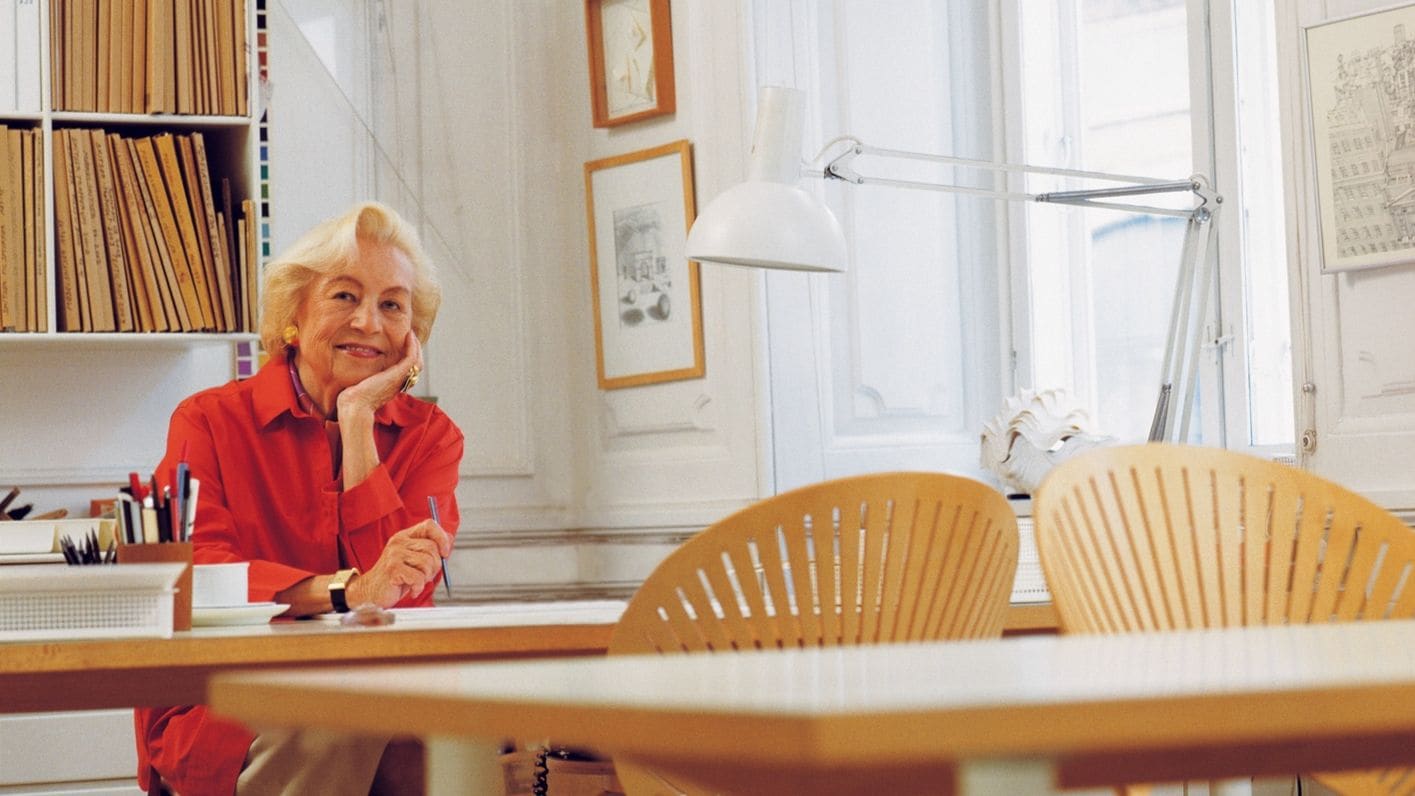
The bench won a gold medal at the 1990 international furniture competition in Asahikawa, Japan, proof that Ditzel's experimental instincts remained sharp well into her sixties. Three years later, she completed Trinidad, a chair inspired by the carved fretwork she had observed on Caribbean balconies and doorways. The seat and back feature intricate cut-outs that cast shifting shadows, translating an architectural vernacular into a lightweight stacking chair. Fredericia has since sold over one million units, and the design marked a turning point for both designer and manufacturer. It established Ditzel as the company's second house designer after Børge Mogensen and helped catalyse the broader revival of Danish furniture in the 1990s.
Recognition followed. Denmark's ID Prize in 1995, Honorary Royal Designer for Industry from London's Royal Society of Arts in 1996, and a lifelong artists' grant from the Danish Ministry of Culture in 1998 confirmed her standing. Yet Ditzel's process remained rooted in observation, not accolade. "Inspiration is the result of many thoughts and many experiences in the company of other people or alone in nature," she said. "Ideas don't come out of thin air. You can't ask for them. They are hard work."
What Endures
Ditzel died in 2005, leaving a body of work that spans from the radical to the quotidian. Reissues continue: Mater reimagined her and Jørgen's 1955 outdoor furniture using ocean-waste plastic in 2019; Kvadrat revisited her 1960s Sisu textile with artist Danh Vo in 2021; Fredericia brought back Bench for Two in 2025. Each revival introduces her thinking to audiences who may not recognise her name but who benefit from her insistence that domestic life deserves ambitious design.
At World Archi Design, we have long argued that the most enduring furniture does not announce itself. It recedes into daily rhythms, shaping behaviour without spectacle. Ditzel understood this implicitly. Her maxim, "Three steps forward and two steps back still means I've taken a step in the right direction," captures both the patience her process required and the incremental nature of meaningful change. She did not seek to overturn domesticity; she sought to make it more flexible, more colourful, more responsive to the ways people actually sit, gather, and rest.
Her work reminds us that radical design need not be loud. Sometimes it hangs from the ceiling, sometimes it invites you to lie down, and sometimes it simply lets light pass through.
Save this story. A free account keeps your reading list and the 07:00 email in one place.
CREATE FREE ACCOUNT →SIGN IN