
The Pendulum Swings
Twenty-five years into this century, Copenhagen gave us bridges that leapt across water, housing that cascaded down hillsides, and a power plant crowned with an artificial ski slope. These were monuments to futurity, expressions of what architecture could become when freed from historical constraint. Yet something curious has happened in the past few years. The city's most compelling work now involves not what can be imagined from scratch, but what can be recovered, reinterpreted, and made to live again.
At World Archi Design, we've been tracking this shift across Northern Europe, but nowhere is it more pronounced than in Denmark's capital. A wave of restoration projects has emerged, driven by converging forces: updated national policy that privileges reuse over demolition, rising awareness of embodied carbon, and perhaps something less quantifiable but equally powerful. A collective exhaustion with the rhetoric of the new.
Policy as Catalyst
Denmark's updated National Architecture Policy, released in 2025 after more than a decade without revision, recalibrated the entire framework around existing buildings. The threshold for demolition has risen sharply. Whole-life carbon accounting now includes the emissions associated with material waste, making the case for preservation not merely aesthetic or historical, but empirically environmental.
Nicolai Overgaard, a partner at Schmidt Hammer Lassen, describes the change as a journey that has only just begun. The policy creates friction where there was once a clear path to the wrecking ball, but he notes that supporting legislation around operational carbon and change of use still lags behind. Architects working in transformation face regulatory environments built for new construction, requiring workarounds and exceptions that slow timelines and complicate approvals.
Still, the direction is unmistakable. Where a few years ago, tearing down a building required little justification beyond financial logic, today the burden of proof has shifted. The default is now retention, and demolition must be argued.
Frederiksberg Swimming Pool: A Scenographic Return
In the Frederiksberg neighbourhood, the 1934 municipal swimming pool reopened recently after a restoration by Cornelius Vöge that treated the building less as infrastructure and more as total environment. Dan Cornelius, founding partner of the firm, describes his role in such projects as a hybrid of biographer, archaeologist, and curator. The original colour scheme, derived from a monumental cubist mosaic by Vilhelm Lundstrøm, was brought back not as historical footnote but as organizing principle for the entire spatial experience.
Public baths in Copenhagen are experiencing a resurgence in use, and Cornelius sees restoration as the most sustainable architectural process available. The pool's improved facilities and updated café sit within a framework of preserved character, a balance that acknowledges both contemporary program and historical DNA. The storytelling, he argues, is vital. Without it, the building becomes a generic container.
The Botanical Palm House: Nine Specialisms, One Envelope
Schmidt Hammer Lassen's ongoing work at the 1872 Palm House in the University Botanical Gardens offers a case study in the complexity of heritage intervention. The project, which began two years ago and is scheduled for completion in 2027, requires expertise across nine disciplines: scaffolding, glasswork, metalwork, and more. Contemporary solutions, heat-retaining curtains among them, are woven into a structure that predates electric lighting.
Elif Tinaztepe, a partner at SHL who has led transformation projects from Australia to Luxembourg, emphasizes that the practice's approach to old buildings is not nostalgic. The interest lies in understanding the logic of construction, the performance embedded in every decision. In an era defined by image, these projects force attention back to function, to the reasons why things were built the way they were.
At the 1861 Gothic Revival University Library in Fiolstræde, which reopened in 2023, the challenge was programmatic: transforming an active student library into a public building while preserving its atmospheric qualities. Secondary glazing and acoustic improvements were introduced carefully. The painted windows, previously restored in the 1980s with acrylic, were returned to linseed oil paint, a more sustainable and historically accurate choice.
Tivoli: Heritage That Refuses to Fossilize
Denmark's most-visited heritage attraction is not a monument but a living organism. Tivoli, the 183-year-old amusement park in central Copenhagen, receives approximately 4.3 million visitors annually. An in-house team of painters, designers, carpenters, and a historian work daily to maintain what CEO Susanne Mørch Koch calls a "calibration" grounded in time and care.
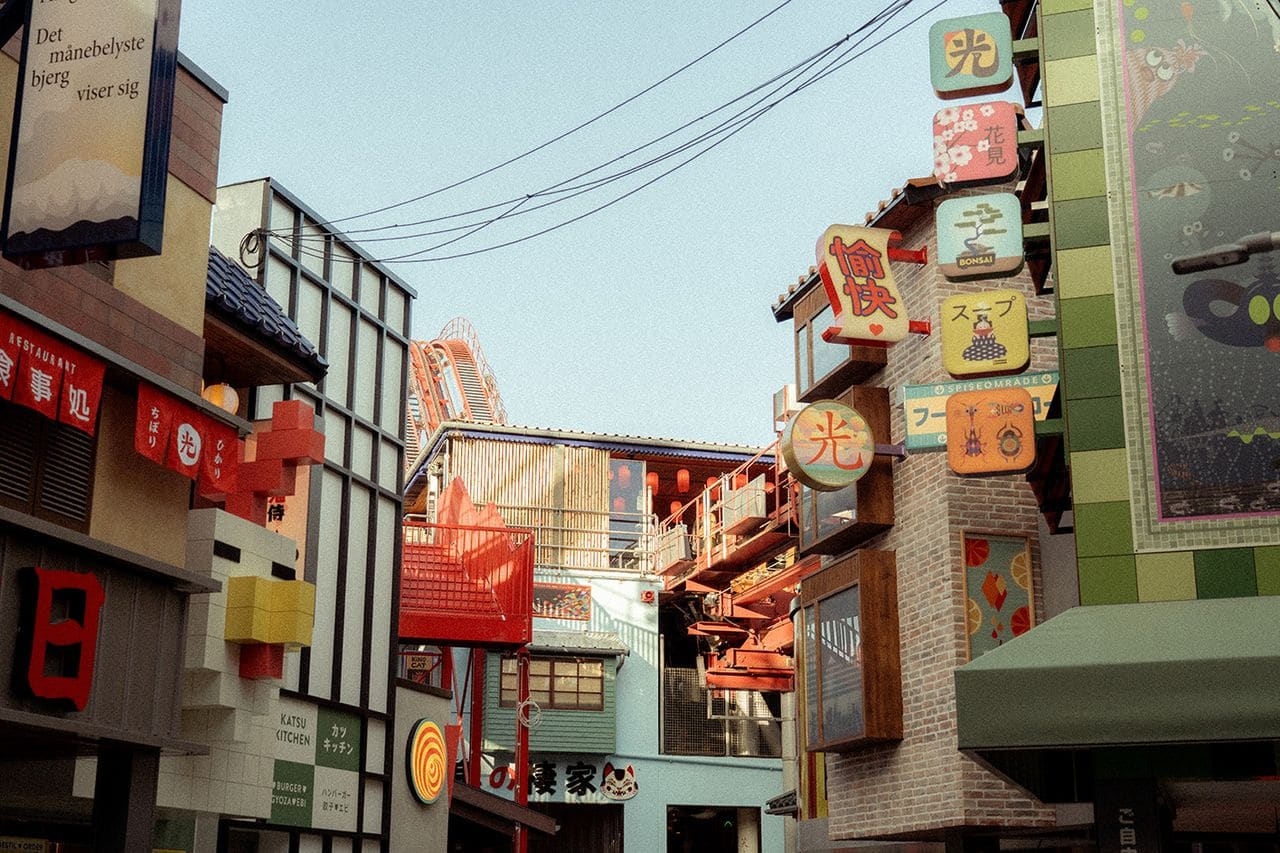
This past August, Tivoli unveiled Hikari, a Japanese-themed district supported by a landmark investment running into the hundreds of millions of Danish kroner. The design layers references from ukiyo-e woodblock prints to the aesthetic of konbini convenience stores, developed in collaboration with specialists in Japanese culture. Yet it speaks in Tivoli's own language, complete with appearances by Pierrot, the park's pantomime clown mascot.
Mørch Koch is adamant that Tivoli should not become a museum. It is a place that unites families across generations, and that intergenerational quality is worth protecting. Sixty-five per cent of visitors are locals, which means that investment in this piece of heritage is also investment in the continuity of civic life. The park's identity is playfully nostalgic, yes, but it is also fluid, capable of absorbing new narratives without losing coherence.
Custodianship as Prestige
A decade ago, corporate and philanthropic interest in heritage restoration was minimal. Today, Tinaztepe notes, being a custodian of older structures carries significant prestige. The motivation appears genuine: a desire to steward something for future generations rather than simply extract value in the present.
This shift is visible across several high-profile Copenhagen projects. Schmidt Hammer Lassen is undertaking a radical restoration of Arne Jacobsen's 1978 Nationalbank. Vilhelm Lauritzen Architects completed a renovation of the 1950s headquarters of Realdania, a Danish philanthropic organization, in 2025. And at the 1625 Børsen, the former stock exchange devastated by fire in 2024, the Danish Chamber of Commerce has opened a visitor center on the construction site, allowing locals to observe the building's revival by Praksis, VMB, and Leif Hansen.
These are not minor refurbishments. They represent substantial financial commitments to the idea that existing buildings, even those damaged or obsolete, are worth the effort of recovery.
Anchoring in a Bigger Continuum
Tinaztepe offers two explanations for why restoration and reuse have "seeped into collective consciousness" in Copenhagen. The first is climate awareness, the recognition that embodied carbon in existing structures represents a resource too valuable to waste. The second is more psychological: a need to be anchored in something that already exists, to situate oneself within a continuum rather than perpetually chasing the future.
Perhaps the appetite for relentless innovation has reached a saturation point. The ski-slope power plant, the cascading housing blocks, the dynamic bridges, all were exhilarating in their moment. But they also implied a certain restlessness, a dissatisfaction with what was already there. The restoration wave suggests a different temperament: one that values continuity, that finds meaning in the act of care, that sees the old not as obstacle but as foundation.
This is not a retreat from ambition. The technical and conceptual challenges of restoration are often greater than those of new construction. Every building presents a unique set of constraints, a distinct vocabulary that must be learned before it can be spoken. The architect becomes translator, negotiating between past intentions and present needs, between what was and what might yet be.
What Precedent Teaches
Copenhagen's turn to restoration echoes earlier movements, though with crucial differences. The postmodern reclamation of ornament in the 1980s was largely stylistic, a reaction against the perceived austerity of high modernism. What is happening now is more pragmatic, driven by material realities and regulatory frameworks as much as by aesthetic preference.
It also differs from the preservationist impulse of the mid-20th century, which often sought to freeze buildings in a mythical original state. Today's approach is more comfortable with layering, with the idea that a building can accumulate interventions across time and remain coherent. The Frederiksberg pool's updated café does not pretend to be from 1934. The Palm House's heat-retaining curtains are not disguised as Victorian technology. The interventions are legible, honest about their moment of origin.
In this sense, Copenhagen's restoration wave shares more with the adaptive reuse strategies that have transformed industrial districts across Europe and North America. The difference is one of scale and scope. Where adaptive reuse often targets single large structures, warehouses or factories, Copenhagen is applying similar thinking across a wider typological range: civic buildings, cultural institutions, infrastructure.
The Limits of Looking Back
There are, inevitably, tensions. Rising tourist numbers, projected to increase by nearly a quarter over the next decade, place pressure on heritage sites to accommodate larger crowds while maintaining the qualities that made them significant in the first place. The Rundetårn observatory tower, with its copper dome and 1920s telescope, is set to reopen this October after an extensive refresh. The challenge will be managing increased footfall without compromising the spiraling brick ramp and intimate scale that define the experience.
There is also the question of what gets preserved and what does not. Heritage frameworks tend to favor the monumental, the architecturally distinguished, the culturally iconic. Ordinary buildings, the background fabric of the city, receive less protection even though they often contribute more to urban character than individual landmarks. Copenhagen's restoration wave has focused on high-profile projects, which raises the question of whether the same principles will extend to more modest structures.
And while reuse is undeniably more sustainable than demolition in terms of embodied carbon, it is not always the most energy-efficient option for operational performance. Historic envelopes rarely meet contemporary standards for insulation and airtightness. Secondary glazing and heat-retaining curtains help, but they are compromises. The challenge for architects is to improve performance without erasing the qualities that justified preservation in the first place.
A Grounded Future
If there is a unifying thread in Copenhagen's restoration work, it is the idea that architecture exists in time, not outside it. Buildings accumulate history, bear the marks of use, embody the values of the societies that created them. To work with existing fabric is to acknowledge that continuity, to accept that architecture is not a series of isolated gestures but an ongoing conversation.
Dan Cornelius's assertion that restoration is the most sustainable architectural process is not merely environmental but existential. It suggests that sustainability is as much about cultural continuity as carbon accounting, that the measure of a building's value includes its capacity to hold memory, to anchor communities, to provide the "moments of togetherness" that Susanne Mørch Koch describes at Tivoli.
The future, in this reading, is not something to be invented from whole cloth but something to be negotiated with what already exists. The past is not a constraint but a resource, a repository of knowledge about materials, craft, and spatial relationships that contemporary architecture often overlooks in its rush toward novelty.
Copenhagen's restoration wave may or may not represent a permanent shift. Architectural culture is cyclical, and tastes change. But for now, the city's most compelling work is being done by architects who see themselves as custodians, translators, and biographers. They are building the future by carefully, thoughtfully, looking back.
Save this story. A free account keeps your reading list and the 07:00 email in one place.
CREATE FREE ACCOUNT →SIGN IN