
The Furniture That Learned to Disappear
Some objects persist not because they resist change, but because they accommodate it. The folding chair occupies a peculiar position in design history: simultaneously ancient and perpetually contemporary, functional yet symbolic, ordinary but endlessly reinterpreted. At World Archi Design, we've observed that certain typologies become testing grounds for broader questions about how we inhabit space. The collapsible chair is one of them.
Its continued relevance stems from a quality rarely discussed in furniture criticism: the ability to exist in multiple states without forfeiting identity. Unlike most seating, which presumes permanence and a fixed relationship to the floor, the folding chair acknowledges that our environments are provisional. It folds, it travels, it adapts. This capacity for transformation has made it a recurring subject of design inquiry across cultures and centuries.
From Portability to Production
Ancient civilizations understood that certain objects needed to travel. Folding stools and chairs allowed rulers and military commanders to carry familiar comforts into unfamiliar territory. These early examples were less about space-saving than about establishing presence: a folding throne could transform a battlefield tent into a seat of power.
The nineteenth century introduced a different imperative. Industrialization demanded efficiency, reproducibility, and material optimization. Patents filed during this period, including those by John Cram in the United States, standardized folding mechanisms and enabled mass production. What had been a specialized craft object became something that could be manufactured at scale. The chair that once signified mobility for the elite became accessible to institutions, military units, and eventually households.
This shift coincided with broader changes in how designers thought about materials. Bent wood and tubular steel, hallmarks of early modernist furniture, offered structural possibilities that traditional joinery could not. Lightness became a virtue, and the folding mechanism, an opportunity to explore how reduction and functionality might coexist.
Modernism and the Visible Hinge
Mogens Koch approached the folding chair with characteristic restraint in 1932. Commissioned for Copenhagen's Bethlehem Church, his design employed canvas and wood to create seating that could be stored efficiently but retained the visual dignity of permanent furniture. Every component served a clear purpose; nothing was decorative. The fold was integrated into the logic of the object, not concealed.
A different lineage emerged from Joseph Beverley Fenby's 1877 patent, which later informed the Tripolina. Originally produced in Tripoli during the 1930s by Paolo Viganò, the design was intended for military use but eventually found a second life in leisure contexts. Its name carries historical weight: Tripoli was an Italian colony, and the chair's association with expeditionary life reflects the entanglements between design, colonialism, and mobility. Objects meant for one purpose often acquire others; the Tripolina's trajectory from military campaign to seaside resort illustrates how use reshapes meaning.
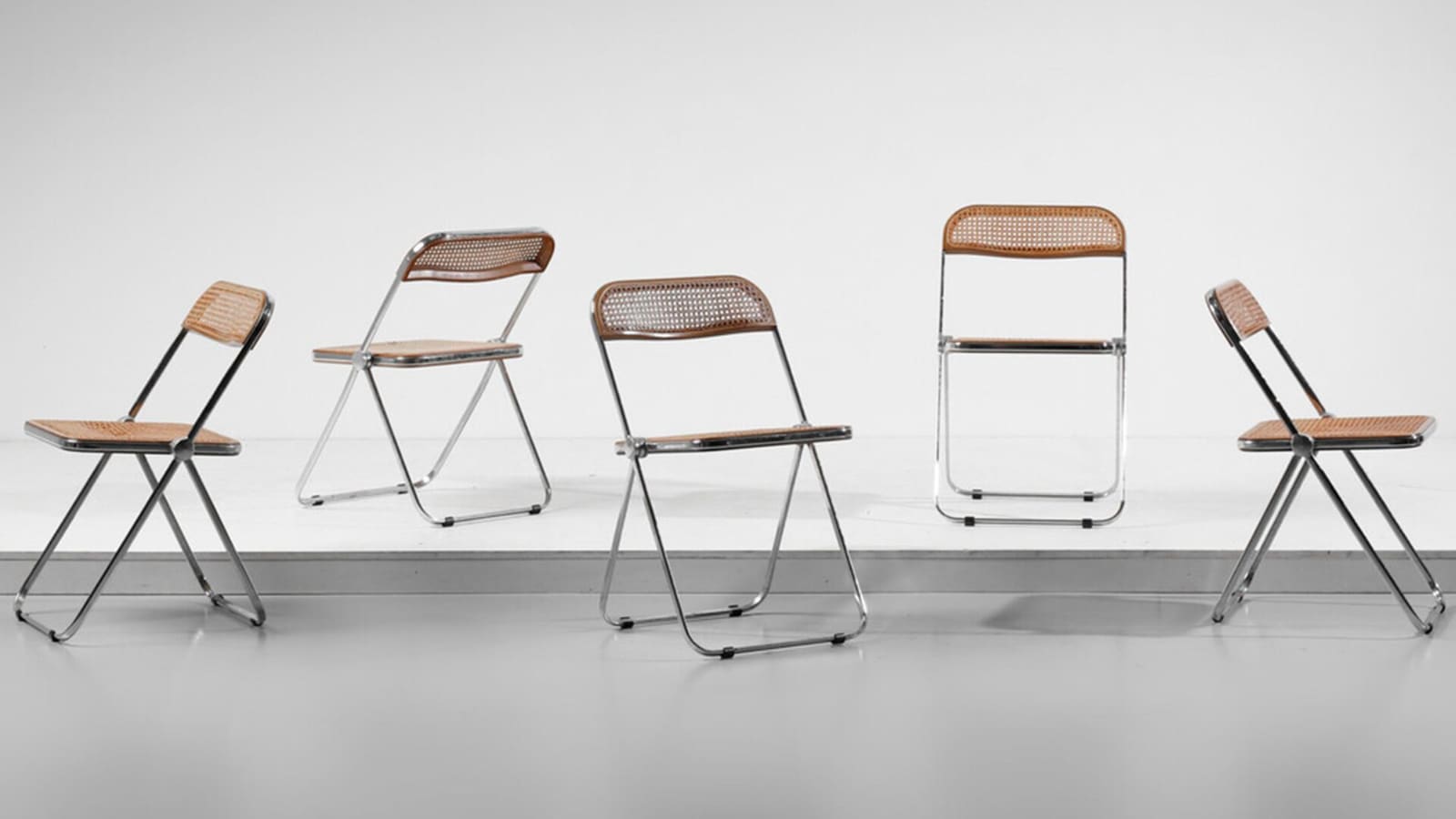
By the mid-twentieth century, designers began treating the folding mechanism not as a feature to be hidden but as the conceptual center of the project. Giancarlo Piretti's Plia, introduced in 1967 through Anonima Castelli, made this explicit. Its transparent polycarbonate seat and visible aluminium hinge turned the act of folding into a visual statement. The mechanism was no longer incidental; it became the design's organizing principle. Plia suggested that transformation itself could be beautiful, that the hinge deserved as much attention as the seat or backrest.
Domestication and the Everyday Fold
While many folding chairs remained associated with institutional or temporary use, some designers explored whether the typology could belong in domestic interiors. Takeshi Nii's Nychair X, developed in the early 1970s, addressed this question directly. Combining a wooden frame with canvas, the chair offered the portability of folding furniture with the comfort expected of a lounge seat. It was designed for living rooms, not auditoriums.
David Chipperfield's Piana, created for Alessi in 2011, pursued a similar goal through different means. Here, the folding action is almost invisible within the chair's geometric simplicity. When open, it functions as everyday seating; when closed, it becomes a compact volume defined by its own structure. Chipperfield's approach emphasizes restraint: the transformation is present but not announced.
Both projects suggest that folding need not signal temporariness. Instead, it can be a quality embedded within objects intended for long-term domestic use, a latent capability that becomes relevant when space or circumstance shifts.
Material Innovation and Structural Play
Contemporary experiments have pushed the folding principle into new formal territory. The Flux Chair, designed by Douwe Jacobs and Tom Schouten in 2009, collapses from a three-dimensional seat into a nearly flat panel. Made from a single flexible material, its transformation is dramatic: the chair almost disappears when folded, then regains volume and structure when opened. This approach treats folding not as a hinge-based operation but as a property intrinsic to the material itself.
Adam Goodrum's Stitch Chair for Cappellini, introduced in 2008, explores a different strategy. Fabricated from a thin aluminium sheet articulated through central hinges, the chair folds almost entirely flat. The name references the seam-like hinges that allow the metal to bend and collapse. Goodrum's design demonstrates how a single material, carefully manipulated, can achieve both structural integrity and extreme compactness.
Leo Salom's Folding Chair for Monstrans takes yet another path, using bamboo plywood to create a lightweight, transportable structure. The choice of material aligns with contemporary concerns around sustainability and resource efficiency. Bamboo's rapid growth cycle and structural properties make it well-suited to furniture that prioritizes minimal environmental impact alongside functional performance.
The Contract Context and Recent Iterations
Folding chairs have never left the contract market, where their stackability and storage efficiency remain essential. Recent projects like THEO, designed by Matteo Thun and Benedetto Fasciana for Plank and presented at Salone del Mobile 2026, demonstrate that the typology continues to evolve within this context. THEO was conceived for both commercial and residential environments, acknowledging that contemporary use often blurs the boundary between public and private space.
The chair's form reflects this dual purpose: clean enough for institutional settings, comfortable enough for extended domestic use. Its folding mechanism is engineered for durability and repeated operation, addressing the practical demands of contract furniture while maintaining visual clarity.
What Folding Means Now
Across the projects we've examined, a pattern emerges. The folding chair persists not because it solves a single problem but because it accommodates many. It addresses space constraints, facilitates storage, enables transport, and responds to changing patterns of use. More fundamentally, it embodies a conception of furniture as something other than fixed.
Most seating is designed around permanence. Chairs, sofas, benches: these objects presume stable locations and enduring relationships to the spaces they occupy. The folding chair offers an alternative. It accepts that environments shift, that needs change, that objects might need to become smaller, lighter, or temporarily absent.
This quality has made the typology relevant across vastly different contexts. Military logistics, ecclesiastical settings, domestic interiors, outdoor leisure, institutional seating: the folding chair adapts. Its form language has ranged from ceremonial to utilitarian, from transparent industrial materials to warm wood and canvas. Yet the underlying logic remains consistent.
Contemporary designers continue to find new expressions within this framework. Some emphasize the mechanism itself, making the hinge or fold line a central visual element. Others integrate transformation so seamlessly that the chair's collapsibility becomes almost invisible until needed. Still others explore how material properties, sustainability, or digital fabrication might redefine what folding means.
A Typology That Refuses Fixity
Perhaps what makes the folding chair enduringly relevant is precisely its refusal to be one thing. It has served as a symbol of authority, a tool of military efficiency, an icon of industrial design, and a subject for formal experimentation. It carries historical weight, from ancient portable thrones to colonial military campaigns, yet remains open to reinterpretation.
The fold is both a practical solution and a conceptual provocation. It asks whether furniture must occupy space constantly or might instead move between presence and absence. It suggests that transformation, rather than stability, could be a design principle worth building around.
In an era increasingly defined by mobility, adaptability, and resource consciousness, the folding chair's centuries-old logic feels newly pertinent. Not because the challenges it addresses are new, but because we are more attuned to the value of objects that can change state without losing coherence. The chair that folds is, ultimately, furniture that has learned to negotiate between what it is and what it might become.
Save this story. A free account keeps your reading list and the 07:00 email in one place.
CREATE FREE ACCOUNT →SIGN IN