
The Strange Comfort of a Roll-Arm Sofa
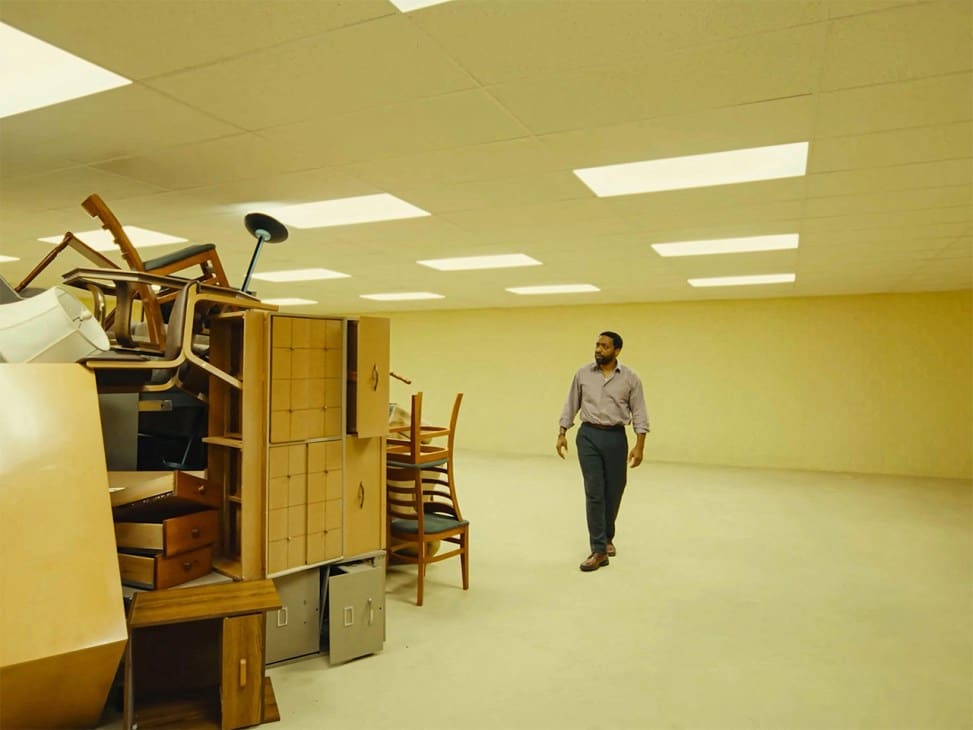
When Kane Parsons's summer release arrived in theatres, it promised something specific: dread drawn from the visual vocabulary of 1990s commercial interiors. The film follows a furniture salesman navigating warehouse-scale corridors, drop ceilings, and seas of beige carpet. These are the liminal zones of corporate America at its most generic, designed to unsettle through their very emptiness. Yet amid the fluorescent-lit monotony, certain pieces of furniture kept appearing: chunky pine tables, slip-covered armchairs, overstuffed sofas against chintz backdrops. And rather than amplifying the film's intended terror, these objects offered something else entirely. They conjured a sense of refuge, as if the furniture itself was pushing back against the architecture's deliberate sterility.
At first glance, this seemed like straightforward nostalgia. But a recent exchange with London-based designer Linda Boronkay suggests the phenomenon runs deeper. In discussing her approach to spatial composition, Boronkay emphasized that furniture and objects, not just the envelope of a room, are her primary instruments. She selects pieces not solely for aesthetic or material merit, but for what she describes as their energy. The designer subscribes to animism, the belief that objects possess a spiritual charge. That charge, she explained, stems from an object's capacity to hold memory or association, to act as a vessel for emotion and experience. When positioned thoughtfully and lit correctly, these pieces can fundamentally alter the character of a space.
The Scale of Loneliness
The 1990s produced a particular architectural condition: big-box retail rewriting the texture of neighbourhoods, single-family homes ballooning into McMansions, suburban sprawl codifying a sense of isolation. The film's set design taps directly into this legacy. What unsettles most is not the individual elements, but the scale. Corridors stretch too wide, rooms yawn too large, ceilings hang too high. These proportions evoke the worst of that decade's spatial logic, where square footage became a metric of success and human scale was sacrificed to the logic of efficiency and display.
In this context, the furniture becomes a counterweight. Ladder-back dining chairs, moulded plastic seating, honey-oak cabinets, even the mismatched showroom arrangements, all carry a different kind of memory. They recall rental properties on family holidays, Christmas gatherings at a relative's house, the tactile familiarity of lived-in spaces. Despite the film's intention to assemble these pieces into something disorienting, they retain their anima. They speak to moments of closeness and warmth, to the intimacy that emerges when objects are chosen with care and used over time.
Objects as Spiritual Vessels
Boronkay's work demonstrates this principle in practice. Her projects, particularly her hospitality designs in New South Wales, are notable for their material richness and layered character. She does not treat furniture as decoration or afterthought. Instead, she curates pieces that carry history, patina, and emotional resonance. A chair is not simply a place to sit; it is a repository of craft, of the hands that made it, of the rooms it has occupied. A table holds the memory of meals shared, conversations had, silences endured. This is animism in a contemporary context, a recognition that the built environment is not inert but alive with accumulated meaning.
The implications for design practice are significant. If objects carry spiritual energy, then curation becomes an act of emotional architecture. The selection of a vintage sideboard over a mass-produced alternative is not merely an aesthetic choice. It is a decision to invite a particular kind of presence into a space, to anchor a room in something beyond its physical dimensions. This approach challenges the primacy often granted to architecture itself, the assumption that walls, floors, and ceilings are the primary determinants of spatial experience. Boronkay's perspective suggests that the objects within those boundaries hold equal, if not greater, power to shape how we feel in a given environment.
Furniture as Counterpoint
The tension in Parsons's film is instructive. The architecture is designed to alienate, to create spaces that feel endless and anonymous. The furniture, by contrast, insists on specificity. A skirted armchair is not a generic form; it is a product of a particular moment in design history, associated with domestic comfort and a certain kind of middle-class aspiration. A pine dining set evokes craft traditions and the warmth of wood grain. Even when these pieces are arranged in ways meant to disorient, they retain their anima. They refuse to be subsumed by the architecture's cold logic.
This dynamic plays out in our own homes and workplaces. Spaces that feel soulless often lack objects with meaningful energy. They are furnished with pieces chosen for convenience or price, items that carry no memory and invite no attachment. By contrast, environments that feel alive are typically populated with objects that have been selected with intention, that carry stories, that have been inherited or discovered or carefully sourced. These pieces do not need to be expensive or rare. They simply need to possess what Boronkay describes as charge, a quality that comes from their history, their materiality, their capacity to hold and reflect human experience.
Curation as Practice
For architects and designers, this understanding shifts the terms of spatial design. It suggests that the most successful interiors are those that balance architectural form with object-level curation. Lighting, proportion, and material palette remain essential, but they must work in concert with the furniture and objects that inhabit a space. A room with perfect proportions and natural light can still feel empty if the objects within it lack anima. Conversely, a modest room can feel rich and inviting if the pieces it contains carry emotional weight.
This is not a call for nostalgia or a rejection of contemporary design. It is an argument for intentionality. Whether sourcing new pieces or vintage finds, the question should not only be whether an object fits a particular aesthetic, but whether it carries the kind of energy that can transform a space. Does it hold memory? Does it invite touch? Does it suggest a narrative beyond its functional role? These are the qualities that give objects their spiritual charge, that allow them to act as counterpoints to architecture, to soften or complicate or enrich the spaces they occupy.
The Lesson of Liminal Spaces
What Parsons's film reveals, perhaps unintentionally, is that furniture can hold its ground against even the most hostile architecture. The liminal spaces of the 1990s, with their oppressive scale and generic finishes, were designed to erase individuality and memory. Yet the objects placed within them, the chunky sofas and ladder-back chairs, retain their capacity to comfort. They carry the anima of domestic life, of human scale, of rooms made for living rather than display or commerce.
This lesson extends beyond cinema. In our own environments, we have the opportunity to choose objects that resist the sterility of contemporary space-making, that anchor our rooms in something more than trend or efficiency. By selecting pieces with care, by seeking out objects that hold memory and energy, we can create interiors that feel genuinely alive. The architecture may define the boundaries, but the objects within those boundaries define the experience. And in that balance, we find the true emotional power of interior design.
Save this story. A free account keeps your reading list and the 07:00 email in one place.
CREATE FREE ACCOUNT →SIGN IN