
The Materiality of Belonging
Walk into a room clad entirely in polished concrete and steel, and you'll feel the temperature drop before your eyes adjust to the light. Now imagine the same volume lined with cork panels, their honeycomb cell structure visible under oblique afternoon sun. The shift is immediate, visceral, a softening that happens as much in the body as in the eye. We've been tracking this phenomenon across residential and hospitality projects for several years now, and the pattern is unmistakable: designers are reaching for materials that carry the memory of landscape, even when that landscape is hundreds of kilometers away.
Cork occupies a curious position in the material taxonomy of contemporary architecture. Harvested from the outer bark of Quercus suber without felling the tree, it regenerates over nine-year cycles, making it one of the few genuinely renewable resources available to the building industry. But its appeal extends far beyond sustainability credentials. Cork introduces a tectonic language that resists the glossy perfection of synthetic finishes, instead offering variation, porosity, and a muted chromatic range that shifts subtly with changing light.
Material Continuity and Spatial Flow
The Three Little Pigs House in Madrid, designed by EME157, demonstrates how cork can dissolve the conventional boundary between facade and interior. Rather than treating the building envelope as a discrete system, the architects extended cork cladding from exterior walls into living spaces, creating a material continuity that reads as both conceptual gesture and experiential reality. This is not simply an aesthetic choice. By maintaining a consistent surface language across thresholds, the project establishes a perceptual field in which interior and exterior become variations on a single spatial idea rather than opposed conditions.
In the kitchen, a sliding cork panel operates as both partition and surface. When closed, it defines a discrete work zone; when retracted, it disappears into the surrounding material field, allowing the kitchen to merge with adjacent living areas. This dual function, structural and atmospheric, exemplifies cork's versatility. The same panel that modulates spatial configuration also contributes to acoustic dampening, thermal regulation, and tactile warmth, a layering of performance that few materials can achieve with such economy.
Acoustic and Thermal Performance
Cork's cellular structure, composed of millions of air-filled chambers sealed by suberin and lignin, gives it exceptional sound-absorption properties. In urban apartments where noise transmission between units remains a persistent design challenge, cork panels can reduce reverberation without the clinical appearance of perforated gypsum or fabric-wrapped fiberglass. The material absorbs mid- to high-frequency sound waves, softening the sharp acoustic signature of hard flooring and glazed surfaces that dominate contemporary interiors.
Thermally, cork provides modest insulation value, approximately R-3.6 per inch, but its real contribution lies in surface temperature. Unlike stone or metal, which can feel cold to the touch even at room temperature, cork remains perceptually neutral, neither drawing heat from the hand nor radiating coolness. This haptic quality makes it particularly suited to surfaces that invite contact: walls in circulation spaces, backsplashes in kitchens, or headboard panels in bedrooms.
Precedent and Innovation
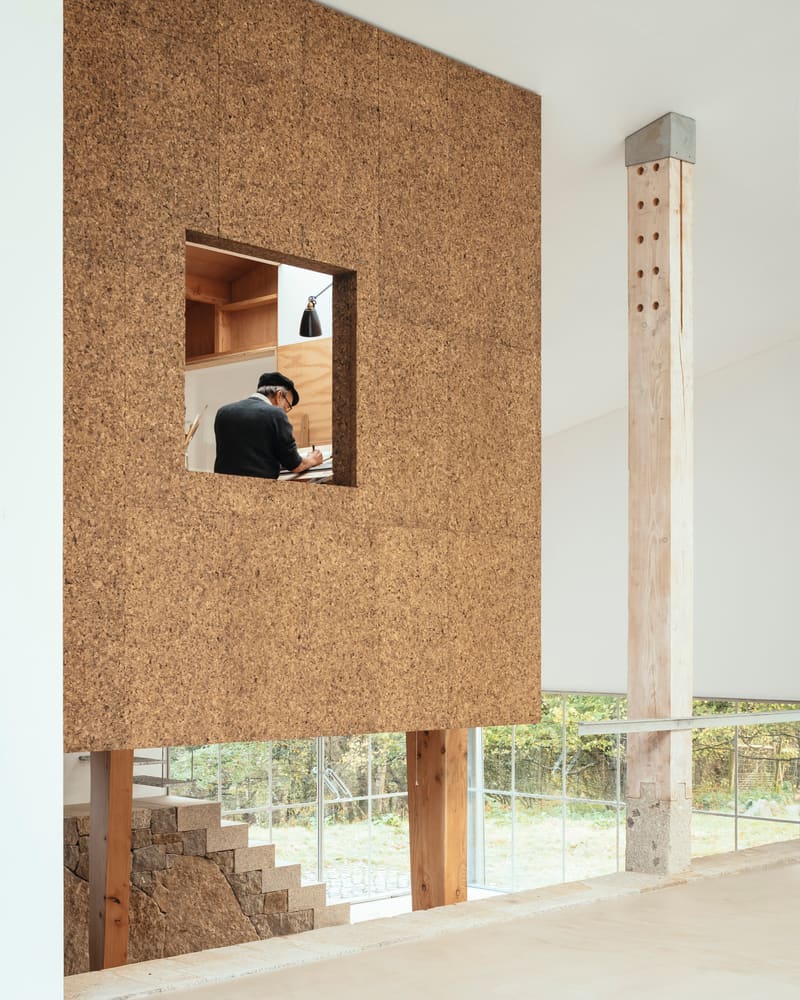
Cork's architectural lineage stretches back further than most designers realize. Frank Lloyd Wright specified cork tile for several Usonian homes in the 1940s, valuing its resilience and warmth underfoot. More recently, studios such as Takk in Barcelona have explored cork as a primary finish material, not merely as flooring but as a continuous surface wrapping walls and ceilings. The Day After House, completed by Takk in 2019, employs large-format cork panels that emphasize the material's grain and natural variation, rejecting the uniformity that industrial processing typically imposes.
This approach aligns with a broader shift in contemporary practice toward what architect Juhani Pallasmaa calls "material authenticity," the idea that materials should reveal rather than conceal their origins and manufacturing processes. Cork, with its visible pores and irregular coloration, resists the kind of digital perfection that renders many interiors indistinguishable from their 3D renderings. It ages, darkens slightly with UV exposure, and develops a patina that records the passage of time and human contact.
Application Strategies
Cork can be applied in several formats, each with distinct spatial implications. Tiles, typically 12 by 12 inches or 12 by 24 inches, create a modular grid that emphasizes rhythm and repetition. Larger panels, up to 4 by 8 feet, minimize joint lines and allow the material's texture to read as continuous surface rather than assembled field. Rolled cork, thinner and more flexible, can wrap curved surfaces or be applied to furniture elements, extending the material vocabulary beyond walls and floors.
Installation methods vary with substrate and application. Adhesive-backed cork can be applied directly to smooth drywall or plywood, while thicker panels may require mechanical fastening with concealed clips or screws. In wet areas, cork must be sealed with polyurethane or wax to prevent moisture absorption, a treatment that slightly alters its appearance and tactility but preserves long-term performance.
Color, Light, and Atmosphere
Cork's natural color range spans from pale honey to deep amber, with regional and processing variations introducing subtle shifts. Unfinished cork absorbs light, creating a matte surface that reduces glare and softens the overall luminosity of a space. This light-absorptive quality can make rooms feel smaller but also more intimate, an effect that works well in residential contexts where coziness is valued over expansiveness.
Artificial lighting interacts with cork in unexpected ways. Grazing light across a cork wall reveals its texture and depth, transforming what might read as flat surface into a topographic field of shadow and highlight. Backlighting, though less common, can silhouette cork's cellular structure when applied in thin sheets, creating a translucent screen that filters light without blocking it entirely.
Challenges and Considerations
Cork is not without limitations. Its relatively soft surface can dent or compress under heavy loads, making it unsuitable for high-traffic commercial applications without protective coatings. It fades gradually when exposed to direct sunlight, a characteristic that can be embraced as patina or mitigated through window treatments and UV-filtering glazing. Cost remains a factor; quality cork products command premium pricing compared to vinyl or laminate alternatives, though lifecycle performance and sustainability benefits often justify the initial investment.
Maintenance is straightforward but non-negotiable. Sealed cork requires periodic reapplication of finish to maintain water resistance. Unsealed cork should be vacuumed or swept regularly to prevent dust accumulation in its porous surface. Spills must be addressed promptly to avoid staining, particularly with wine, coffee, or oil-based substances that can penetrate the material's cellular structure.
Forward Trajectories
As biophilic design continues to shape architectural discourse, materials like cork offer tangible ways to reconnect interior environments with natural systems. This is not about literal imitation, placing potted plants in lobbies or printing leaf patterns on wallpaper, but about reintroducing the material qualities, textures, thermal characteristics, and acoustic behaviors, that define our experience of the non-built world.
Cork's future in interior architecture likely lies in hybrid applications, where it combines with other materials to create composite systems that leverage its strengths while compensating for its weaknesses. Cork-and-bamboo laminates, cork-faced acoustic panels with mineral wool cores, and cork veneers over engineered substrates all point toward a design culture that values material intelligence over material purity.
At World Archi Design, we've observed how the projects that use cork most successfully treat it not as novelty but as one element within a carefully calibrated material palette. When paired with concrete, it provides warmth and softness; alongside glass, it introduces opacity and texture; next to wood, it offers chromatic variation and a finer grain. The material rewards restraint and careful detailing, revealing its full potential only when designers resist the urge to apply it everywhere and instead deploy it where its specific qualities, acoustic, thermal, tactile, can genuinely enhance spatial experience.
Save this story. A free account keeps your reading list and the 07:00 email in one place.
CREATE FREE ACCOUNT →SIGN IN