
A Private Collection Finds Public Form
Most privately funded art institutions begin with a collector's impulse to share. The Kvareli Foundation of Contemporary Art, which sits on a wine estate roughly 130 kilometres northeast of Tbilisi, follows that pattern but adds a geographic twist: its founder, Georgian businessman Jemal Inaishvili, looked to Japan's Seto Inland Sea for inspiration. After visiting Naoshima Island, a privately funded arts destination that has become a pilgrimage site for architecture and contemporary art audiences, Inaishvili decided to create a similar anchor in Georgia's Kakheti province, a region historically synonymous with viticulture rather than visual culture.
The foundation draws on Inaishvili's personal holdings of approximately 1,500 pieces, the majority of which are by Georgian artists. That scale of collection, combined with the ambition to build a destination rather than a city gallery, set the parameters for the architecture: the building needed to function as both container and monument, a structure capable of holding its own against the dramatic topography of wooded slopes and open vineyards that define the estate.
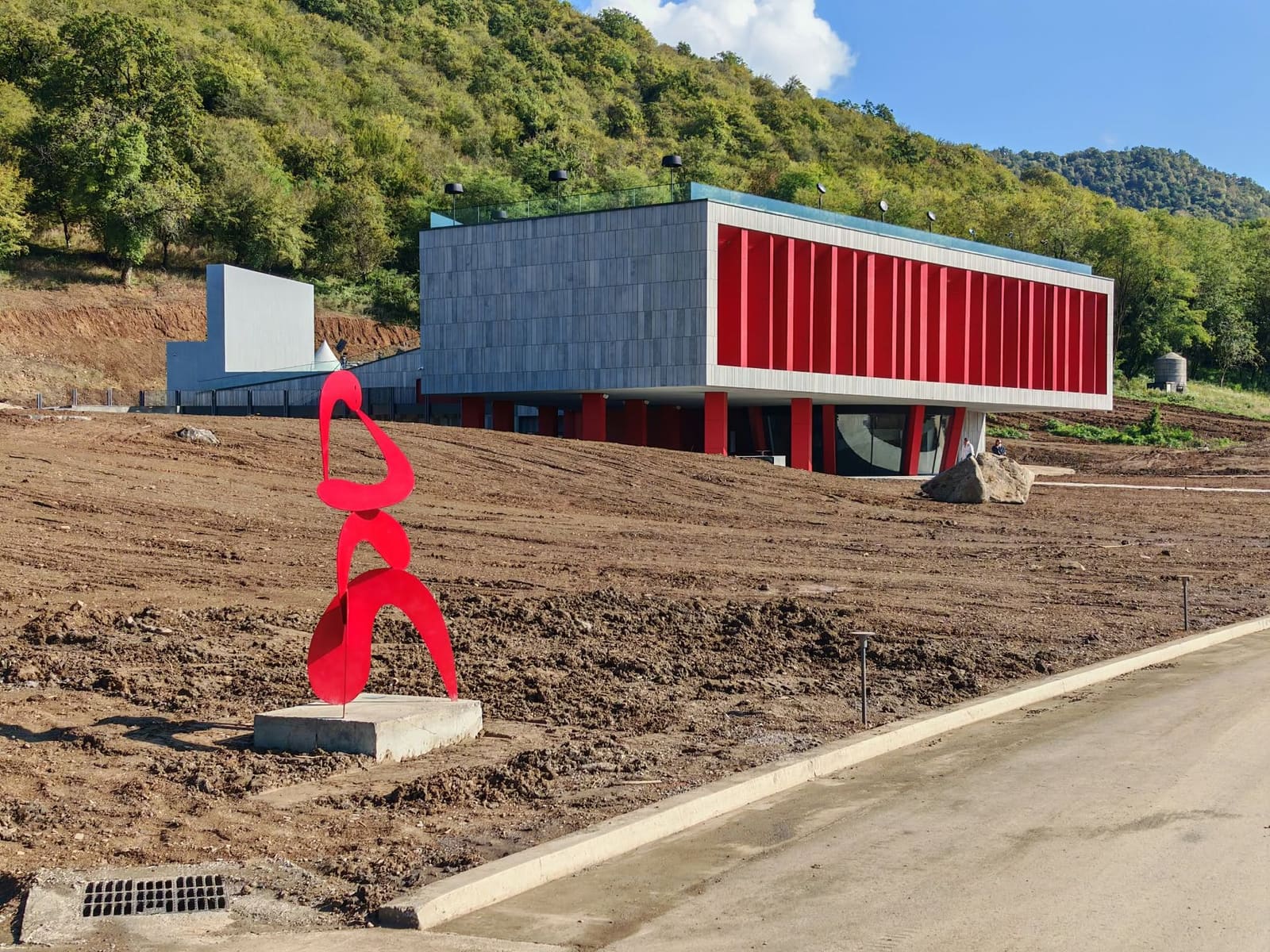
Tbilisi-based practice Midamo, led by Giorgi Chkonia and Dato Danelia, developed the initial design concept. The scheme was subsequently refined by the foundation's in-house designer and architect, Irakli Sharpilo. The result is an elongated concrete volume that spans more than 23,680 square feet, organised across three floors and crowned by a rooftop terrace. The building's most distinctive feature is its skin: a dense repetition of vertical fins clad in red tile, framed within grey textured panels. The effect is industrial yet rhythmic, a tectonic expression that acknowledges the rugged materiality of the surrounding landscape without attempting to mimic it.
Mediating Between Mountain and Vineyard
Chkonia describes the building as a bridge between two contrasting conditions: the vertical thrust of the mountains to one side and the horizontal expanse of vineyards to the other. That metaphor is not merely conceptual. The gallery mass is elevated, creating a deep recess beneath that serves as the entrance sequence. Visitors approach through a paved surface woven from basalt tiles, then move into a wood-decked garden courtyard adjacent to a pond scattered with rocks. The transition from open landscape to enclosed space is choreographed to delay the encounter with art, allowing the site itself to establish a rhythm before the galleries are revealed.
The entrance sequence culminates in a curved staircase that rises into the main exhibition spaces. Chkonia emphasises the importance of that vertical shift, describing it as the "emotional heart of the interior". The sudden change in spatial scale and light quality is intended to generate a sense of surprise, a moment of reorientation that separates the experience of arrival from the act of viewing. This approach to circulation recalls the spatial compression and release strategies employed in certain Japanese museum designs, where the path through a building is treated as a narrative device rather than a functional necessity.
Inside, the foundation employs a range of ceiling treatments to delineate different zones. The ground floor offers a classic white-cube environment, a neutral backdrop for works that require minimal architectural interference. As visitors move upward, the architecture becomes more assertive. Exposed structural elements dominate the upper levels, and the ceiling is treated as an industrial fifth wall, with fixtures, ducts and cables left visible. This shift in material language suggests a deliberate move away from the pristine, hermetic gallery model toward a more raw, process-oriented aesthetic that foregrounds the building's construction.
A Multifunctional Platform in a Wine Region
The foundation is positioned as the cultural anchor of a larger complex that includes a winery and a 94-room boutique hotel, scheduled to open by the end of 2026. That integration of hospitality, agriculture and art is not incidental. Inaishvili's stated goal is to diversify the reasons people visit Kakheti, a region that has long attracted domestic and international tourists for its wine production and culinary traditions. The addition of a contemporary art institution introduces a new variable into that equation, one that could shift the region's cultural profile if the programming sustains interest beyond the novelty of opening.
The foundation's creative director, Nino Sulkhanishvili, has outlined an ambitious public programme that includes exhibitions, talks, performances, film screenings and music events. The inaugural exhibition, titled "Georgian Contemporary Art: Origins and Continuities", traces the evolution of the genre from the 1960s to the present. The show examines the gradual divergence from Soviet ideological narratives and the subsequent exploration of Georgian identity, moving from collectivist themes toward individual expression and self-creation. That historical arc provides a framework for understanding the collection and establishes a narrative that future exhibitions can build upon or challenge.
Sulkhanishvili has emphasised the foundation's role in supporting contemporary artistic practice in Georgia, where she argues adequate representation is currently lacking. Through research, exhibitions and public programmes, the institution aims to provide artists with a space to develop their work, thereby strengthening regional production. The foundation also positions itself as a platform for education, critical discourse and international exchange, functions that extend beyond the display of objects to encompass the infrastructure necessary for a sustained artistic community.
Accessibility and the Museum Habit
One of Sulkhanishvili's stated priorities is to cultivate a broader museum-going culture in Georgia. She has noted that museum attendance in the country tends to be limited to art professionals and a narrow segment of the public. The foundation's location outside Tbilisi complicates that challenge: while the estate offers a compelling destination experience, it also requires a deliberate journey, one that may appeal to tourists but could prove less accessible to local audiences without targeted programming and outreach.
The amphitheatre, which features wide, shallow steps ascending to the rooftop, suggests an intention to accommodate large gatherings and outdoor events. That flexibility is essential if the foundation is to function as more than a static exhibition venue. The ability to host performances, screenings and public talks in an outdoor setting expands the institution's potential audience and creates opportunities for programming that does not depend solely on the visual arts.
Sulkhanishvili's emphasis on education and accessibility reflects a recognition that the success of the foundation will be measured not only by the quality of its exhibitions but by its ability to engage audiences who might not otherwise visit a contemporary art institution. That mission is particularly relevant in a regional context, where cultural infrastructure is often concentrated in capital cities, leaving provincial areas underserved.
Precedent and Ambition
The Naoshima model that inspired Inaishvili is both a useful reference point and a cautionary tale. Naoshima's success is the result of decades of sustained investment, careful curation and a network of internationally recognised architects and artists. The island's transformation into an arts destination did not happen overnight, and its impact on the local economy and community has been the subject of ongoing debate. The Kvareli Foundation faces a different set of conditions: Georgia's contemporary art scene is smaller and less internationally visible than Japan's, and the region's tourism infrastructure, while growing, is not yet at the scale that would guarantee consistent visitor numbers.
The foundation's architectural ambition is evident in its material choices and spatial organisation. The use of red-tiled fins as a dominant facade element is a bold gesture, one that risks reading as overly repetitive if not balanced by the building's interior complexity. The decision to expose structural elements on the upper floors introduces a degree of roughness that contrasts with the polished exterior, suggesting a willingness to embrace multiple architectural languages within a single project.
Whether the foundation can sustain its programming and attract the diverse audiences Sulkhanishvili envisions remains an open question. The integration of art, wine and hospitality offers a compelling proposition, but the long-term viability of the institution will depend on its ability to build relationships with artists, curators and audiences both within Georgia and internationally. The inaugural exhibition provides a strong foundation, but the challenge will be to maintain momentum and avoid the pitfalls of becoming a destination that is visited once and then forgotten.
A Monument That Must Earn Its Place
Inaishvili's insistence that the building function as a "contemporary art monument" sets a high bar. Monuments, by definition, are meant to endure, to mark a moment or a movement with sufficient clarity that they remain legible over time. The Kvareli Foundation's architecture achieves a degree of formal distinctiveness, but its status as a monument will ultimately be determined by the work it supports and the conversations it generates. A building can command attention through scale and material, but it becomes a monument only when it accumulates meaning through use.
The foundation's location in Kakheti, a region with deep historical ties to Georgian culture and agriculture, adds a layer of significance to the project. By situating a contemporary art institution in a landscape defined by tradition, the foundation creates a productive tension between past and present, between the established identity of the region and the new cultural possibilities the building represents. That tension is architectural as much as programmatic, visible in the contrast between the industrial concrete volume and the organic forms of the surrounding vineyards and forests.
The rooftop terrace, accessible via the amphitheatre steps, offers panoramic views of the estate and the mountains beyond. That gesture toward the landscape is a reminder that the foundation, for all its architectural assertiveness, is ultimately embedded in a specific place. The success of the project will depend on its ability to honour that context while creating a space for contemporary practice that does not feel constrained by it. The foundation has opened with a clear vision and substantial resources. The next phase will reveal whether that vision can be sustained and whether the institution can become the cultural anchor Inaishvili and Sulkhanishvili have envisioned.
Save this story. A free account keeps your reading list and the 07:00 email in one place.
CREATE FREE ACCOUNT →SIGN IN