
A Building That Listens
There is something almost circular about designing a structure to house music. Architecture freezes moments in space; songs capture them in time. The challenge becomes how to translate ephemeral sound into durable form, how to make concrete and steel speak to rhythm and verse. At Monmouth University in West Long Branch, New Jersey, COOKFOX Architects faced exactly this paradox when creating The Bruce Springsteen Center for American Music, a facility that opened its doors this year to preserve not just one musician's legacy, but the broader narrative of American sound.
Rick Cook, the project's lead architect, admits he wasn't initially drawn to the subject matter. But as the design process unfolded, he began to recognize parallels between his discipline and the songwriter's craft. Both deal in narrative structure. Both rely on pacing, tension, and release. The difference is mostly temporal: one builds stories you walk through, the other builds stories you hear.
The result is a 30,000-square-foot building that reads less like a shrine and more like a conversation between material culture and musical heritage, a place where the grit of the Jersey Shore meets the precision of contemporary museum design.
Massing and Materiality as Regional Grammar
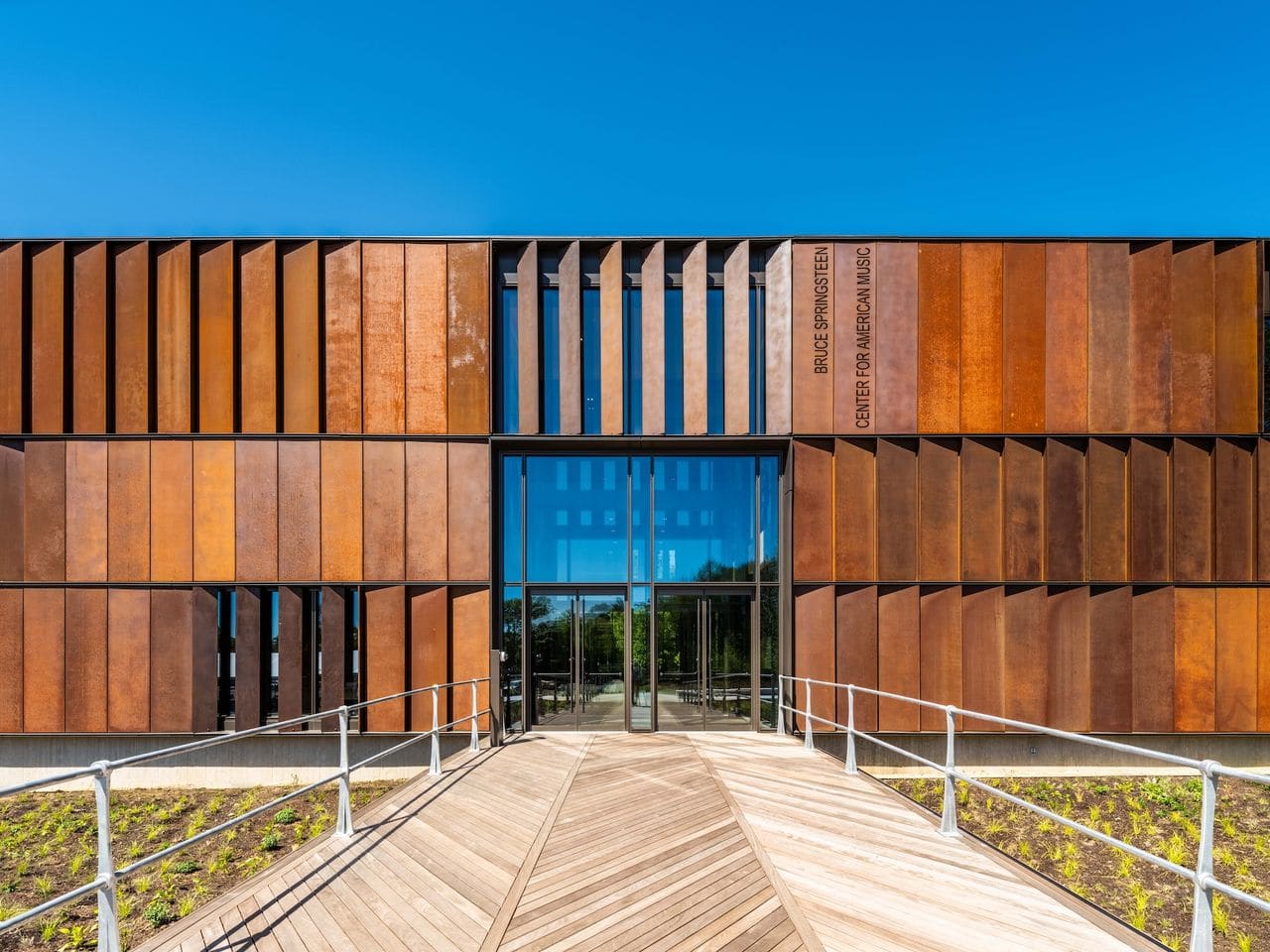
The building sits at the eastern edge of the Monmouth campus, roughly a mile from the modest house where Springsteen composed "Born to Run." Its form is intentionally straightforward: a two-story rectilinear volume clad in weathering steel, the kind that ages and oxidizes over time. The choice is deliberate. Weathering steel, often called Corten, carries associations with industrial infrastructure, factories, rail yards, and the working-class landscapes that populate so many Springsteen lyrics.
LaGuardia Design Group handled the landscape architecture, planning a meadow of native grasses and wildflowers that will eventually grow tall enough to obscure the building's lower portions. The effect, once mature, will be one of emergence: the structure hovering above a swaying field, much like the way a melody rises out of silence.
But the most pointed gesture is the entrance itself. A long, inclined ramp constructed from heavy timber planks leads visitors to the front doors. It's an unmistakable reference to the Asbury Park boardwalk, the beachfront promenade where Springsteen cut his teeth performing in clubs like The Stone Pony. Cook describes the ramp as the project's conceptual starting point: if you're going to honor a musician whose identity is inseparable from the Jersey Shore, you begin with the boardwalk.
Other details carry similar weight. A copper beech tree planted near the entrance mirrors one that stood at Springsteen's childhood home in Freehold. Inside, flooring in the auditorium uses end-cut wood, a nod to traditional factory floors. The seats are upholstered in denim-like fabric. These choices avoid pastiche by remaining grounded in tectonic logic; they're not decorative appliqués but material decisions that echo the building's larger themes.
Program as Curatorial Argument
The center divides its program into two distinct zones. The northern half houses a 150-seat auditorium with a fully glazed front facade, offering views out to the campus while allowing passersby to glimpse performances inside. The southern half contains galleries and archival storage across two levels. A double-height atrium, framed in heavy timber, anchors the entry sequence.
The auditorium is designed for flexibility: film screenings, lectures, live performances. Its transparent facade is unusual for a performance space, where acoustic isolation and light control typically dictate solid walls. But the decision reflects a broader institutional ethos. This is not a hermetically sealed archive. It's a public-facing cultural venue meant to engage the surrounding community, even when events aren't taking place.
Adjacent to the lobby, the gift shop incorporates display cases fabricated from stage flooring salvaged from "Springsteen on Broadway," the artist's long-running theatrical residency. It's a small but effective example of adaptive reuse, transforming performance infrastructure into retail furniture.
Curating the Canon
The center grew out of the Bruce Springsteen Archives, a grassroots collection begun by fans and later acquired by Monmouth University in 2011. Bob Santelli, the center's executive director and a veteran music curator who has worked with the Rock and Roll Hall of Fame and the Grammy Museum, oversaw the transformation of a 15,000-piece assortment stored in a campus house (some items literally kept in a bathtub) into a professionally managed repository of more than 30,000 objects.
But Santelli and the university faced a conceptual hurdle. Springsteen himself was reluctant to endorse a museum focused solely on his career. The solution was to broaden the scope. The galleries now trace the evolution of American popular music across genres and generations, using Springsteen's work as a lens rather than the exclusive subject.
On the ground floor, rotating exhibitions explore thematic threads. The inaugural show, "Chimes of Freedom: Protest, Patriotism and the Power of Song," examines music's role in social movements. Items on display include handwritten lyrics to Woody Guthrie's "This Land Is Your Land" and Springsteen's "Streets of Minneapolis," alongside artifacts from other artists who used their platforms for advocacy.
The broader collection includes Frank Sinatra's shoes, a guitar played by Prince, and a Lady Gaga costume. These objects anchor the museum's argument that American music is a continuous, cross-pollinating tradition, not a series of isolated stars.
The Springsteen Floor
The second level is where the pilgrimage intensifies. Here, the focus narrows to Springsteen and the E Street Band. The galleries include reconstructed domestic interiors, a listening room designed to simulate the experience of attending a live concert, and vitrines displaying the iconic denim jeans and white T-shirt from the "Born in the U.S.A." album cover.
Among the most affecting objects is Springsteen's first song, written in 1967 when he was still a teenager, and a scrapbook of press clippings maintained by his mother. These items humanize the mythology, offering glimpses of the artist before the stadium tours and Grammy hauls.
A dedicated research center occupies part of this floor, providing scholars and enthusiasts access to archival materials by appointment. The space includes climate-controlled storage, study carrels, and listening stations. It's a recognition that the center's mission extends beyond exhibition into scholarship and preservation.
Precedents and Departures
Museums dedicated to individual musicians are not new. Graceland has been a pilgrimage site since 1982. The Bob Dylan Center opened in Tulsa in 2022, designed by Olson Kundig. The National Blues Museum in St. Louis and the Country Music Hall of Fame in Nashville both attempt to narrate genre histories through artifact and interpretation.
What distinguishes the Springsteen Center is its dual mandate: to celebrate a single artist while situating that artist within a larger cultural continuum. The curatorial strategy recalls the approach taken by the Woody Guthrie Center, also in Tulsa, which uses Guthrie's life and work as an entry point into discussions of folk traditions, labor movements, and American identity.
Architecturally, the building resists the bombast that often accompanies celebrity-focused institutions. There are no swooping cantilevers or mirrored facades. The heavy timber and weathering steel speak to vernacular building traditions rather than formal pyrotechnics. It's a restrained approach that aligns with Springsteen's own aesthetic: plainspoken, rooted in place, suspicious of unnecessary flourish.
Resonance Beyond the Fan Base
Santelli anticipates that the center will attract a range of visitors: hardcore fans making a pilgrimage, music scholars conducting research, and tourists wandering in on a rainy beach day. The hope is that even those unfamiliar with Springsteen's catalog will leave with a deeper appreciation for how American music functions as both art and social document.
This ambition hinges on the building's ability to welcome without overwhelming. The transparency of the auditorium facade, the openness of the ground-floor circulation, and the clarity of the wayfinding all work to make the center feel accessible rather than insular. It's a museum that wants to be discovered, not just visited.
Cook, the architect, describes his own conversion. He entered the project as a skeptic and emerged as a believer, not necessarily in the music itself but in the narrative power it represents. Architecture, he notes, deals in physical permanence. Music exists in the moment. The challenge was to create a vessel that honors that difference without trying to resolve it.
What Stays and What Fades
At night, the building glows from within, its timber structure visible through large expanses of glass. It's an image that captures the center's central tension: the desire to preserve something inherently fleeting. Recordings, instruments, handwritten lyrics can all be archived. But the experience of hearing a song for the first time, or the collective energy of a live performance, resists preservation.
The Springsteen Center doesn't pretend to solve this problem. Instead, it offers a place where memory and material culture intersect, where the ephemeral is given weight and context. Whether it succeeds will depend not just on the quality of its collections or the skill of its architects, but on its ability to remain a living institution, one that continues to engage with the evolving story it set out to tell.
New Jersey has always been a state defined by transit: the corridor between New York and Philadelphia, the highway between somewhere and somewhere else. Springsteen's music often captures that in-between quality, the restlessness of people on the move. Perhaps it's fitting, then, that his museum sits not in a major city but on a quiet university campus, a place where visitors have to make a deliberate choice to go. It's a pilgrimage, not a stopover. And that, more than any single design decision, may be the building's most important statement.
Save this story. A free account keeps your reading list and the 07:00 email in one place.
CREATE FREE ACCOUNT →SIGN IN