
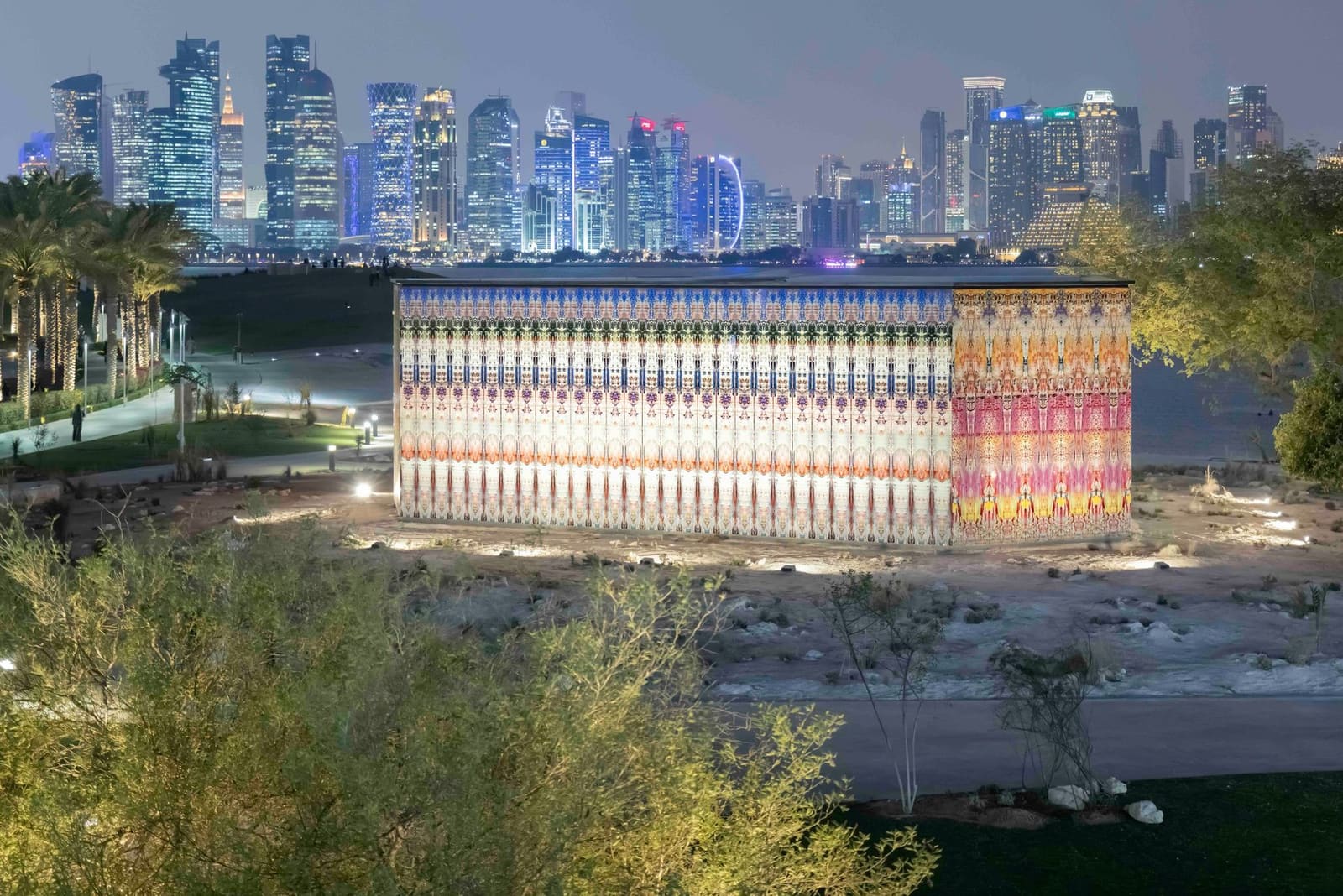
From Canvas to Facade: A Generative Process
What happens when an artist applies algorithmic subdivision to a single painting? In Gerhard Richter's case, the answer is a hexagonal pavilion whose exterior walls encode 8,192 individual strips of colour, each derived from a 1990s abstract work through relentless digital bisection. Unveiled by Qatar Museums on 20 November 2026, the pavilion now stands in MIA Park, adjacent to Doha's Museum of Islamic Art, and represents Richter's most complete synthesis of painting, sculpture, and architectural form.
The genesis lies in a 2010 experiment. Richter isolated a digital photograph of Abstract Painting (724-4), a work from his 1990s output, and began cutting. Two vertical strips became four, then eight, then sixteen. He continued the process through thirteen iterations until the original composition had fragmented into thousands of linear units. The resulting sequence, which Richter calls Patterns, became the template for the pavilion's six exterior walls. Each strip is mirrored and repeated horizontally, producing a rhythmic façade that oscillates between chromatic intensity and optical disorientation.
The choice of hexagonal geometry is deliberate. Richter has long approached painting as a problem of structure and system; the six-sided plan reinforces the pavilion's status as a spatial proposition rather than a decorated shelter. It also establishes a dialogue with Islamic geometric tradition, a visual language deeply embedded in Doha's architectural and cultural landscape. Yet Richter's pattern is not ornamental in the classical sense. It is the residue of a mechanical process, one that privileges repetition and seriality over symbolic meaning.
Interior: Mirrors, Strips, and an Endless Loop
Step inside and the environment shifts from façade to enfilade. Three large-scale Strip paintings from 2024 hang on the interior walls, direct descendants of the series Richter initiated in 2011. These works employ the same subdivision logic as the exterior Patterns but retain the material presence of paint on canvas. Positioned opposite them are two floor-to-ceiling mirrors, which multiply the paintings and their viewers into an infinite regress. The effect is vertiginous: the pavilion becomes a chamber of recursive images, where the boundary between object and reflection dissolves.
At the centre stands Strip-Tower (2026), a freestanding sculpture Richter designed exclusively for this space. The tower extends the vertical logic of the Strip paintings into three dimensions, creating a totemic presence that anchors the otherwise dematerialised interior. Outside, adjacent to the pavilion, sits Brunnen (Well), a stone sculpture that offers a material counterpoint to the pavilion's digital origins.
The collaboration with Selldorf Architects, the New York firm responsible for realising the structure, was integral. Annabelle Selldorf described the project as a process of making manifest work that had existed primarily in Richter's conceptual framework. The architectural challenge was not merely to house the art but to extend its generative logic into built form. The pavilion's proportions, its hexagonal plan, and the precise calibration of its mirrored interior all reflect a design ethos that privileges spatial experience over conventional display.
Context: Islamic Geometry Meets Algorithmic Abstraction
Richter's 2013 visit to Doha occurred midway through his development of the Strip paintings. He has stated that the city's architecture and history catalysed the idea for a pavilion that could unify the thematic threads of that body of work. The pavilion's Patterns, with their horizontal repetition and mathematical rigour, evoke the interlace and tessellation central to Islamic art. Yet the resemblance is structural rather than stylistic. Where traditional Islamic pattern derives from cosmological and theological principles, Richter's system is post-painterly: it begins with a specific canvas and subjects it to a neutral, iterative operation.
This convergence of Western abstraction and Islamic visual tradition is not without precedent. Artists from Matisse to Ellsworth Kelly have engaged with Islamic pattern, often extracting its formal vocabulary while discarding its symbolic content. Richter's approach is more procedural. He does not borrow motifs; he generates a parallel system that happens to resonate with the region's visual heritage. The result is a pavilion that feels both site-specific and conceptually autonomous.
The location in MIA Park reinforces this duality. The Museum of Islamic Art, designed by I. M. Pei and completed in 2008, is itself a study in geometric abstraction and monumental form. Richter's pavilion, smaller in scale but no less rigorous, functions as a kind of annex or counterpoint. Where Pei's museum employs mass and volume to evoke permanence, Richter's structure dissolves solidity into pattern and reflection.
A Decade in the Making
The pavilion opens as part of Qatar Creates Fall/Winter 2026-27 and coincides with the inaugural Rubaiya Qatar 2026, an international visual arts quadrennial running through 30 April 2027. Its completion marks the culmination of more than a decade of development, from Richter's initial visit to Doha to the final installation of the Strip-Tower. For an artist now in his mid-nineties, the pavilion represents a rare opportunity to realise a gesamtkunstwerk, a total work that integrates painting, sculpture, architecture, and site.
Yet the pavilion is also a statement about the limits of authorship. Richter's process, which begins with a painting and ends with a building, relies on collaboration, digital tools, and architectural expertise. The artist's hand is present in the conceptual framework, but the pavilion's materialisation required a network of fabricators, engineers, and designers. This distributed model of production is central to Richter's late practice, which increasingly treats the artwork as a system to be executed rather than a singular object to be made.
The pavilion's mirrored interior ensures that no two visits will be identical. As light shifts throughout the day and as visitors move through the space, the interplay of Strips, mirrors, and observers produces an environment that is perpetually in flux. Richter has described the Strips as "endlessly fascinating," a phrase that applies equally to the pavilion itself. It is a structure designed not for contemplation from a fixed vantage point but for immersion, for the experience of being inside a pattern that has no beginning and no end.
Save this story. A free account keeps your reading list and the 07:00 email in one place.
CREATE FREE ACCOUNT →SIGN IN