
The Radius as Constraint
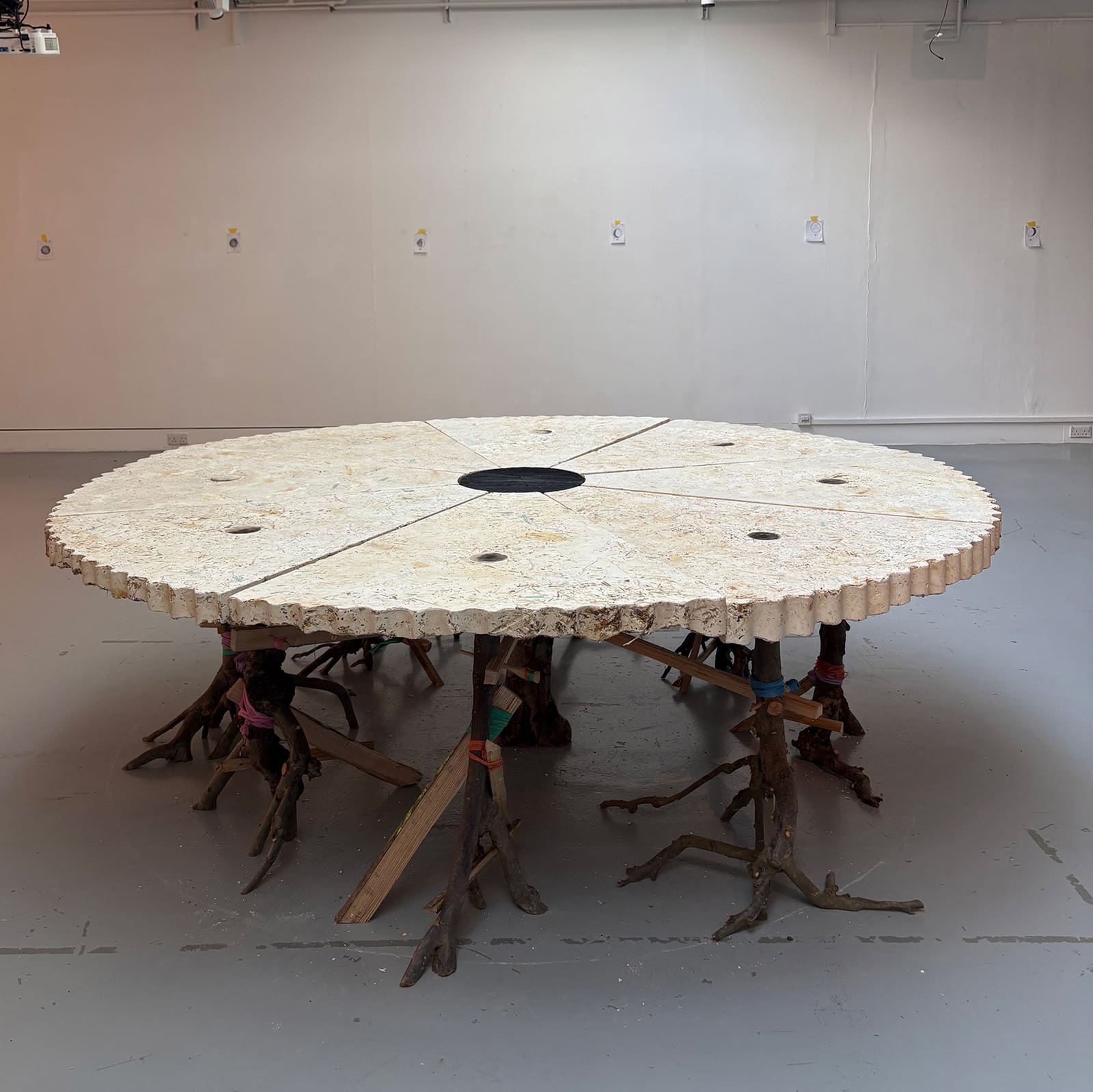
What happens when you draw a circle on a map and decide that everything inside it becomes your palette? For Charles Holland, Catharine Rossi, and the design studio Local Works, that circle measured 40 miles across, centered on Canterbury, UK. The result is Harvest Moon, a table that transforms regional materiality into a research proposition about locality, ritual, and the visible life of objects.
At World Archi Design, we have long observed how constraints drive invention. The hyper-local mandate here is not nostalgic pastoralism but a deliberate interrogation of supply chains, fabrication techniques, and the cultural rituals embedded in making. Every component, including the mallets and hammers used to assemble the piece, originates within that geographic boundary. Apple tree wood for tools, chestnut for pegs, chalk for the tabletop, bark peelings, baling twine, and pallet straps scavenged from agricultural operations. The design asks whether a radius can function as both a formal and ethical framework.
Casting Chalk Like Concrete
The tabletop reads as terrazzo, but its matrix is cast chalk rather than cement. Local Works developed the technique iteratively, refining the shell casting process to the point where confidence in the material allowed progressively thinner sections. Embedded within the chalk are apple-wood "rebars," bark chips, wood shavings, and lengths of baling twine, all bound into a composite that performs structurally while narrating its own assembly.
Holland describes the top as a shell rather than a monolith, framed in chestnut timber and reinforced with reclaimed apple branches. The method recalls both vernacular lime-ash floors and contemporary experiments in bio-composites, situating the table at the intersection of tectonic tradition and material improvisation. The casting process was the project's most significant technical challenge, requiring Local Works to balance weight, thickness, and structural integrity without industrial admixtures or standardized aggregates.
Visible Joinery, Chromatic Assembly
The table's aesthetic is deliberately forensic. Bindings, props, supports, and "rebars" remain exposed, their ad-hoc nature foregrounded rather than concealed. Brightly colored straps and twine serve dual roles: they key the assembly sequence, a chromatic instruction set for builders, and they provide visual counterpoint to the earthy palette of chalk, bark, and timber.
This approach aligns with a lineage of expressive joinery, from the Pompidou Centre's color-coded services to the open-source furniture systems of Enzo Mari. But where those precedents often privilege industrial materials and replicability, Harvest Moon embraces variability. Each reassembly becomes a performance, a barn-raising in miniature, with the chromatic bindings functioning as both score and ornament.
Disassembly as Distribution
Harvest Moon was conceived as a research artifact, not a static object. It is designed to be disassembled, transported, and reassembled at different sites, with each iteration functioning as a social event. The accompanying publication includes assembly drawings, hosting guidelines, and a musical score to accompany the process. The ritual evolves with each gathering, the music adapts, and the table becomes a vehicle for collective engagement rather than a finished product to be admired.
This positions the work within a broader discourse on participatory design and demountable architecture. We have seen similar strategies in pavilions by Rural Urban Framework and the mobile structures of Shigeru Ban, where assembly is conceived as pedagogy. Here, the table's modularity and the transparency of its construction logic invite non-specialist builders into the process, collapsing the distance between designer and user.
Biomaterials and the Economics of Landscape
Beyond its formal and social dimensions, Harvest Moon functions as a lens onto the economic and ecological forces shaping the Canterbury landscape. Holland notes that the project surfaced insights into how policy, consumer preference, climate pressures, and market dynamics determine what is grown, harvested, and discarded within that 40-mile radius. Coppicing practices, apple orchard management, agricultural waste streams, all of these systems became legible through the act of sourcing.
This is where the project transcends craft romanticism. The table is not a retreat into preindustrial making but an audit of contemporary rural production. The use of baling twine and pallet straps, materials typically treated as disposable byproducts, reframes agricultural waste as design feedstock. The chalk, a ubiquitous geological feature of the region, is mobilized as a structural material rather than a景观 element. The result is a kind of territorial inventory, a material census rendered in three dimensions.
Precedents and Departures
Harvest Moon invites comparison with other regionalist experiments. The rammed-earth walls of Rick Joy, the reed-and-mud constructions of Anna Heringer, the bamboo tectonics of Vo Trong Nghia, all operate within similar constraints of locality and low-impact fabrication. But where those projects often engage vernacular building types at architectural scale, Harvest Moon compresses the inquiry into a single piece of furniture, using the table as a microcosm of larger territorial and material questions.
The project also resonates with the "new materialism" in design research, where scholars like Rossi have tracked how materials carry cultural, economic, and political histories. The table becomes a didactic object, its construction a form of knowledge production about place, process, and the hidden labor embedded in everyday objects.
The Harvest as Method
The table's name is not incidental. Harvest implies both gathering and seasonality, a cyclical relationship to landscape and resource. By linking the act of making to the ritual of harvest, the project suggests that design might operate according to agrarian rather than industrial temporalities. Materials are not ordered from suppliers but gathered, foraged, and salvaged. Assembly is not a factory operation but a communal event, marked by music and shared labor.
This framing challenges the dominant paradigms of design production, which privilege speed, standardization, and dematerialized supply chains. Harvest Moon proposes an alternative: slower, place-bound, and socially embedded. Whether such a model can scale beyond the research context remains an open question, but the table demonstrates that the conversation itself, about what locality might mean in design, is worth having.
Forward Implications
As the table travels and reassembles, it will accumulate a history of sites, participants, and iterations. Each gathering will test the robustness of the assembly logic, the adaptability of the materials, and the appeal of the ritual. The publication ensures that the knowledge generated is not proprietary but shared, a commons of technique and process.
For practices interested in circular economies, bio-based materials, and participatory fabrication, Harvest Moon offers a condensed case study. It suggests that hyper-local sourcing is not merely an ethical stance but a design generator, producing forms and processes that would be impossible under conventional supply models. The question it leaves us with is not whether such work is viable at scale, but whether scale is the right metric at all.
Save this story. A free account keeps your reading list and the 07:00 email in one place.
CREATE FREE ACCOUNT →SIGN IN