
A Viennese Education in Beauty
Before Hedy Lamarr became synonymous with Hollywood glamour or laid the groundwork for modern wireless communication, she learned to read space. Growing up in a nine-room apartment on Vienna's Peter-Jordan-Strasse, the young Hedwig Eva Maria Kiesler absorbed lessons in texture and composition from her mother, a former concert pianist who traded performance for family life. Soft fabrics, delicate lace, lush velvet, and rooms filled with flowers became the vocabulary of comfort that Lamarr would deploy throughout her adult life.
This early education in domestic aesthetics was not superficial. It represented a philosophy: that the environments we inhabit shape our capacity for creativity and contentment. Lamarr's mother surrounded her daughter with music, taking her to concerts and operas rather than theater, cultivating an appreciation for structure and harmony that would later inform both her acting and her inventive work. The home, in this framework, was not merely backdrop but a site of cultivation.
Benedict Canyon and the Hilltop Bungalow
When Lamarr arrived in California under contract with Metro-Goldwyn-Mayer in 1937, the studio briefly housed her at the Chateau Marmont before securing a six-room hilltop bungalow at 1807 Benedict Canyon. The monthly rent of one hundred dollars came directly from her paycheck, but the property offered something money alone could not purchase: privacy and the freedom to build a domestic world on her own terms.
The bungalow's garden became an extension of her Viennese upbringing. She filled it with potted petunias, kept rabbits and chickens in the lush grounds, and scattered Snow White and the Seven Dwarfs figurines among the greenery. The choice of whimsical ornament alongside barnyard animals suggests a deliberate rejection of Hollywood's polished veneer in favor of something more playful and grounded. Here was a young actress, newly arrived in a foreign industry, asserting her right to an interior life that did not conform to studio expectations.
Hedgerow Farm and the Art of Display
By the time Lamarr purchased the property at 2727 Benedict Canyon Drive, later known as Hedgerow Farm, she had divorced her first husband and was preparing to marry screenwriter Gene Markey. The nine-room farmhouse, perched on a sloping mountainside, featured a swimming pool and a fireplace with an antique mantel attributed to the Dutch woodcarver Grinling Gibbons, whose baroque detailing and naturalistic motifs had made him a favorite of English aristocracy in the seventeenth century.
Lamarr's choice of a Gibbons mantel is revealing. His work, characterized by cascading fruit, flowers, and foliage carved in limewood, represented a marriage of craftsmanship and organic form. For an actress who would later co-patent a frequency-hopping communications system, the selection of such a piece suggests an aesthetic affinity for complexity and layered meaning. The dining room became a gallery for her collections of antique porcelain, copper, and pewter, arranged with the same attention to texture and light that her mother had taught her decades earlier in Vienna.
The living room, meanwhile, balanced formality with lived comfort. Linen draperies softened the light, a large radio-phonograph occupied a central position (a nod to her lifelong love of music), and her beloved Great Dane claimed a designated spot on the cushioned divan. This was not a showroom but a space designed for habitation, where the radio played comedians Bob Hope and Fred Allen, and where her third husband, actor John Loder, would later read aloud from John Steinbeck, Daphne du Maurier, and Somerset Maugham.
Separate Bedrooms, Shared Lives
When Lamarr married Loder in 1943, they continued living at Hedgerow Farm but maintained separate bedrooms that reflected their individual sensibilities. Hers featured gray wood paneling, matching gray carpet, and a tufted headboard with valance upholstered in rose-patterned fabric. The palette was restrained, almost monastic, creating a retreat within the retreat. Loder's room took a different approach: red plaid wallpaper and royal blue carpet announced a more ornate, almost theatrical aesthetic.
The arrangement speaks to a broader question about domestic space and partnership. At World Archi Design, we have long observed that the most successful shared interiors often accommodate divergent tastes rather than forcing consensus. Lamarr and Loder's solution, giving each partner a room that reflected their personality, allowed the marriage to unfold across multiple registers. The couple also kept two cats and retreated periodically to a log cabin in Big Bear Lake, a resort in the San Bernardino Mountains, where they spent time without telephones, visitors, or servants.
The Homebody and the Public Image
After her marriage to Loder, Lamarr made a conscious effort to reshape her public persona. She stopped attending parties and nightclubs, preferring the quieter pleasures of jigsaw puzzles, antique shopping, and tending to her flower beds. Her art collection grew to include works by Grandma Moses, Amedeo Modigliani, Georges Rouault, Pierre Bonnard, and Maurice Utrillo, a roster that spans folk art, modernism, and Fauvism. The eclecticism of the collection mirrors the range of her own career: an actress who could move between melodrama and comedy, a beauty icon who also held patents.
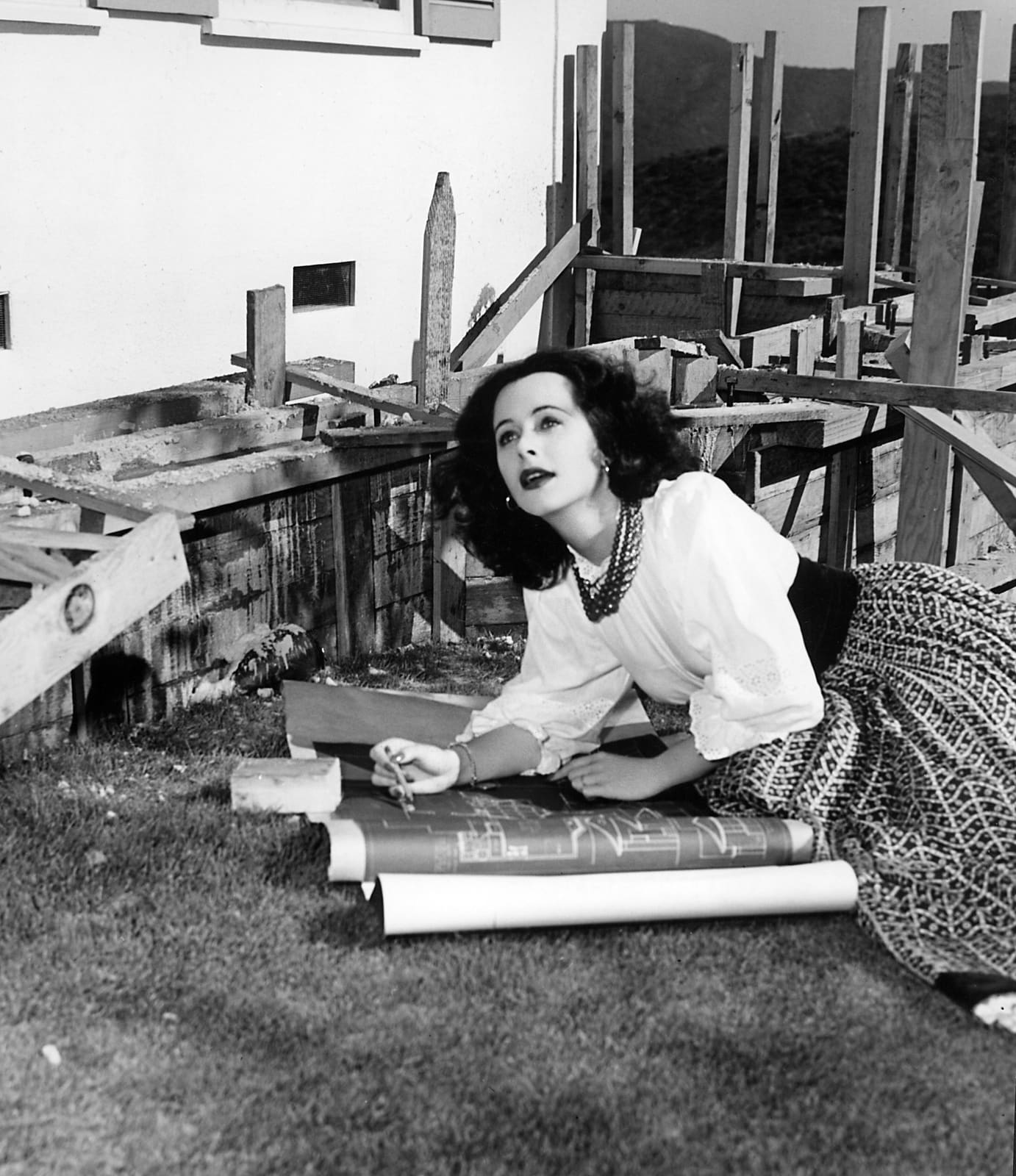
The decision to embrace domesticity was not a retreat but a rebalancing. Lamarr had always been a polymath, someone for whom "improving things comes naturally." Her invention of frequency hopping, developed during World War II to assist the Allied forces, demonstrated the same attention to system and structure that she applied to her interiors. Both required an ability to see patterns, to understand how individual elements could combine into a coherent whole.
Motherhood and the Spanish-Style Mansion
Lamarr gave birth to her daughter, Denise Hedwig Loder, in 1945, and her son, Anthony Loder, arrived three years later. By then she and Loder had separated, divorcing in 1947. She sold Hedgerow Farm to Humphrey Bogart and Lauren Bacall for ninety-seven thousand five hundred dollars and purchased a two-story Spanish-style mansion at 919 North Roxbury Drive for seventy-five thousand dollars.
The move to Roxbury Drive marked a new chapter. Having grown up as an only child, Lamarr wanted her daughter to have a sibling, to avoid the loneliness she herself had experienced. The Spanish-style mansion, with its stucco walls and tiled roofs, represented a different architectural language than the farmhouse. Spanish Colonial Revival architecture, which flourished in Southern California during the 1920s and 1930s, emphasized courtyards, arched openings, and a connection between interior and exterior space. For a mother of two, the style offered both privacy and the possibility of supervised play in protected outdoor areas.
The Florida Epilogue
Toward the end of her life, Lamarr relocated to Casselberry, Florida, purchasing a house on Wesson Drive in 1999. She died there in January 2000, far from the hills of Benedict Canyon and the studios that had made her famous. The Florida house, modest by comparison to her earlier estates, suggests a return to essentials. After decades of navigating the demands of Hollywood and raising children largely on her own, Lamarr chose a quieter setting, one that allowed her to control the terms of her engagement with the world.
Precedents and Parallels
Lamarr's approach to domestic space invites comparison with other figures who straddled multiple disciplines. Eileen Gray, the Irish architect and furniture designer, similarly used her homes as laboratories for exploring materiality and spatial composition. Gray's E-1027, built on the French Riviera in the late 1920s, combined modernist principles with a deep attention to lived experience, much as Lamarr's interiors balanced refinement with the textures of daily life.
The difference, perhaps, lies in intent. Gray was trained as a designer; her homes were manifestos. Lamarr, by contrast, was an autodidact in both invention and interior design, someone who learned by doing and who trusted her instincts. Her collections of antique porcelain and modernist painting, her Snow White figurines and Gibbons mantels, suggest a mind uninterested in stylistic purity. She assembled spaces that worked for her, drawing on whatever traditions felt relevant.
What Remains
The homes Lamarr created over the course of her life offer a counternarrative to the usual story of Hollywood glamour. Yes, she was beautiful; yes, she was celebrated. But the interiors she inhabited reveal someone more interested in texture, music, and the quiet satisfactions of arranging objects than in performing wealth. Her frequency-hopping patent, largely ignored during her lifetime, has since been recognized as foundational to wireless communication. Her homes, similarly, deserve recognition not as period pieces but as evidence of a sensibility that understood how space shapes thought.
In an era when celebrity interiors are often curated by teams of professionals and photographed for maximum impact, Lamarr's approach feels refreshingly personal. She filled her rooms with things she loved, not because they signaled status but because they brought her pleasure. The potted petunias, the Great Dane on the divan, the jigsaw puzzles and antique copper, all point to someone who understood that a home is not a stage set but a tool for living. And in that sense, her domestic legacy is as enduring as her technological one.
Save this story. A free account keeps your reading list and the 07:00 email in one place.
CREATE FREE ACCOUNT →SIGN IN