
The Domestic Paradox of Modular Play
Anyone who has lived with Lego understands the contradiction at its heart. The system promises infinite creative freedom, yet that freedom comes with a cost: the logistical burden of managing thousands of tiny interlocking pieces. The sets themselves, those boxed instructions that guide you toward a predetermined outcome, offer a tidy solution. But they also betray the original promise of the brick, which was never about replication. It was about invention.
At World Archi Design, we've tracked the rise of storage-as-design across residential interiors, from bespoke joinery that conceals children's play materials to modular systems that attempt to bridge utility and aesthetics. Few succeed in doing both. Most default to plastic bins or stackable crates, functional but visually indifferent. The question remains: can storage for something as ubiquitous and chaotic as Lego be both beautiful and intelligent?
The Newland brothers, an engineer, a nano-scientist, and an economics graduate, believe it can. Their product, Brickle, began as a family necessity and evolved into a piece of furniture that treats the toy with the seriousness it arguably deserves.
Form Follows Function, But Function Needs Refinement
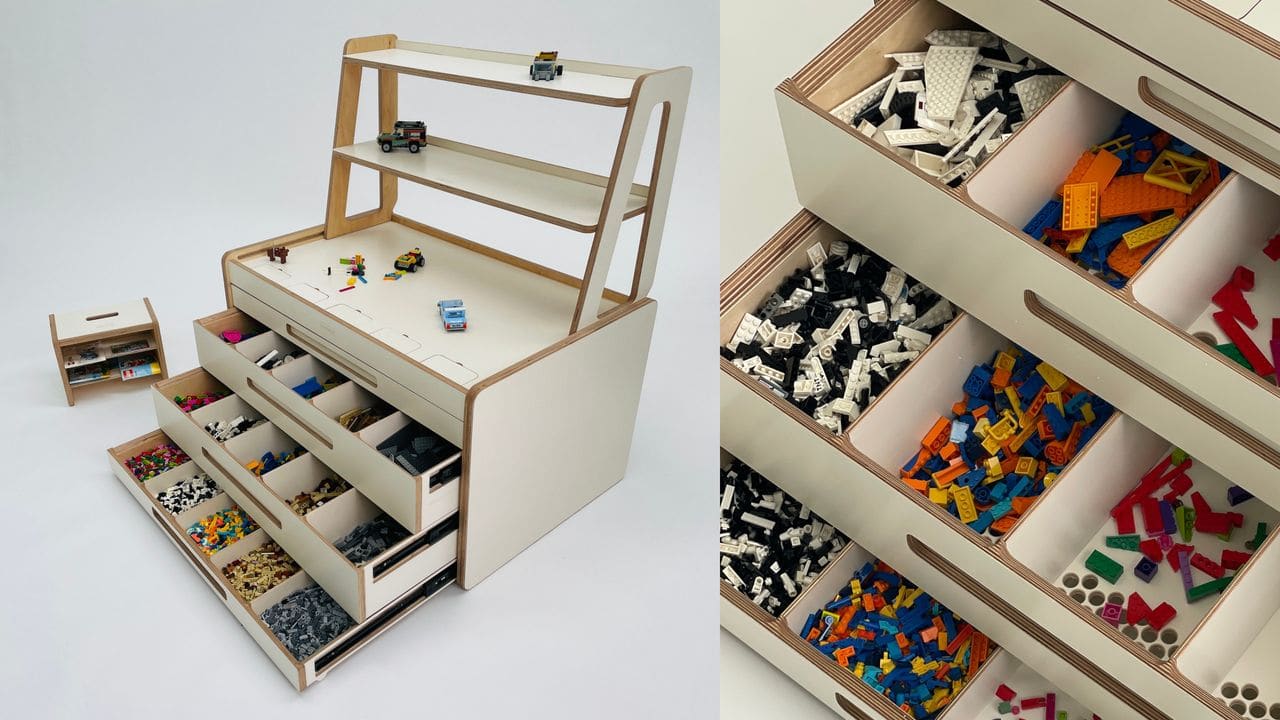
The Brickle unit resembles a plan chest, that staple of architecture studios and printmaking workshops. It is a typology that signals care, organization, and a respect for the materials stored within. Matt Newland, the engineer among the three brothers and currently working in yacht design, led the design development. The result is a low-profile cabinet manufactured in Cardigan, Wales, built from FSC-certified birch plywood.
The top surface functions as a construction plate, a flat working area sized to accommodate building at scale. Three or five rectangular slots are cut into this surface, allowing users to sweep loose bricks directly into the sorting mechanism below. It is an elegant gesture, one that eliminates the need for separate collection bins or scooping tools.
Beneath the top plate sit four drawers. The uppermost drawer is compartmentalized, designed to hold minifigures, specialty pieces, and elements that defy categorization by size alone. The two middle drawers feature arrays of holes drilled along their front edges, sized to allow smaller pieces to fall through while retaining larger ones. The bottom drawer catches everything that passes through the layers above. A few shakes of each drawer, and gravity does the rest.
The Mechanics of Simplicity
There is nothing revolutionary about size-based sorting. Sieves, screens, and graduated mesh systems have existed for centuries across industries, from agriculture to mining. What distinguishes Brickle is not the innovation of the mechanism but the refinement of its execution within a domestic object.
The sorting arrays are not adjustable, which means the system imposes a fixed taxonomy on the bricks. This is both a limitation and a feature. It removes decision-making from the process, automating what would otherwise require manual sorting. For families with thousands of pieces, the time saved is considerable. For purists who prefer sorting by color, function, or theme, the system may feel reductive.
The unit is available in two sizes. The larger version measures one meter wide, 65 centimeters deep, and 56 centimeters high, with a capacity of roughly 15 kilograms of bricks. According to Brickle, that translates to between 10,000 and 18,000 pieces, though brick weight varies significantly depending on type. The unit itself weighs 56 kilograms, a heft that speaks to the quality of materials and construction. The smaller "Bach" version is 63 centimeters wide and holds nine kilograms of bricks, weighing in at 40 kilograms.
Material Choices and the Aesthetics of Responsibility
Brickle offers three finishes: natural oak veneer, cream paint, and black paint. The company also accepts custom color requests, offering the full RAL chart and other manufacturer palettes. This level of customization positions the product not as a toy accessory but as a piece of interior furniture, one that must coexist with sofas, rugs, and shelving.
The decision to use FSC-certified birch plywood rather than particleboard or plastic is significant. Plywood, with its visible laminated edges and structural integrity, has a long history in furniture design, from Alvar Aalto's bent-ply chairs to the modular shelving systems of the mid-century. It is a material that communicates craft and durability, qualities often absent in products marketed toward children.
The finish quality matters here. The painted versions, particularly the cream, recall the matte surfaces of Scandinavian cabinetry, while the oak veneer aligns with the warmer, tactile aesthetic that has dominated residential interiors over the past decade. The unit does not try to disappear. It announces itself as furniture, and in doing so, it elevates the activity it supports.
Contextualizing Storage in the Domestic Landscape
Storage furniture for children's play materials has historically occupied a strange position within domestic design. It is often relegated to playrooms or bedrooms, hidden from view, treated as a necessary evil rather than an integrated element of the home. This reflects a broader cultural ambivalence about visible childhood within adult-oriented spaces.
In recent years, that boundary has softened. Open-plan living has forced a reckoning with how family life is organized spatially, and designers have responded with solutions that acknowledge the presence of children without sacrificing aesthetic coherence. We've seen this in the rise of neutral-toned play kitchens, wooden toy storage that mimics credenzas, and modular seating that doubles as toy bins.
Brickle fits within this lineage. It does not apologize for what it is, nor does it attempt to disguise its function. Instead, it presents that function as worthy of design attention. The unit can live in a playroom, but it could just as easily occupy a living room or study without disrupting the visual language of the space.
The Question of Scale and Accessibility
The larger Brickle unit is priced at £1,850, with the smaller version starting at £1,460. By any measure, this is a significant investment for a storage system. For context, a mid-range modular shelving unit from a Scandinavian flat-pack retailer might cost a fifth of that. The question, then, is whether the design, materials, and functionality justify the price.
This is where precedent becomes useful. Custom joinery for children's spaces, particularly in urban apartments where space is at a premium, can easily exceed several thousand pounds. Built-in storage that integrates with the architecture of a room, concealing toys while maintaining a clean sightline, is a luxury service. Brickle offers a middle path: a pre-designed, manufactured object that delivers some of the benefits of bespoke furniture without the lead time or bespoke cost.
It is worth noting that the unit is built to last. At 56 kilograms, it is not a disposable object. It is furniture that could, in theory, outlive the Lego phase of a household and be repurposed for other storage needs. The drawers, the construction surface, the material quality, all of these suggest longevity.
What It Means to Take Play Seriously
There is a philosophical dimension to Brickle that goes beyond sorting efficiency. By treating Lego storage as a design problem worthy of serious attention, the Newland brothers are making an argument about the value of play itself. They are suggesting that the tools we use to support creative activity, particularly for children, deserve the same level of craft and consideration as the tools we use for work.
This is not a new idea. Montessori furniture, Froebel blocks, and the pedagogical toys of the early 20th century all emerged from a belief that the objects surrounding a child shape their development. Good design, in this view, is not a luxury but a responsibility.
Brickle does not claim to be educational furniture in the formal sense, but it operates within the same ethos. It removes friction from the creative process. It makes the transition from chaos to order less painful. It allows the act of building to begin more quickly and end more cleanly. These are not trivial contributions.
The Longevity of Modular Systems
Lego, as a system, has remarkable staying power. Sets from the 1960s are still compatible with bricks produced today, a rare feat in an industry driven by planned obsolescence. This means that collections accumulate across generations, passed down, added to, and eventually requiring management at scale.
Brickle is designed for this kind of accumulation. It is not a starter solution for a small set or two. It is a response to the moment when the pile becomes unmanageable, when the creative potential of the bricks is locked away by the sheer difficulty of accessing them.
Whether the unit will find a market beyond affluent households with both the space and the budget for high-end children's furniture remains to be seen. But as a design object, it succeeds in what it sets out to do: it takes a mundane problem and solves it with elegance, materiality, and a respect for the activity it supports. In doing so, it reminds us that storage, when done well, is not about hiding things away. It is about making them usable.
Save this story. A free account keeps your reading list and the 07:00 email in one place.
CREATE FREE ACCOUNT →SIGN IN