
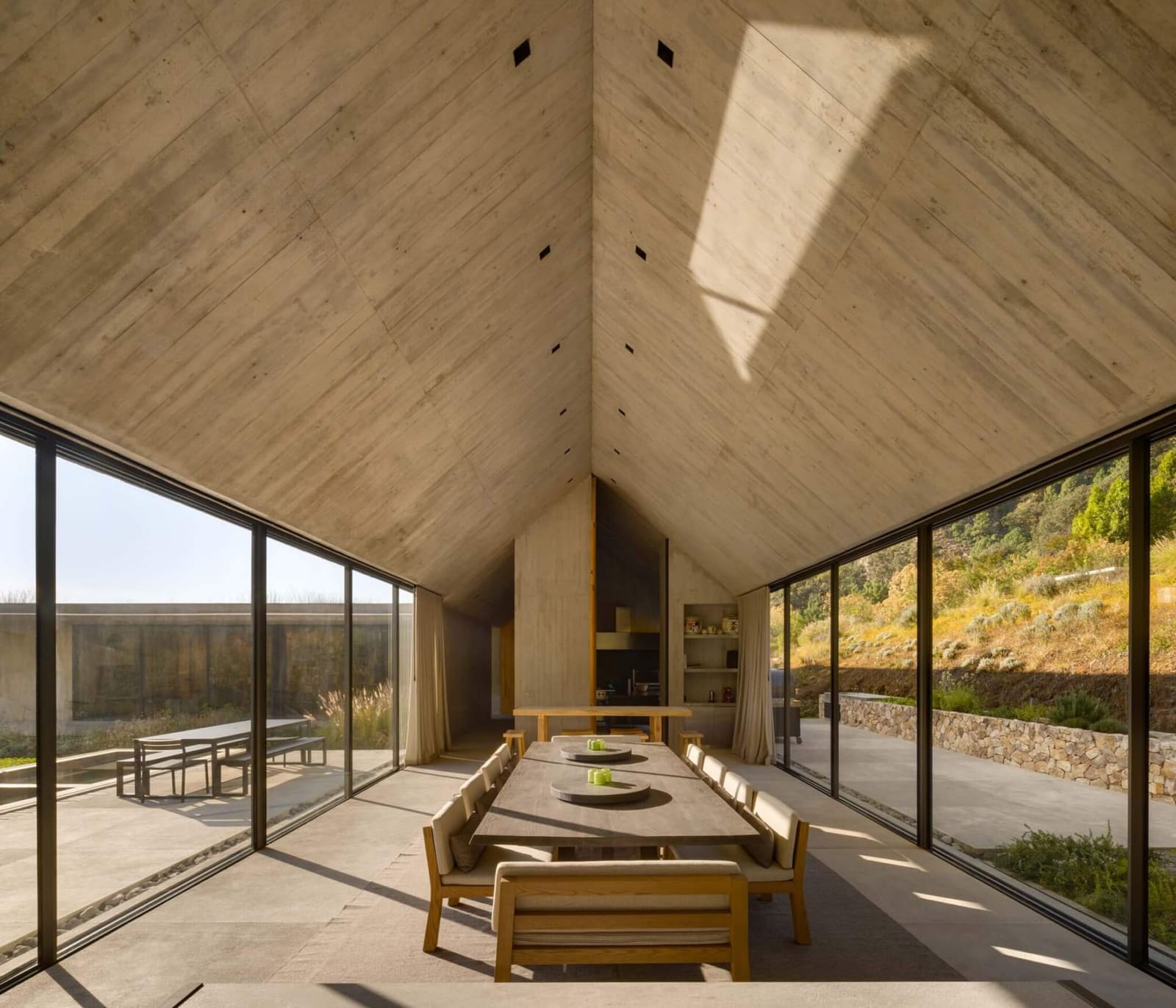
A Reserve Reimagined
When residential development meets conservation, the outcome is typically compromise: density traded for greenery, ecological value sacrificed to buildable lots. Yet within the 200-hectare expanse of Reserva Peñitas, located in the forested hills outside Valle de Bravo, Mexico, a different model has emerged. Here, architecture functions less as occupation and more as careful insertion, a practice that JSa's recently completed Casa Marte illustrates with particular clarity.
At World Archi Design, we have observed a growing appetite among practices to position dwellings not merely within landscape, but as active participants in its recovery. Casa Marte advances that premise by operating entirely off-grid, drawing on passive strategies and renewable systems while participating in the broader land-regeneration ambitions that define Reserva Peñitas. The project joins a small but significant roster of contemporary interventions within the reserve, each treating the forest not as backdrop but as collaborator.
Project Context and Spatial Organisation
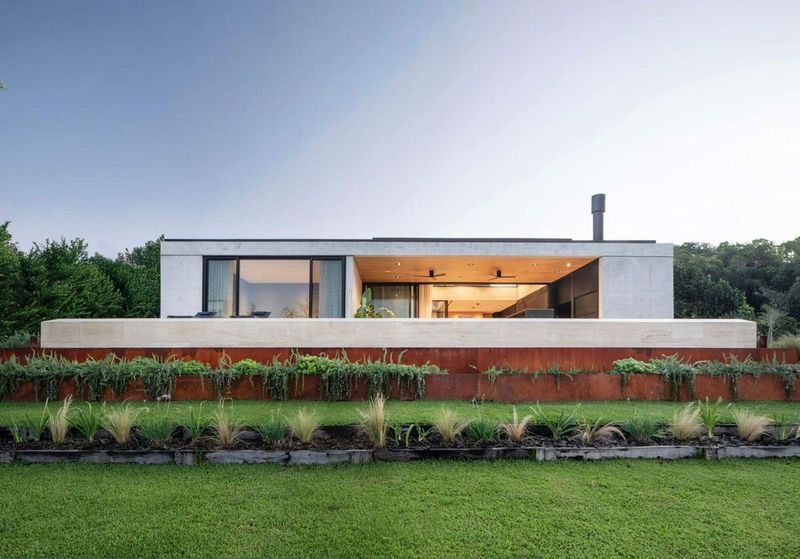
Casa Marte / JSa, Valle de Bravo, Mexico, 2026
The compound occupies a sloped site within the reserve's mixed pine-oak canopy, a terrain that descends steeply toward seasonal watercourses and opens intermittently to views of the surrounding valley. JSa organised the program across multiple pavilions rather than consolidating it under a single roof, a move that reduces site disturbance and allows the architecture to follow topography rather than dominate it.
Each structure is positioned to minimise grading and tree removal. Circulation between pavilions occurs along pathways that trace existing contours, reinforcing the sense that the compound inhabits the forest rather than displacing it. This dispersed massing also modulates scale: no single volume asserts dominance, and the cumulative effect reads as a series of clearings rather than a carved estate.
The main living pavilion addresses the slope with a split-level section, embedding the lower floor into the hillside while lifting the upper level to capture cross-ventilation and filtered daylight. Sleeping quarters and support spaces occupy separate volumes, each calibrated to microclimate and view. The strategy recalls Peter Zumthor's approach at the Thermal Baths in Vals, where fragmentation and topographic embedding dissolve monolithic presence, though here the material palette and programmatic logic are entirely domestic.
Material Palette and Construction Logic
JSa's material selections privilege local sourcing and low embodied energy. Walls employ rammed earth mixed with site-excavated clay, stabilised with minimal cement. The technique yields thermal mass that buffers diurnal temperature swings, a critical asset in Valle de Bravo's temperate highland climate, where nights drop sharply even in summer.
Timber framing, milled from sustainably harvested regional pine, supports gabled roofs clad in standing-seam metal. The profile is deliberately vernacular, echoing the pitched forms common to rural Mexican construction, but details are refined: eaves extend generously to shed rain and shade glazing, while ridge vents promote stack-effect cooling without mechanical assist.
Glazing is concentrated on north and south elevations, with deep reveals and operable shutters that allow residents to modulate daylight and airflow. East and west facades remain largely solid, reducing heat gain during morning and late-afternoon sun angles. The fenestration strategy is elemental, yet its discipline yields comfort with negligible energy input.
Floors are poured concrete, polished and sealed to function as thermal sinks. During cooler months, passive solar gain warms the slabs; in warmer periods, the mass remains cool, stabilising interior temperatures. The interplay between rammed earth, concrete, and timber creates a palette that is tactile and restrained, foregrounding material honesty over decorative gesture.
Off-Grid Systems and Self-Sufficiency
Casa Marte operates independent of municipal infrastructure. Photovoltaic arrays, mounted on pavilion roofs and oriented to maximise winter and summer insolation, supply electricity stored in lithium-ion battery banks. JSa sized the system to meet peak demand while allowing headroom for cloudy intervals, a conservative approach that prioritises reliability over minimal investment.
Rainwater harvesting feeds all domestic water needs. Collection occurs via roof catchments that channel runoff into underground cisterns, where filtration and UV treatment render it potable. Greywater from sinks and showers undergoes secondary treatment in constructed wetlands before irrigating native plantings. Blackwater is processed through a composting system that returns nutrients to the landscape, closing the loop on waste.
Heating derives from high-efficiency wood stoves fueled by fallen timber and thinning operations within the reserve. The approach aligns with broader forest-management practices that reduce fire risk and maintain canopy health. Cooking relies on a combination of induction cooktops, powered by the PV array, and a traditional wood-fired oven integrated into the main pavilion's hearth.
The systems are neither experimental nor bleeding-edge; their effectiveness lies in integration and calibration. JSa avoided technological overreach, opting instead for proven, maintainable solutions that residents can operate without specialist support. This pragmatism distinguishes Casa Marte from off-grid projects that lean heavily on automation and proprietary hardware, which often fail when repair expertise is distant or unavailable.
Landscape Integration and Ecological Regeneration
Reserva Peñitas was conceived not merely as a residential enclave but as a platform for ecosystem restoration. Prior to designation as a reserve, the land suffered from overgrazing and selective logging, which degraded soils and reduced biodiversity. Current management emphasises reforestation with native species, erosion control, and the reintroduction of wildlife corridors.
Casa Marte participates in this broader effort through careful site stewardship. JSa worked with ecologists to map sensitive zones, including riparian buffers and areas of high species density, which were placed off-limits to construction. Disturbed soils were stabilised with native grasses and shrubs, selected for their ability to establish quickly and support pollinator populations.
The compound's footprint was minimised through vertical stacking and the elimination of superfluous hardscape. Driveways and parking are surfaced with permeable gravel rather than asphalt, reducing runoff and heat-island effect. Outdoor lighting is limited to low-level fixtures with warm colour temperatures and full cutoff optics, mitigating skyglow and preserving nocturnal habitat.
These measures extend the logic of regeneration from policy to practice, demonstrating that residential occupation need not arrest ecological recovery. The architecture becomes infrastructure for coexistence, mediating between human habitation and the broader life of the forest.
Precedents and Broader Context
Casa Marte belongs to a lineage of projects that interrogate the relationship between dwelling and terrain. Rick Joy's Desert Nomad House in Tucson similarly employs rammed earth and dispersed massing to settle into arid topography, while Wendell Burnette's own residence explores thermal mass and passive cooling in extreme heat. Both projects share with Casa Marte a commitment to place-specific performance and material restraint.
Within Mexico, the work of Tatiana Bilbao and Frida Escobedo has advanced a discourse around materiality and context, particularly in residential commissions that engage rural and peri-urban conditions. Bilbao's social-housing prototypes and Escobedo's interventions in vernacular typologies offer models for architecture that is culturally grounded yet formally inventive. JSa's approach is less formally experimental but no less rigorous in its engagement with site and sustainability.
Valle de Bravo itself has become a locus for contemporary practice, attracting architects drawn to its dramatic topography and proximity to Mexico City. The region's appeal lies partly in regulatory flexibility that permits experimentation, and partly in a client base receptive to environmental ambition. Casa Marte reflects both conditions: a project enabled by a supportive regulatory framework and a client willing to prioritise performance over convention.
Implications for Residential Practice
The significance of Casa Marte extends beyond its immediate context. As climate volatility intensifies and infrastructure fragility becomes more apparent, off-grid residential models offer a form of resilience that grid-tied developments cannot match. The compound demonstrates that self-sufficiency need not entail aesthetic compromise or functional austerity; comfort and autonomy can coexist when systems are thoughtfully integrated.
Moreover, the project challenges the prevailing logic of residential development, which treats landscape as amenity rather than collaborator. By embedding architecture within an active regeneration program, JSa reframes dwelling as ecological practice, a shift with implications for how we conceive land use in sensitive environments.
The dispersed massing and material modesty of Casa Marte also suggest an alternative to the villa typology that dominates luxury residential work in forested and coastal zones. Rather than asserting presence through scale or formal drama, the compound achieves distinction through restraint and responsiveness, qualities that may prove more durable as expectations around environmental stewardship evolve.
Looking forward, we expect to see greater integration of residential architecture with conservation and regeneration initiatives, particularly in regions where development pressure threatens fragile ecosystems. Casa Marte offers a template: not prescriptive, but indicative of what becomes possible when design ambition aligns with ecological responsibility. The forest, in this reading, is not simply preserved but enlisted, and architecture becomes one instrument among many in the work of restoration.
Save this story. A free account keeps your reading list and the 07:00 email in one place.
CREATE FREE ACCOUNT →SIGN IN