
A Decade-Long Search Ends in the Northern Quarter
There is something quietly fitting about measuring spectacles in a space where cloth was once measured by the yard. At 16 Smithfield Buildings in Manchester's Northern Quarter, the latest Cubitts location occupies part of a Victorian structure that housed Affleck & Brown, a department store that operated from the 1860s until 1973. For more than a century, fabric was sold here and garments tailored to fit. Now, in the same high-ceilinged rooms, frames are adjusted and lenses fitted with equal care.
The eyewear brand, founded in 2013, spent a decade searching for the right Manchester property. The building's history as a maker's space, combined with its location in a neighborhood defined by independent trade and creative industry, made it an ideal match. It opened on 30 July 2026 as the brand's 21st shop worldwide and 19th in the United Kingdom.
Designing From Within, Not Depositing From Outside
For this project, Cubitts turned to Youth, a Manchester-based design studio known for its work on the Cotswolds hotel Hyll. The decision to work with a local practice was deliberate. Too many retail interiors, especially those belonging to national or international brands, arrive in regional cities fully formed, carrying the same aesthetic language regardless of context. Youth co-founder Liam McGroarty saw an opportunity to do something different.
The studio's approach was rooted in a critique of how Manchester is often represented. Repeated references to the city's musical and industrial past, while historically accurate, can flatten its contemporary identity. Instead, Youth aimed to design a space that acknowledges heritage without being defined by it. The result is an interior that feels both rooted and forward-facing, using materials and forms that nod to the past while resisting nostalgia.
Precision Steelwork Meets Unfinished Plaster
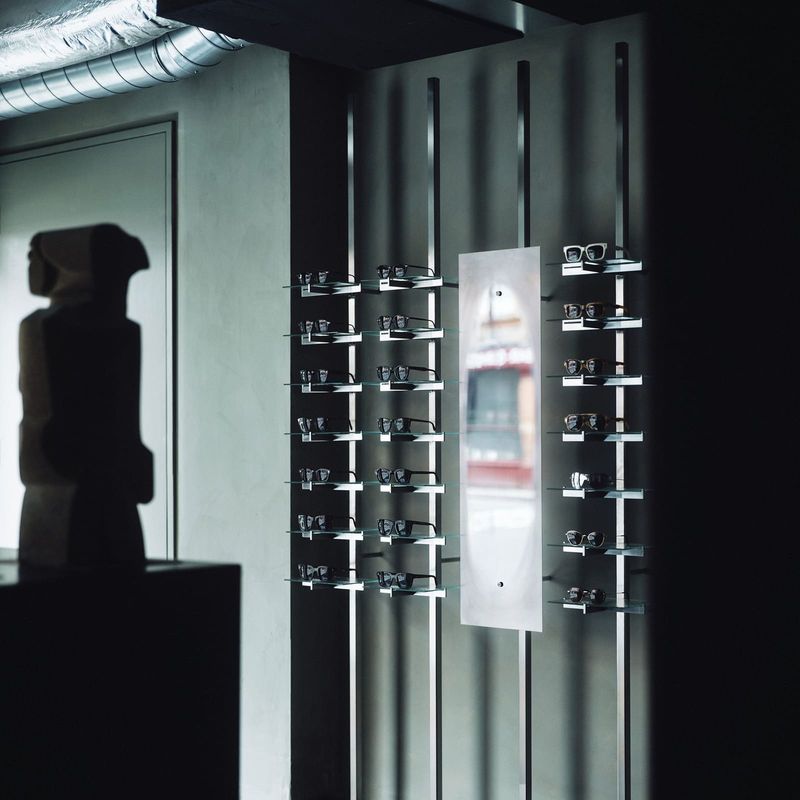
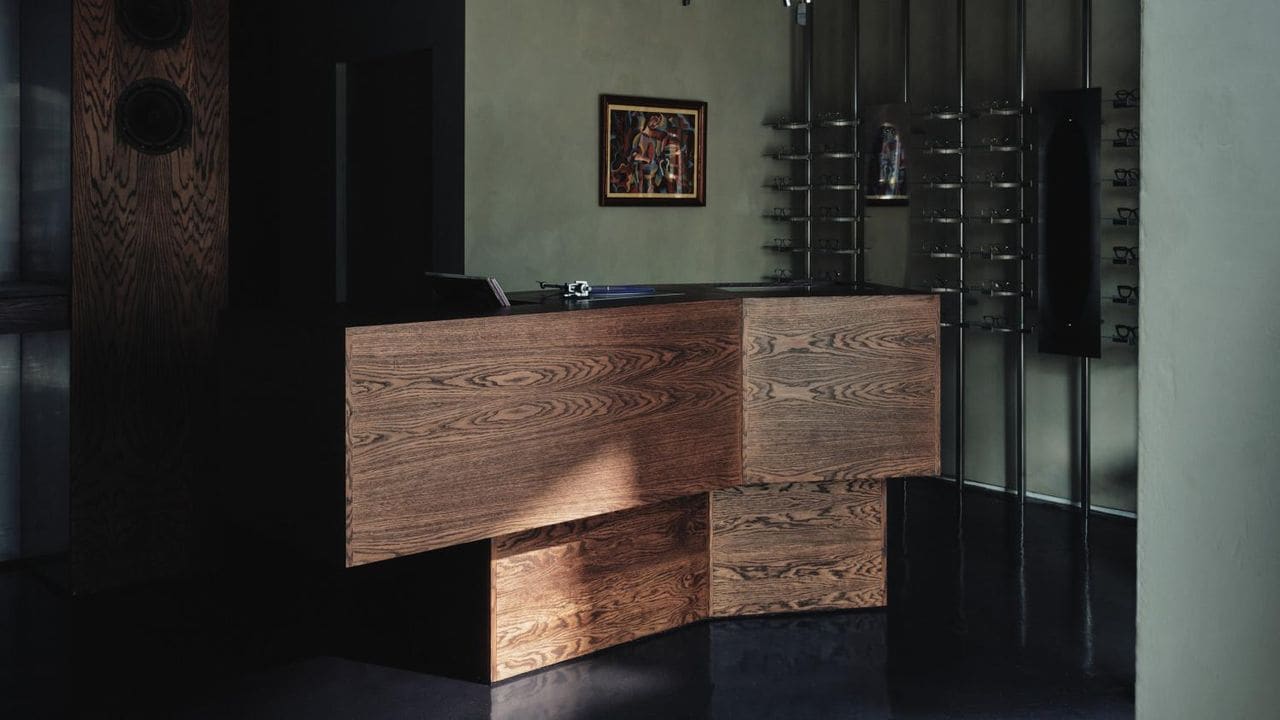
The design contrasts refined craft with raw surfaces. Display units feature precise steelwork paired with rain-textured glass platforms, which hold up to 72 optical frames and sunglasses. Under spotlights, the textured glass throws broken, watery shadows across the floor, a subtle play of light that introduces movement into an otherwise composed space. These carefully fabricated elements sit against plaster walls left deliberately unrefined, their texture and imperfections visible.
Mirrors are framed in sleek steel but feature hand-dimpled surfaces that return a softened, imperfect reflection. This interplay between exactitude and irregularity runs throughout the interior. It is a spatial translation of the brand's philosophy: optics demands technical precision, but the experience of wearing glasses is ultimately human and subjective.
Making the Invisible Visible
Unlike conventional optical shops, where repairs and consultations happen behind closed doors, Cubitts makes these processes visible. A dedicated repairs desk, an optometric room, and a bespoke consultation area are separated by waxed-cotton curtains but remain part of the open floor plan. This transparency echoes the layout of the brand's recently opened headquarters and optical manufactory in King's Cross, where production and service are treated as part of the customer experience rather than hidden backstage.
At the center of the Manchester shop, a faceted oak counter serves as a social anchor. Its geometry invites gathering rather than transactional exchange. A turntable is integrated into the joinery, introducing sound into the space and creating an informal connection to the neighborhood's record stores. The musical reference is subtle, avoiding the trap of overt cultural signaling while still acknowledging the city's creative ecosystem.
Objects That Reflect Labor and Modernism
Youth curated a selection of artworks and objects to give the space a sense of accumulated character. An original painting by Francis Hoyland depicts a seamstress at work; a Cubist gouache by Marcel Gille shows a forge worker. Both reference traditions of close manual labor, echoing the building's history as a site of making. A pair of modernist sandstone figures by sculptor Richard Perry stand in front of a speaker, while a vintage revolving bookcase originally made by Manchester cabinetmakers Goodall, Lamb and Heighway using timber salvaged from HMS Foudroyant holds publications from The Modernist, a Manchester-based publisher.
These objects were chosen not to decorate but to layer meaning. They speak to tailoring, industry, and modernism without announcing those themes outright. The effect is a space that feels lived-in and considered, as if the interior has evolved over time rather than being installed in a single moment.
A Brand DNA That Adapts to Place
As Cubitts expands, the challenge is maintaining coherence across locations without imposing uniformity. Each shop is designed to belong to its neighborhood, responding to local architecture, history, and culture. What unites them is not a fixed aesthetic but an underlying approach: precision in craft and service, combined with warmth and human-scaled detail.
In Manchester, that approach translates as a space where industrial heritage is reinterpreted through contemporary materials and forms. The design avoids the familiar visual shorthand of exposed brick and vintage machinery, opting instead for a more abstracted vocabulary. Steelwork and textured glass evoke industrial processes without literalizing them. The unfinished plaster walls acknowledge the building's age without restoring it to a museum-like state.
Tailoring Space to Context
The parallel between the building's past and present uses is not forced, but it resonates. Both tailoring and optical fitting are practices rooted in measurement, adjustment, and attention to individual needs. Both require a combination of technical skill and interpersonal sensitivity. In this sense, the shop is less a departure from the building's history than a continuation of it.
Youth's interior does not attempt to erase the building's Victorian bones. Instead, it works with them, layering new materials and forms into the existing shell. The result is a space that feels neither preserved nor erased, but adapted. It is an approach that reflects a broader shift in how contemporary design engages with historic structures, favoring dialogue over restoration or rupture.
The Antithesis of Clinical
Optical retail has long been dominated by a clinical aesthetic: white surfaces, bright lighting, minimalist displays. Cubitts has built its identity in opposition to this model. Its shops are warm, tactile, and richly detailed, designed to feel more like studios or workshops than sterile medical environments. The Manchester location continues this trajectory, using materials like oak, steel, and waxed cotton to create a sense of warmth and craft.
The decision to keep services visible rather than hidden reinforces this ethos. Repairs, fittings, and consultations become part of the spatial narrative, demystifying the technical side of optical care while maintaining a sense of expertise. It is a model that borrows from the workshop tradition, where skill is demonstrated rather than concealed.
What the Northern Quarter Adds
The Northern Quarter has long been Manchester's creative and independent retail hub, home to vintage shops, record stores, cafés, and studios. It is a neighborhood defined by making and trading, where small businesses and cultural spaces coexist. Cubitts' arrival here is both strategic and symbolic. The brand positions itself as part of this ecosystem rather than as an external arrival.
By commissioning a local studio and sourcing objects that reflect Manchester's craft and modernist traditions, Cubitts signals an investment in place-specific design. The shop does not feel like a franchise or a pop-up. It feels embedded, as if it has always been part of the neighborhood's fabric. That sense of belonging is increasingly rare in retail design, where brand consistency often trumps local context.
Designing for Where the City Is Going
McGroarty's observation that Manchester is often defined by its past rather than its future points to a broader challenge in regional design. Heritage is valuable, but it can also be limiting when it becomes the only lens through which a place is understood. Youth's interior for Cubitts attempts to hold both past and future in tension, acknowledging history while imagining what comes next.
This is not a rejection of Manchester's industrial or musical legacy. It is a refusal to let those legacies become static or decorative. The design engages with them as living traditions, reinterpreted through contemporary materials and spatial strategies. It is an approach that could serve as a model for other brands entering regional markets, where the temptation to lean on familiar cultural signifiers is often strong.
Precision With Soul
The phrase "precision with soul" captures the dual nature of optical retail. Lenses must be ground to exact specifications; frames must sit correctly on the bridge of the nose. But the act of choosing glasses is also expressive, personal, and subjective. It requires technical knowledge and aesthetic judgment in equal measure.
At Cubitts Manchester, that duality is built into the architecture. The precise steelwork and the hand-dimpled mirrors, the rain-textured glass and the unfinished plaster, the faceted oak counter and the integrated turntable - all of these elements balance exactitude with warmth. The space does not choose between being a workshop and being a social space. It is both, and that is what makes it work.
Save this story. A free account keeps your reading list and the 07:00 email in one place.
CREATE FREE ACCOUNT →SIGN IN