
A Shift in Strategy
Design festivals thrive on drama. They demand installations that photograph well, moments that interrupt the everyday, and narratives bold enough to compete with hundreds of other voices across a single city. Yet Audo Copenhagen's approach to 3daysofdesign 2026 suggests a different calculus. Where last year's Monuments exhibition leaned into theatricality, juxtaposing classical sculpture against contemporary forms with almost operatic intensity, this year's Quiet Grandeur pulls in the opposite direction. The result is an exhibition that feels more like an interior monologue than a public declaration, and it works precisely because of that restraint.
Audo House, the brand's 1918 Nordhavn headquarters, has become a laboratory for this kind of thinking. Part concept shop, part café, part boutique hotel, the building operates as both showroom and lived environment. Each year during Copenhagen's design week, the interiors are reimagined entirely. This time, the concept shop was transformed into a cohesive exhibition space rather than a product showcase, with new launches and archival pieces staged together to create a single, flowing narrative about materiality, craft, and how people occupy space.
The Architecture of Calm
Norm Architects, who have shaped Audo House's interiors since its inception, collaborated with art director Christian Møller Andersen to develop the exhibition's visual language. The result is an environment where large-scale painted dividers and artworks by Mika Liebe act as architectural gestures, creating rhythm and depth without fragmenting the space. The shop floor reads less like a retail environment and more like a carefully composed stage set, one where each element has been placed with intention.
Seven new product launches anchor the exhibition. Chairs, tables, and lamps from Norm Architects, Danielle Siggerud, Atelier Axo, and Krøyer-Sætter-Lassen sit alongside established Audo pieces, creating a dialogue between contemporary form and enduring craft traditions. The Conrad Lounge Table, designed by Laura Lange, uses form-pressed veneer with solid wood edges, its visible screws left exposed as a deliberate articulation of construction. The Mauro Dining Chair by Krøyer-Sætter-Lassen draws on the unhurried atmosphere of Italian trattorias while maintaining the clarity and restraint associated with Danish design.
These are not objects designed to command attention through novelty. Instead, they operate through a vocabulary of softened silhouettes, sculptural curves, solid timber, natural weaving, and earthy tonal palettes. The effect is cumulative rather than immediate, a kind of spatial layering that rewards sustained engagement.
Material Honesty and Tectonic Expression
One of the exhibition's quieter strengths is its commitment to material honesty. The Puffin Dining Table by Atelier Axo was originally created for Copenhagen restaurant Bobe, shaped through conversations about atmosphere and the experience of gathering. Its design reflects an understanding of how tables function not just as surfaces but as social anchors, places where ritual and conversation unfold.
Similarly, the Eave Seamline Lounge Chair by Norm Architects continues the language of the studio's Eave collection, but in a more singular form. The sculpted seat, upholstered in tactile fabrics, wraps the body with both softness and structure. The Penguin Wooden Lounge Chair by Ib Kofod-Larsen, a reissue of a mid-century design, demonstrates how proportion, material, and comfort can create a calm and balanced expression without relying on decorative gesture.
The Admiral Portable Lamp by Pernille Arlien-Søborg extends this logic into lighting. Compact and diffused, the lamp is designed to move easily between rooms and outdoor spaces, offering a warm LED glow wrapped in fabric softness. It is the kind of object that responds to how people actually live, rather than how they are imagined to live in aspirational interiors.
Beyond the Showroom
Quiet Grandeur extended beyond the main exhibition space into other areas of Audo House. A presentation celebrating the 90th anniversary of Flemming Lassen's The Tired Man served as an emotional anchor, connecting contemporary practice to a longer trajectory of Danish modernism. The Tired Man, with its reclining form and expressive simplicity, remains a reference point for designers working within the Nordic tradition, and its inclusion here underscores the exhibition's interest in continuity rather than rupture.
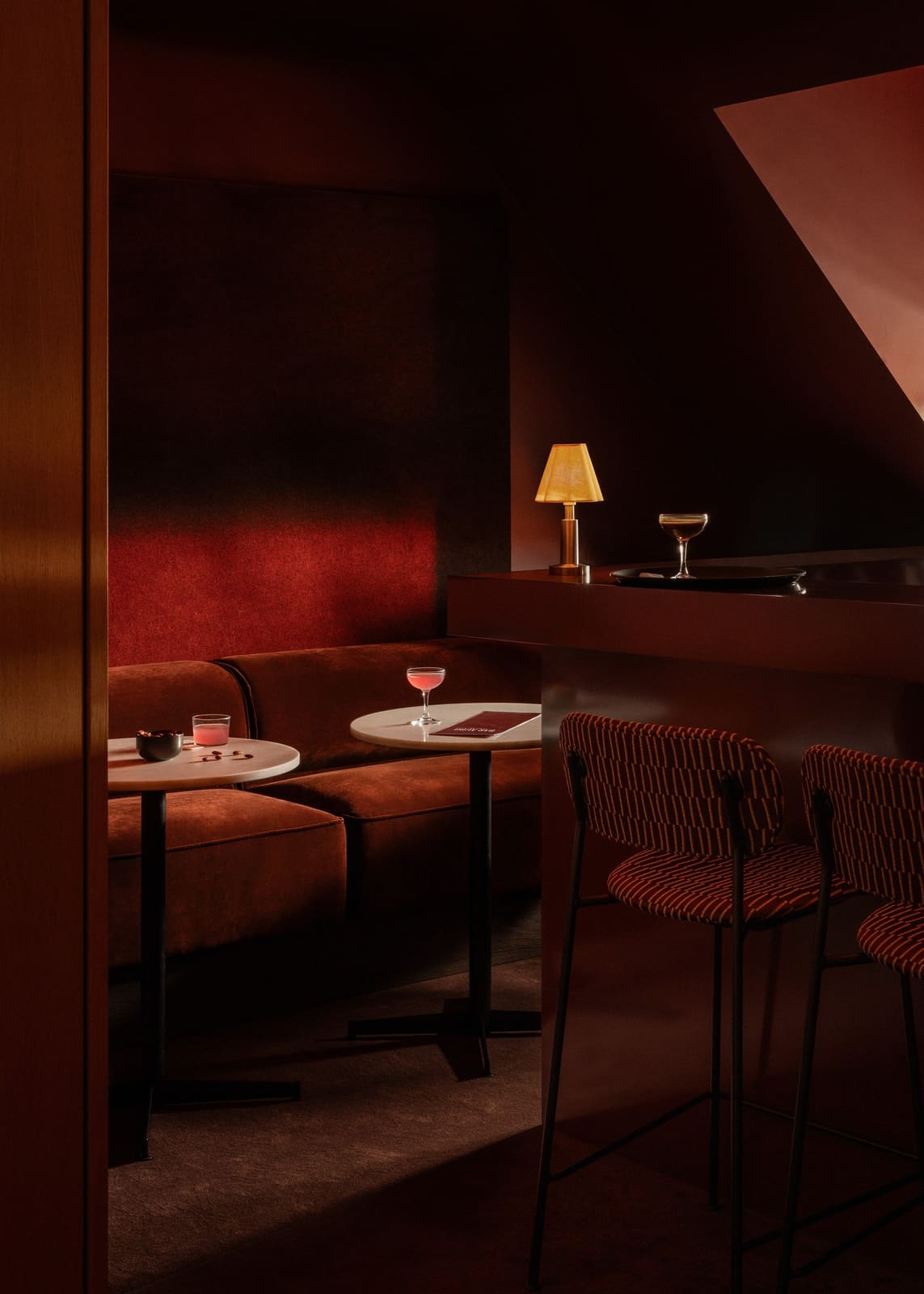
A nearby Cinema Room explored the legacy of the Lassen brothers, offering an immersive layer of storytelling that situates Audo's work within a broader cultural and historical context. Meanwhile, a collaboration with Bird, a Copenhagen cocktail and vinyl destination, created an intimate bar experience shaped by music, hospitality, and atmosphere. The courtyard featured a preview of Danielle Siggerud's forthcoming outdoor collection for Audo, extending the exhibition's material language into exterior settings.
These ancillary programmes are not afterthoughts. They reflect an understanding that design operates not just through objects but through the environments and experiences those objects enable. By staging the exhibition across multiple rooms and contexts, Audo reinforces the idea that design is fundamentally about how people gather, connect, and feel.
Precedent and Context
Audo's approach to Quiet Grandeur invites comparison with other recent efforts to stage design as atmosphere rather than spectacle. The work of studios like Dieter Rams and John Pawson comes to mind, both of whom have long argued that restraint is not the absence of expression but a highly disciplined form of it. In the context of Nordic design, this lineage extends through figures like Alvar Aalto, whose work balanced modernist clarity with a deep sensitivity to material and human scale.
What distinguishes Audo's exhibition is its willingness to embrace classicism without irony. Where much contemporary design either rejects historical reference or deploys it as pastiche, Quiet Grandeur engages with classical forms and proportions as living resources. This is a Nordic reading of classicism, one that prioritizes enduring principles over surface decoration, and it gives the exhibition a sense of timelessness that feels increasingly rare in a field often driven by novelty.
The Case for Restraint
At World Archi Design, we have been tracking a growing interest in design strategies that prioritize atmosphere over impact, subtlety over spectacle. Quiet Grandeur is a compelling example of this shift. It argues that grandeur and calm are not opposites, that an enduring idea of contemporary living can be grounded, graceful, and quietly self-assured. In an industry often dominated by the logic of the image, where projects are designed to perform on Instagram before they perform in space, Audo's exhibition offers a different model.
This is not to suggest that drama has no place in design. Monuments, last year's exhibition at Audo House, was effective precisely because of its theatricality. But Quiet Grandeur demonstrates that restraint can be equally compelling when executed with clarity and conviction. The exhibition does not demand attention. It earns it, through careful composition, material integrity, and a coherent vision of what contemporary design can be.
As design weeks proliferate globally and the pressure to produce ever more spectacular installations intensifies, Audo Copenhagen's decision to turn the volume down feels like a deliberate counterpoint. It is a reminder that the most enduring spaces are often the quietest, and that atmosphere, when handled with skill, can speak as powerfully as any grand gesture.
Photo: Audo
Save this story. A free account keeps your reading list and the 07:00 email in one place.
CREATE FREE ACCOUNT →SIGN IN