
The Unlikely Journey from Museum to Miniature
There's something quietly compelling about watching a building cross over from the realm of architecture into the world of toys. Not every structure earns this particular form of cultural consecration, yet the V&A Dundee, Kengo Kuma's first completed project in the United Kingdom, is now vying for precisely that honor. A fan-built Lego prototype has set in motion a campaign to transform the museum into an official set within the Danish toy company's Architecture range, and the architect himself has lent his voice to the effort.
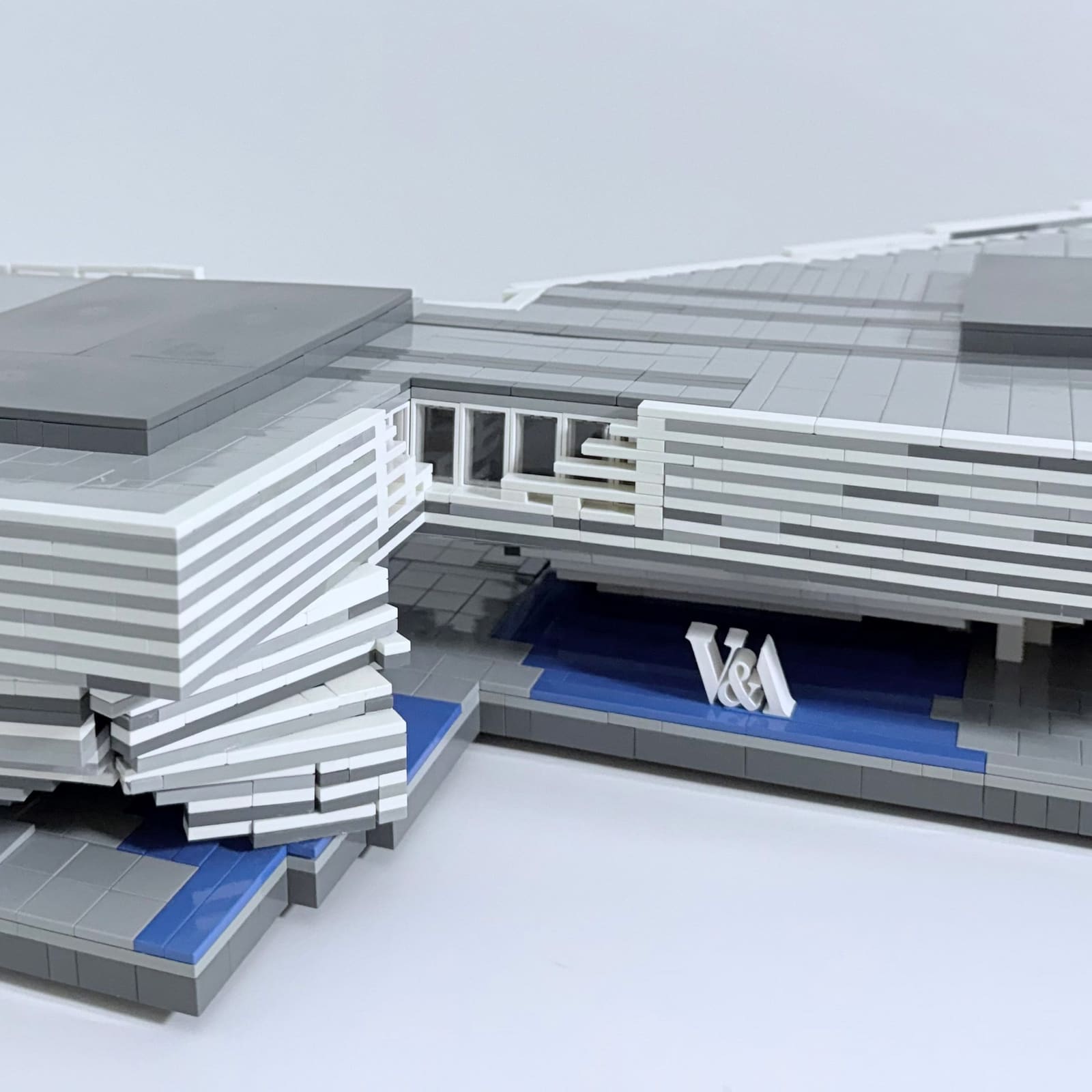
The campaign hinges on a replica constructed by Brian McNicoll, founder of web studio 532 Design, who invested 2,900 pieces into capturing the museum's distinctive form. His model currently sits on display within the very building it replicates, a recursive gesture that speaks to both the accessibility of Kuma's design language and the peculiar way Lego has become a vernacular for translating built form into something tactile and participatory. McNicoll submitted his work to Lego Ideas, the platform where public voting determines which fan concepts might be elevated to official production. The threshold is 10,000 supporters, a number the campaign is still climbing toward, having gathered over 2,800 votes so far.
What makes this particular bid interesting is not merely its regional pride or the novelty of seeing a contemporary museum miniaturized. It's the alignment between the building's tectonic logic and the constraints of Lego's modular system. At World Archi Design, we've been tracking how certain architectural vocabularies translate more gracefully into other media, and Kuma's approach to massing and surface at Dundee appears almost purpose-built for the medium.
A Building Shaped by Water and Trade
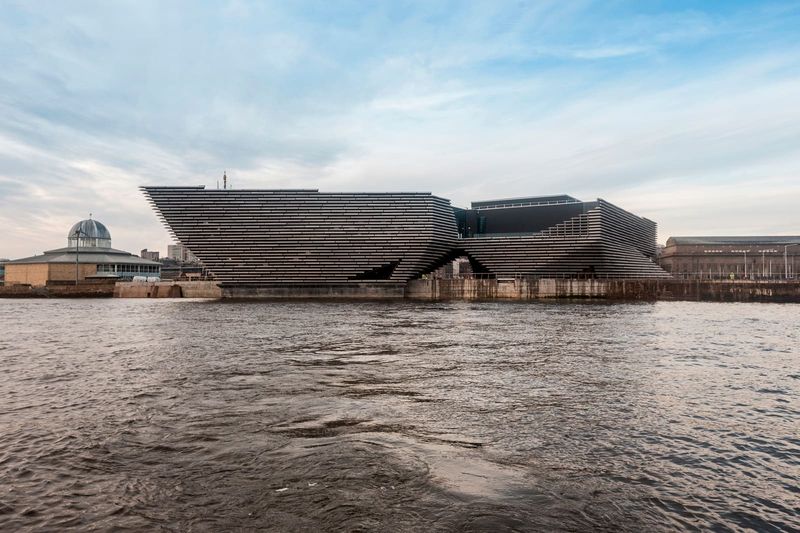
Completed in 2018, the V&A Dundee occupies a prominent site along the city's waterfront, conceived as Scotland's first dedicated design museum and an outpost of London's Victoria and Albert Museum. Kuma's design responds directly to Dundee's maritime context, a city whose historical identity was forged through global trade routes along the River Tay. The building is composed of two angular, cantilevered volumes that meet at oblique angles, clad in approximately 2,500 precast concrete panels arranged in horizontal bands. This layering creates a striated facade that shifts in texture and shadow as light moves across it throughout the day.
The architect has described the structure as a gateway, a threshold through which the city reconnects with the broader world. In this sense, the museum is less an object dropped onto the site and more an articulation of movement and exchange, a physical embodiment of flows that once defined the port city. The horizontal banding references the geological stratification of coastal cliffs, while the cantilevered forms evoke the prows of ships. It's an architecture of allusion rather than imitation, a quality that distinguishes Kuma's work from more literal vernacular references.
For McNicoll, this banded, angular composition proved surprisingly compatible with Lego's grammar. The toy's inherent modularity, its reliance on stacking and offsetting, mirrors the museum's layered facade. McNicoll used 3D visuals from a Dundee Waterfront app as a reference, rotating the digital model to verify scale and angles as he assembled the physical replica. The process required close attention to the building's proportions and the rhythm of its surface articulation, qualities that are often flattened in architectural photography but which become legible again through the discipline of brick-by-brick reconstruction.
Translating Tectonic Expression into Toy Form
Lego's Architecture series has long occupied a curious niche within both toy culture and architectural discourse. Launched in the early 2000s, the line offers scaled-down versions of iconic structures, from Frank Lloyd Wright's Fallingwater to more recent additions like the Sagrada Familia, which debuted with 12,060 pieces. These sets are marketed not as children's playthings but as display objects for adults, a form of architectural appreciation that sits somewhere between model-making and collectible merchandise.
What the series reveals, inadvertently, is which buildings possess a formal clarity that survives radical reduction in scale and material. Modernist works, with their clean lines and bold gestures, tend to fare well. Ornate or highly detailed facades often lose their character when translated into Lego's chunky aesthetic. Kuma's V&A Dundee occupies an interesting middle ground. Its massing is sculptural and legible from a distance, while its surface treatment, though nuanced in reality, reads as a pattern of horizontal bands that can be approximated through stacked bricks.
McNicoll's prototype demonstrates this compatibility. The angular cantilevers, achieved through careful offsetting of layers, capture the building's dynamic profile. The textured facade, rendered in alternating shades of gray and tan bricks, evokes the precast concrete panels without attempting a literal one-to-one correspondence. It's an exercise in abstraction, finding the minimum viable representation that still registers as the original.
Kuma has expressed admiration for how McNicoll approached the translation. The architect noted that the Lego version would extend the building's reach beyond those who can visit Dundee in person, offering a different mode of engagement with the design. There's a democratizing impulse here, the idea that architecture can be experienced not just through photography or drawing but through the act of assembly, piece by piece. It's a hands-on pedagogy, a way of understanding spatial relationships and structural logic through tactile interaction.
The Campaign and Its Cultural Resonance
The effort to turn the V&A Dundee into an official Lego set has mobilized local support, particularly among schools in the area. This grassroots energy reflects a broader trend in which communities rally around landmarks as symbols of civic identity. The museum, still relatively new, has already assumed this role in Dundee, serving as a visual anchor for the revitalized waterfront and a point of pride for residents.
If the campaign reaches its 10,000-vote threshold, the design will be reviewed by Lego's internal board, which evaluates feasibility, market potential, and alignment with the brand. Approval is far from guaranteed; many fan submissions that hit the vote target are ultimately declined. But if successful, the V&A Dundee would become the first Scottish building in the Architecture series, a distinction that carries symbolic weight beyond the product itself.
Kuma has framed the potential Lego set as a continuation of the museum's original ambition: to connect Dundee with the world. The building was meant to serve as a conduit, a physical manifestation of the city's historical engagement with global networks. A Lego set, distributed internationally, would literalize this aspiration in an unexpected way, turning the museum into an object that circulates far beyond its geographic origin.
What This Says About Architecture's Popular Reach
The V&A Dundee campaign also raises questions about how contemporary architecture enters popular consciousness. In an era when most people encounter buildings through screens rather than in person, the act of constructing a miniature replica offers a different kind of intimacy. It's a slower, more deliberate engagement than scrolling through images, requiring attention to proportion, sequence, and structure.
Lego's Architecture series has become one of the few mass-market platforms for architectural literacy, introducing canonical works to audiences who might never set foot in a museum or open a design magazine. The inclusion of a building like the V&A Dundee, designed by a living architect and completed within the last decade, would signal that the series is not merely a catalog of historical monuments but a recognition of ongoing architectural production.
At the same time, the campaign underscores the precarity of contemporary architecture's cultural standing. A building's transformation into a Lego set depends not on critical consensus or professional accolades but on public enthusiasm, measured in clicks and votes. It's a reminder that architecture's relevance is negotiated across multiple registers, from scholarly discourse to popular affection, and that these registers don't always align.
The vote count continues to climb, with the campaign set to run through next year. Whether or not the V&A Dundee ultimately joins Lego's Architecture lineup, the effort itself reflects a desire to see local landmarks validated on a global stage, to have one's city recognized through the language of play and assembly. For Kuma, whose practice spans continents and scales, the prospect of seeing his Dundee museum reconstructed in living rooms around the world may be the most fitting realization of his original vision: a building that serves as a bridge, connecting a Scottish port city to wherever bricks are stacked and stories are built.
Save this story. A free account keeps your reading list and the 07:00 email in one place.
CREATE FREE ACCOUNT →SIGN IN