
A Material That Refuses to Die
Most materials we design with accept a fundamental premise: they are inert. Once fabricated, they begin a slow march toward entropy. Wear accumulates. Tears remain. Stains set. The trajectory is one-way. But what if a garment could regenerate its own surface, knit closed its wounds, and respond to environmental cues not through embedded sensors but through cellular biology? That question has guided a research team at the Shenzhen Institutes of Advanced Technology toward an engineered living material that redefines what we mean by "textile."
The breakthrough centers on cordyceps militaris, a fungus kept in a dormant metabolic state rather than killed outright. By maintaining the organism in this liminal condition, researcher Ke Li and her colleagues have preserved its biological functions while achieving the structural stability necessary for fabrication. The result is a sheet material that can be cut, sewn, and shaped, yet remains capable of new growth when triggered by a simple nutrient solution made from potato water. It is, in effect, a fabric that can wake up.
At World Archi Design, we have tracked mycelium's ascent from niche biofabrication curiosity to mainstream packaging substitute. Companies now produce rigid panels, foam alternatives, and leather-like sheets from fungal networks. But nearly all of these applications rely on thermal or chemical processing that arrests metabolic activity, rendering the final product stable and dead. The Shenzhen team's approach inverts that logic. Rather than killing the organism to stabilize it, they have calibrated drying conditions at 45 degrees Celsius to induce dormancy, a state that preserves latent biological capacity without active growth.
The Mechanics of Regeneration
The material's self-renewing properties emerge from this dormant architecture. When the nutrient solution is applied to the surface, dormant mycelial cells germinate and extend new hyphal filaments across the substrate. This process refreshes the textile's surface layer, effectively reversing minor abrasion or wear. For more significant damage, such as punctures or tears, a small patch of fresh fungus can be introduced along with the nutrient medium. The living cells then grow across the gap, fusing with the existing mycelial network and closing the breach without adhesives or mechanical fasteners.
This repair mechanism differs fundamentally from conventional textile mending. There is no seam, no interruption in the material matrix. The new growth integrates seamlessly with the old, a biological suture that restores both structural integrity and surface continuity. It is regeneration in the truest sense, not restoration.
The hydrophobic nature of the fungal surface provides an additional functional layer. Liquid beads and rolls off rather than penetrating, conferring a degree of self-cleaning behavior without chemical treatments or synthetic coatings. This property, intrinsic to the cordyceps militaris cell wall structure, suggests durability advantages in applications where exposure to moisture or contaminants is expected.
Programmable Biology as Design Variable
Beyond the mycelial base, the research introduces a modular biological framework. By co-culturing cordyceps militaris with other organisms at the outset, the team has demonstrated what they term a "plug-and-play" system for augmenting material properties. Brewer's yeast, or saccharomyces cerevisiae, produces a consistent blue pigmentation when integrated into the fungal mat. Aspergillus niger, another fungal species, confers ultraviolet resistance. Both additions are achieved through simple co-culture rather than genetic modification, sidestepping the regulatory and ethical complexities of synthetic biology.
This approach positions the material not as a fixed product but as a platform, one where functional attributes can be mixed and matched according to application requirements. Need UV protection for an exterior architectural panel? Introduce aspergillus niger. Want color without dyes? Co-culture with pigment-producing yeast. The implications extend beyond aesthetics or performance tweaks. They suggest a future where material specification becomes a matter of biological programming, where designers select organisms the way they now select finishes.
The research team's paper in Science Advances frames this work within the broader ambitions of engineered living materials, a field that has long promised environmental responsiveness and autonomous function but has struggled to scale beyond laboratory curiosities. The challenge lies in reconciling biological activity with the mechanical robustness, spatial uniformity, and manufacturing consistency that real-world applications demand. By achieving dormancy without death, and modularity without genetic engineering, the Shenzhen group has threaded a narrow path between biological potential and practical constraint.
From Concept to Garment
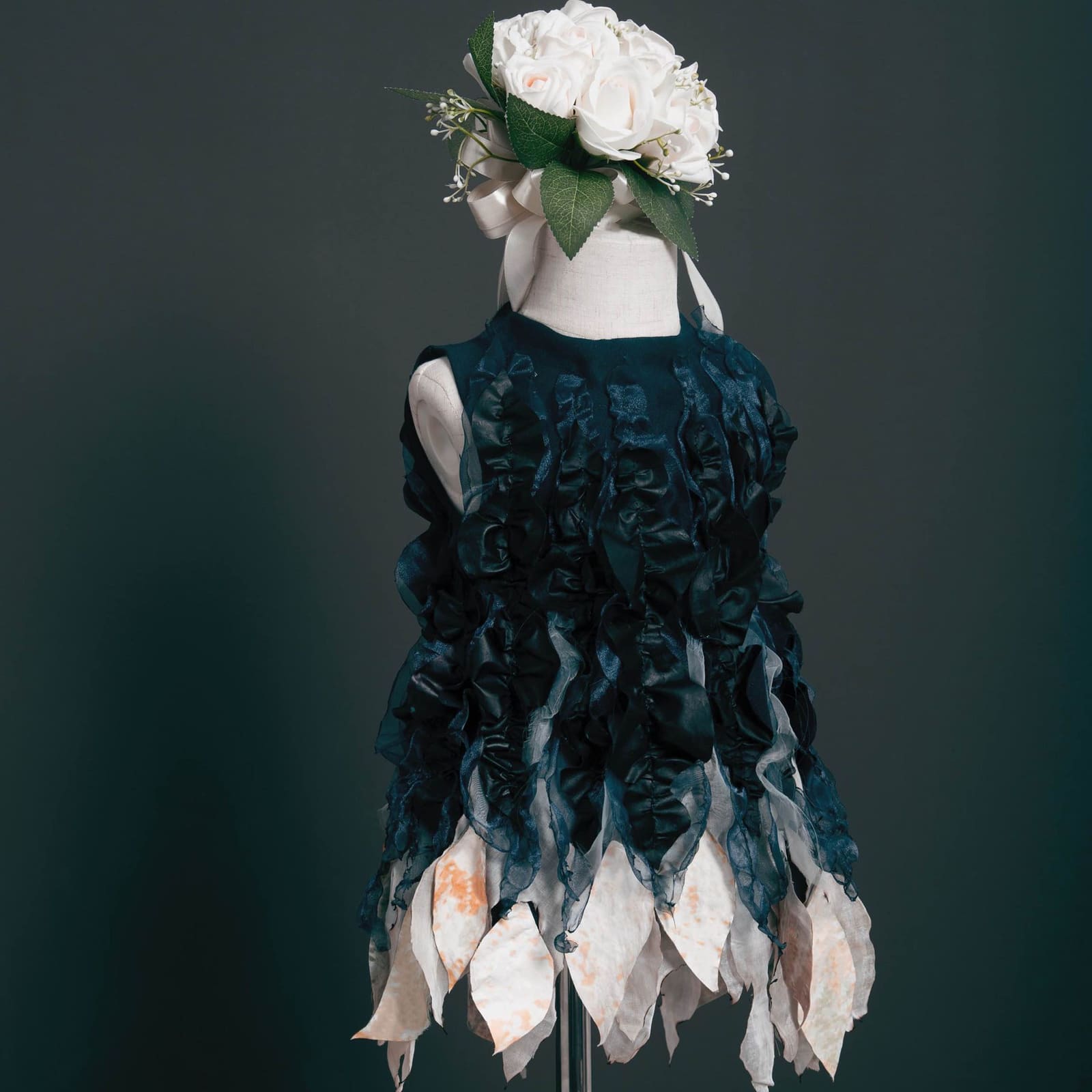
Berlin-based material innovation studio Peelsphere translated the research into wearable form. Founder YouYang Song collaborated with the scientists to produce a prototype dress that showcases several iterations of the fungal textile. The garment's body features the self-pigmented blue variant, achieved through brewer's yeast co-culture. Other sections display the unmodified cordyceps surface, with its pale, fibrous texture.
The dress functions more as proof of concept than production-ready apparel. Its aesthetic is deliberately unpolished, foregrounding the material's organic origins rather than mimicking conventional textile refinement. Surface irregularities, variations in thickness, and the visible structure of mycelial filaments are preserved as design elements. This is not fabric pretending to be something else. It is fungus, alive and visible.
Song's studio, known for a plant-based leather alternative derived from fruit peels and algae, brought expertise in biofabrication workflows and material handling. The construction process involved cutting the fungal sheets and assembling them without traditional stitching in some areas, instead relying on the material's inherent flexibility and the potential for biological bonding at seams. The result is a garment that reads as both textile and organism, occupying an ambiguous category that challenges conventional material classifications.
Durability, Safety, and the Path Forward
Ke Li acknowledges the material's current limitations. Moisture resistance remains a concern, as prolonged exposure to humidity can trigger unwanted germination or compromise structural integrity. Durability under repeated wear and laundering has not been extensively tested. Safety protocols for garments containing living organisms are undefined. Manufacturing consistency, critical for any material aspiring to commercial viability, requires further refinement.
The applications she envisions reflect these constraints: conceptual fashion, accessories, decorative surfaces, exhibition pieces, biodegradable packaging. Contexts where visual expression and a defined product lifetime are prioritized over long-term durability or routine use. The material is not yet ready for everyday clothing or permanent architectural installation, but it opens a speculative space where those applications become imaginable.
At World Archi Design, we have seen precedents for living systems in built environments, from algae bioreactors integrated into building facades to bacterial concrete that self-heals through microbial calcite precipitation. These technologies share a common ambition: to shift material behavior from passive to active, from decaying to self-maintaining. The Shenzhen textile extends that trajectory into the realm of finish and surface, where the line between structure and organism dissolves entirely.
Implications for Adaptive Environments
The broader implications reach beyond garments. If a textile can renew itself, why not a wall surface? If a fabric can be programmed with biological add-ons, what prevents architectural skins from doing the same? The dormant-state strategy that enables this material could be applied to larger-scale systems, where building envelopes respond to seasonal conditions, repair weather damage autonomously, or shift color and porosity in response to environmental cues.
Such visions remain speculative, contingent on solving problems of scale, regulation, and long-term stability. But the precedent is now established. A material can be both living and functional, both biologically active and structurally sound. The challenge shifts from whether such systems are possible to how they can be refined, standardized, and integrated into existing design and construction workflows.
The Shenzhen research does not solve those challenges. It does, however, demonstrate a viable path forward, one that leverages dormancy rather than death, modularity rather than genetic complexity, and biological capacity rather than synthetic augmentation. In doing so, it rewrites the material contract: objects no longer need to be permanent or inert. They can grow, heal, and adapt. They can, in a very real sense, stay alive.
Save this story. A free account keeps your reading list and the 07:00 email in one place.
CREATE FREE ACCOUNT →SIGN IN