
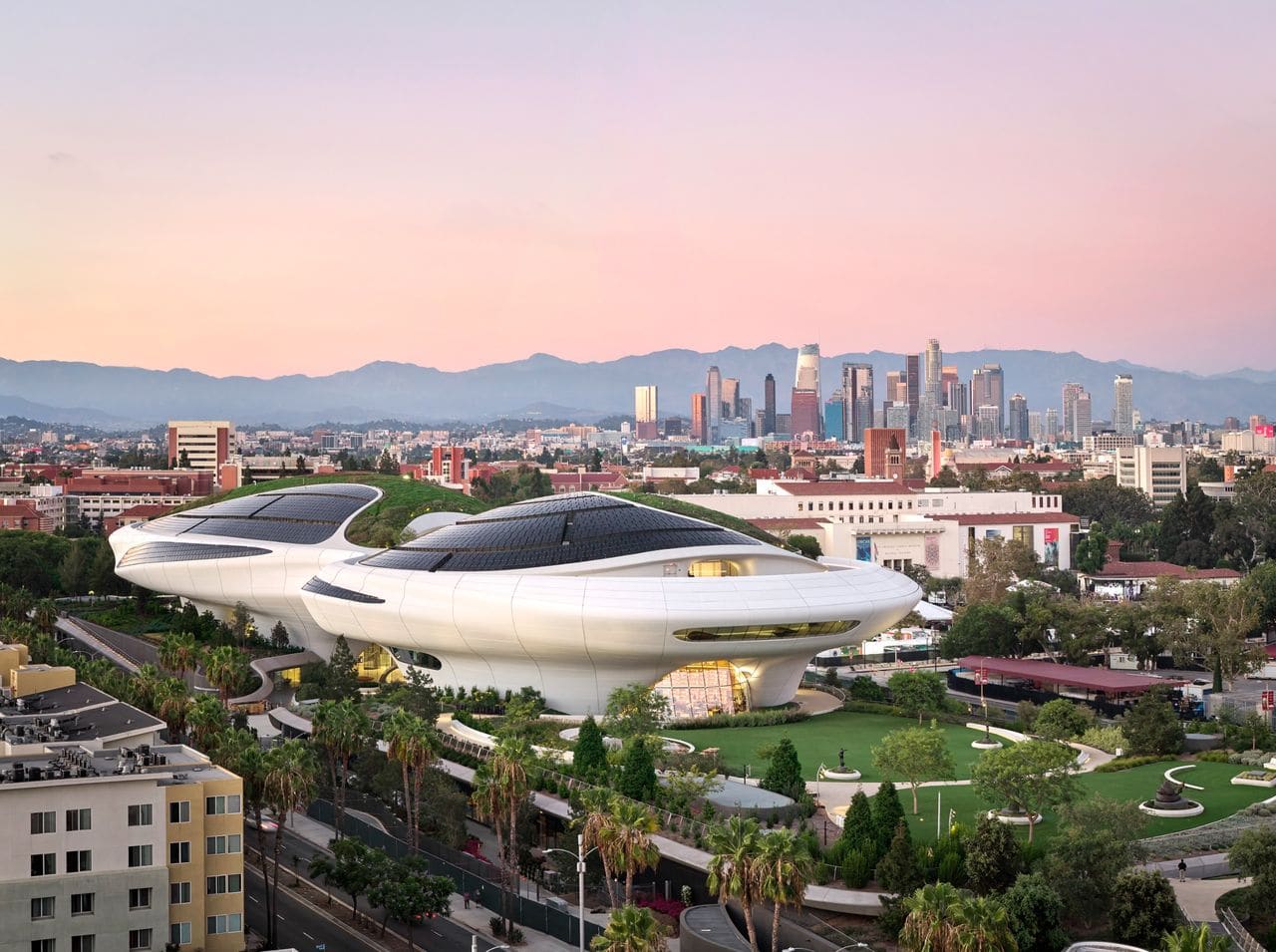
A Museum That Floats Like a Question
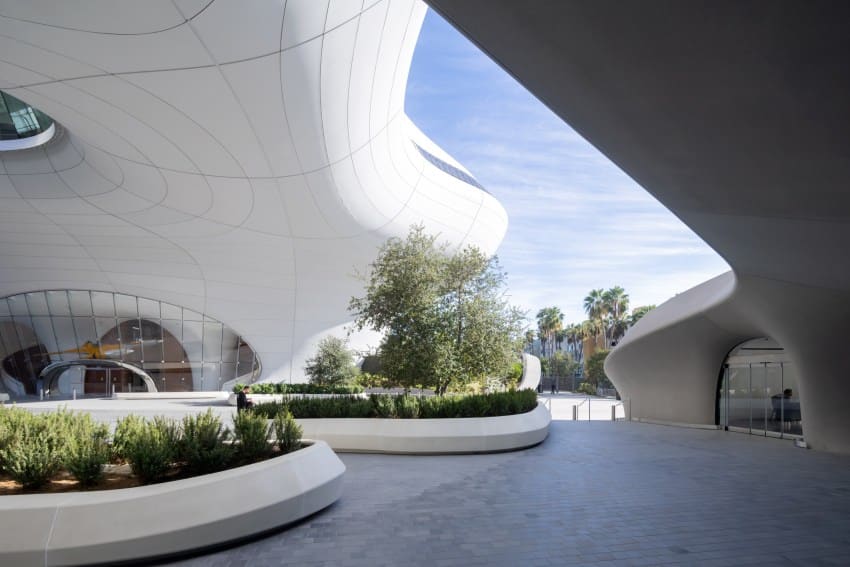
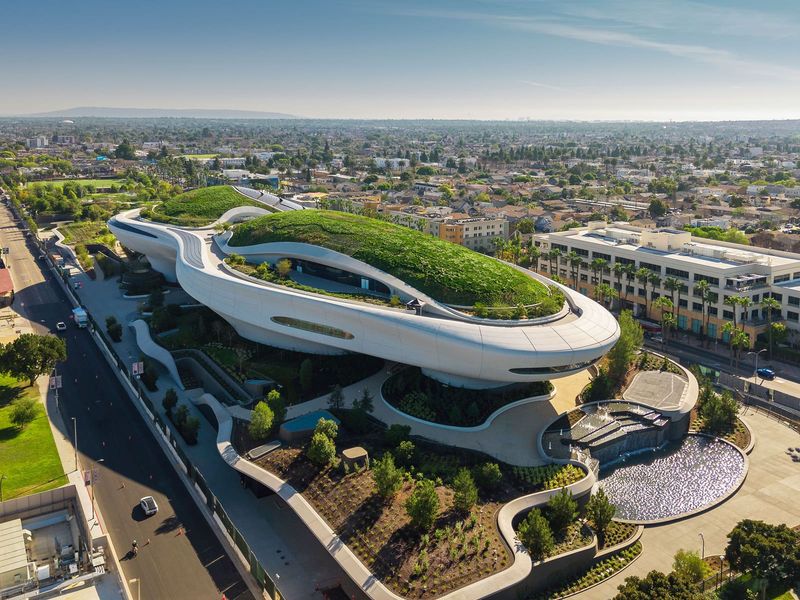
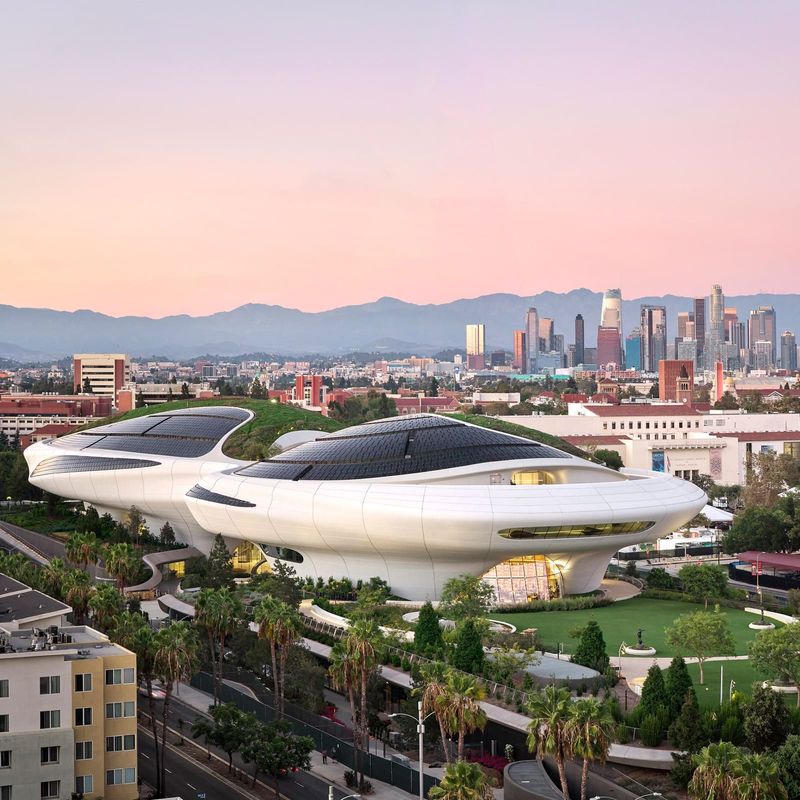
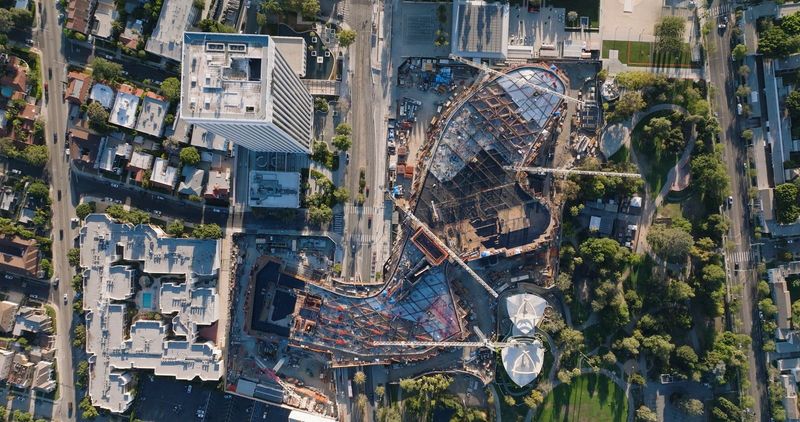
At World Archi Design, we've tracked MAD Architects' evolution from the ethereal Harbin Opera House to the fluid Hainan Science Museum, and the Lucas Museum of Narrative Art in Los Angeles extends that vocabulary into new territory. Ma Yansong describes the building as a cloud, and the metaphor holds: the structure appears to hover above Exposition Park, its curved concrete skin reading as weightless despite the 300,000 square feet of program it contains. A waterfall cascades down the north lawn, completing what Yansong frames as a rainstorm emerging from that cloud. It's poetic, yes, but it's also deeply tectonic. The building's mass is carefully concealed through cantilevers and a recessed ground floor that makes the upper volumes appear to defy gravity.
Critics have compared the form to one of George Lucas's fantastical creatures, and there's truth in that reading. But the more compelling interpretation is structural: MAD has designed a building that refuses the institutional gravity of traditional museums. Where institutions like the Getty or LACMA sit heavily on their sites, asserting permanence and authority, the Lucas Museum reads as transient, almost provisional. That instability is intentional. It mirrors the subject matter inside, which spans cave paintings to contemporary street art, all united by a single thesis: pictures have always been humanity's primary tool for storytelling.
The Argument for Narrative Art
Lucas himself appeared during the press preview to clarify what "narrative art" actually means. His definition is disarmingly simple: art that tells stories. For two millennia, he noted, images were the only available medium for narrative. Before written language achieved widespread literacy, before cinema, before digital media, humans painted on cave walls to communicate events, myths, and ideas. The museum's collection begins with those prehistoric marks and extends through medieval illuminated manuscripts, 19th-century illustration, 20th-century concept art, and contemporary works by artists like Banksy.
The classification system inside the galleries reflects this breadth. Some rooms are organized by artist, with multiple iterations of Norman Rockwell's "Triple Self Portrait" demonstrating how a single creator can interrogate the act of representation itself. Other galleries group works by genre: fantasy, science fiction, adventure. A bronze figure of Indiana Jones marks the entrance to the latter, a winking acknowledgment of Lucas's own contributions to cinematic storytelling. Still other rooms are organized by social context: school, sports, civic life. The civic gallery includes anti-war propaganda dating back to 1971, and the mural section on the upper floor features an original Banksy stencil.
What emerges from this taxonomy is less a coherent art-historical narrative than an expansive argument about ubiquity. Visual storytelling isn't confined to galleries or cinema; it permeates education, politics, recreation, and daily life. The Beatles' Abbey Road photo shoot appears in the photography section, not as rock memorabilia but as an example of how a single staged image can become culturally definitive. The museum's curatorial strategy is to collapse hierarchies between "high" and "popular" culture, between fine art and commercial illustration, between ancient and contemporary. It's a move that will unsettle traditionalists, but it's also architecturally legible: the building itself resists categorization.
Public Space as Narrative Infrastructure
One of the project's most significant gestures happens outside the ticketed galleries. The 11-acre public green space surrounding the museum includes an amphitheater, landscaped gardens, and multiple artworks accessible without admission. A fountain features a statue of Yoda, modeled after the one at Skywalker Ranch but updated to include Grogu clinging to the elder Jedi's robes. It's a small detail, but it encodes the evolution of the Star Wars narrative over decades. The outdoor program signals that the museum's mission extends beyond its walls: visual storytelling belongs to everyone, not just those who can afford a ticket.
The Education Wing reinforces this accessibility. Visitors can enter through one of two main entrances, a parti that echoes MAD's design for the Hainan Science Museum, where multiple points of entry democratize circulation. Inside, a full-scale Naboo Starfighter from The Phantom Menace hangs overhead, and beyond it lies a three-story library open to the public. During the press preview, the shelves displayed a history of Industrial Light & Magic alongside the complete works of Egon Schiele, a pairing that encapsulates the museum's refusal to segregate commercial and fine art practices. The library functions as both resource and argument: if narrative art is everywhere, then its study should be universally available.
The Museum Wing and the Death Star Elevators
Cross the courtyard to the Museum Wing, and the experience shifts. Three tubular glass elevators, which Yansong describes as vehicles for "departing reality," rise through the center of the space. The visual reference to the Death Star is unavoidable, and it's hard to say whether that's homage or irony. Either way, the elevators perform a critical function: they transform the act of moving between floors into a moment of spectacle, a reminder that circulation itself can be narrative.
The ground floor of the Museum Wing houses two theaters that screen films continuously during open hours, and an introductory exhibition titled "The History of Narrative Art: Heroes, Myths, The Sacred." This is where the cave paintings appear, and where Lucas's method becomes explicit. He has never been shy about borrowing from mythology and art history to construct Star Wars, and the exhibition lays those precedents bare. Joseph Campbell's monomyth, medieval quest narratives, and ancient hero cycles are presented as source material, not footnotes.
Upstairs, the Cinema gallery reveals the synthesis. Anakin's life-size pod racer from The Phantom Menace is displayed mid-action, and the original R2-D2 from A New Hope sits nearby. Nearly every artifact is accompanied by concept art from illustrators like Ralph McQuarrie, showing the iterative process by which static images became cinematic sequences. It's a rare institutional acknowledgment of illustration as a foundational practice, not a secondary one. In architecture, we talk about the sketch as the origin of the building; here, the museum extends that logic to filmmaking.
Precedents and Comparisons
MAD's Lucas Museum invites comparison with other recent institutions that blur the line between architecture and spectacle. Frank Gehry's Guggenheim Bilbao remains the obvious reference point: a building so sculptural that it risks overshadowing its contents. But where Gehry's titanium curves read as exuberant, almost celebratory, MAD's concrete cloud is quieter, more introspective. The form is complex, but it doesn't shout. It hovers.
Closer in spirit might be Herzog & de Meuron's Elbphilharmonie in Hamburg, another project where a floating volume redefines a civic skyline. Both buildings use cantilevers to create the illusion of weightlessness, and both employ a single dramatic gesture, a waterfall in Los Angeles and a crystalline concert hall in Hamburg, to anchor the composition. The difference is programmatic: the Elbphilharmonie is a performance venue that occasionally exhibits art; the Lucas Museum is a repository that occasionally performs.
Within the United States, the museum also enters into conversation with Renzo Piano's Academy Museum of Motion Pictures, which opened in Los Angeles in 2021. Both institutions grapple with how to display the ephemera of cinema, objects that were never intended for static exhibition. Piano's solution was to create a spherical theater as a counterpoint to the rectilinear Saban Building; MAD's approach is to dissolve the boundary between exhibition and circulation, making the journey through the museum as narratively significant as the objects on display.
What Happens Next
Tracey Bates, the museum's CEO, framed the institution's success not in terms of attendance or critical reception but in terms of inspiration. If the museum sparks imagination in even one young visitor the way visual storytelling sparked Lucas's imagination decades ago, she suggested, the project will have succeeded. It's a modest benchmark for a building that cost over one billion dollars and took nearly 20 years to realize, but it's also the only one that matters.
The Lucas Museum opens at a moment when the cultural role of museums is being widely debated. Attendance is down at many institutions, and younger audiences increasingly consume culture digitally rather than in physical spaces. MAD's design responds to that shift by making the architecture itself an event, a reason to visit beyond the collection. The floating cloud, the Death Star elevators, the waterfall, these are Instagram-ready moments, and the museum knows it. But beneath the spectacle is a more serious proposition: that visual storytelling, in all its forms, deserves the same institutional validation as painting and sculpture.
Whether that proposition holds will depend on how the collection evolves. The inaugural galleries are heavy on Star Wars and Lucas's own archive, which is both a strength and a limitation. The museum will need to expand its scope, to acquire works by contemporary artists who are pushing narrative art in new directions, if it wants to remain relevant beyond its opening moment. The building, at least, is ready. Its flexible gallery spaces and generous circulation can accommodate a wide range of practices.
For now, the Lucas Museum stands as MAD Architects' most ambitious American project, and as a test case for whether narrative art can sustain a major cultural institution. The cloud has landed in Los Angeles. What stories it will tell in the decades to come remain to be written.
Save this story. A free account keeps your reading list and the 07:00 email in one place.
CREATE FREE ACCOUNT →SIGN IN