
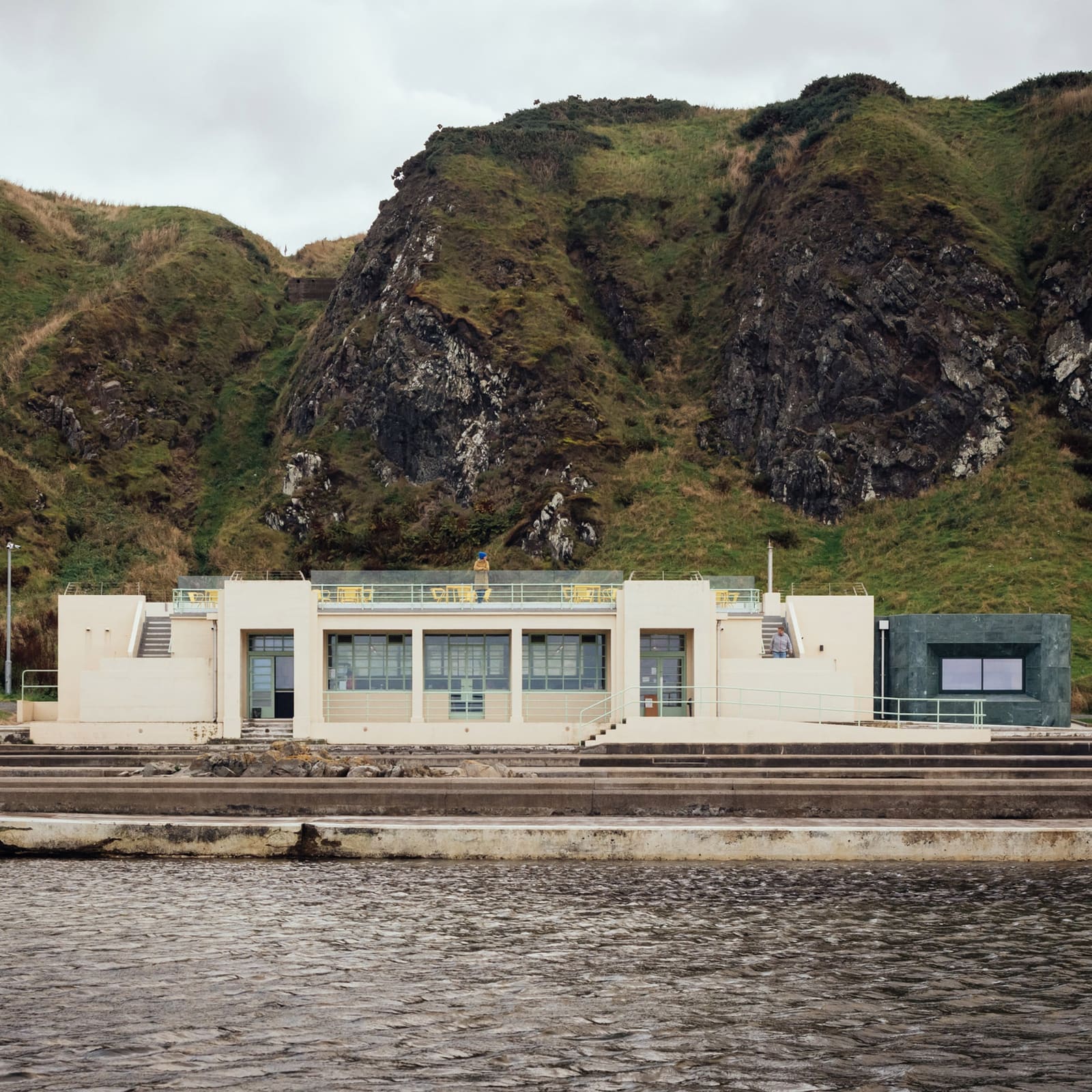
A Pavilion Against the Elements
The North Sea coast of Aberdeenshire is not gentle. Salt spray, wind, and the relentless freeze-thaw cycle of Scottish winters have claimed countless structures over the decades. The Tarlair Outdoor Pool Pavilion, built in the 1930s near Macduff, spent years in dereliction, its art deco lines softened by weather and neglect. London-based Studio Octopi was tasked with bringing the tea pavilion and adjacent lido pools back into public use, a brief that required reconciling the fragility of historic fabric with the demands of one of Britain's most exposed coastlines.
The project, now shortlisted for the RIAS Andrew Doolan Best Building in Scotland Award, represents a particular strand of adaptive reuse: not merely preserving a relic, but re-equipping it for sustained use. Director James Lowe describes the studio's approach as homage rather than replica. The pavilion's original character, its stepped massing and horizontal emphasis, remains legible. What has changed is the envelope.
Forensic Colour and Material Substitution
Studio Octopi's intervention hinges on two forensic exercises. The first was a paint analysis of the pavilion's original railings, which revealed layers of green pigment dating to the 1930s. The second was a material substitution: replacing deteriorated render with marble cladding in a shade that echoes that green. The choice of marble is not ornamental. In this context, it functions as a weather shield, a material capable of shedding water and resisting the corrosive salt air that had eaten through the previous surface.
The green marble cladding wraps the exterior in a continuous skin, a tectonic move that reads as both protective and decorative. It recalls the streamlined facades of interwar seaside architecture, pavilions and lidos that lined British coasts in the 1920s and 1930s, many of which have since vanished. The Tarlair project joins a small cohort of survivors, among them the Saltdean Lido near Brighton and the Tinside Pool in Plymouth, both art deco structures that have undergone similar restoration campaigns in recent years.
The Lido as Social Infrastructure
Lidos occupy a particular place in British architectural history. Built as public health infrastructure during the interwar period, they were democratic spaces, accessible to populations who could not afford private clubs or foreign holidays. The Tarlair pools, carved into the rocky shoreline, offered cold-water swimming in a landscape otherwise dominated by fishing and agriculture. Their decline in the latter half of the 20th century mirrored broader shifts: the rise of indoor leisure centres, the appeal of warmer Mediterranean destinations, and the high cost of maintaining open-air facilities.
The restoration returns the pavilion and pools to their original function, but with contemporary expectations of comfort and safety. New changing facilities, updated filtration systems, and accessible pathways have been integrated without overwhelming the original plan. The tea pavilion, once a modest refreshment kiosk, now serves as a year-round community space, its interior reconfigured to accommodate events and gatherings beyond the summer swimming season.
Reuse as Regional Strategy
The Tarlair project is one of three finalists for the Andrew Doolan award this year, alongside the Paisley Central Library by Collective Architecture and the Edinburgh Futures Institute by Bennetts Associates. The Royal Incorporation of Architects in Scotland noted that all three shortlisted schemes engage with retrofit and reuse, a reflection of shifting priorities within the profession. In Scotland, where historic building stock is dense and demolition costs are high, adaptive reuse has moved from niche practice to mainstream strategy.
The award, established in 2002, will announce its 2026 winner on 26 November. Previous recipients include a public park renewed by Stallan-Brand and LDA Design in 2025, and a series of civic and educational projects that foreground community engagement. The emphasis on reuse this year signals a broader recognition that the most sustainable building is often the one already standing.
Precedent and Departure
Studio Octopi's portfolio includes several waterfront projects, among them the King's Cross Pond Club in London and the Thames Baths proposal, both of which explore the intersection of public recreation and urban water. The Tarlair pavilion extends that inquiry into a rural context, where the client is not a developer but a community trust, and the site is not a gentrifying district but a remote fishing village with a population of fewer than 4,000.
The pavilion's marble cladding, while functional, also marks a departure from the roughcast render typical of Scottish vernacular. It introduces a level of finish more commonly associated with civic monuments than seaside amenities. Whether this reads as appropriately celebratory or incongruously formal will likely depend on one's view of what a restored lido should aspire to be: a faithful reconstruction, or a new building that acknowledges its origins without being bound by them.
Resilience and Longevity
The marble envelope is intended to last. Studio Octopi's choice prioritises longevity over cheaper, faster alternatives, a decision that reflects the realities of coastal maintenance budgets. A render facade might require repainting every five to seven years; marble, if properly detailed, can endure for decades with minimal intervention. This calculus, between upfront cost and lifecycle performance, is central to the logic of the project.
The Tarlair restoration does not solve the broader question of how to sustain heritage infrastructure in remote regions with limited funding. But it offers a model: invest in durable materials, respect the original design language, and programme the building for year-round use. Whether that model can be replicated elsewhere depends on factors beyond architecture, among them local governance, community ownership, and the willingness of funders to back projects that may not generate immediate returns.
The pavilion and lido are now open. On calm days, swimmers return to the seawater pools, and the tea pavilion fills with visitors. On rough days, the green marble holds the line against the North Sea, a material stand-in for the persistence required to keep such places alive.
Save this story. A free account keeps your reading list and the 07:00 email in one place.
CREATE FREE ACCOUNT →SIGN IN