
A System Built on Provocation
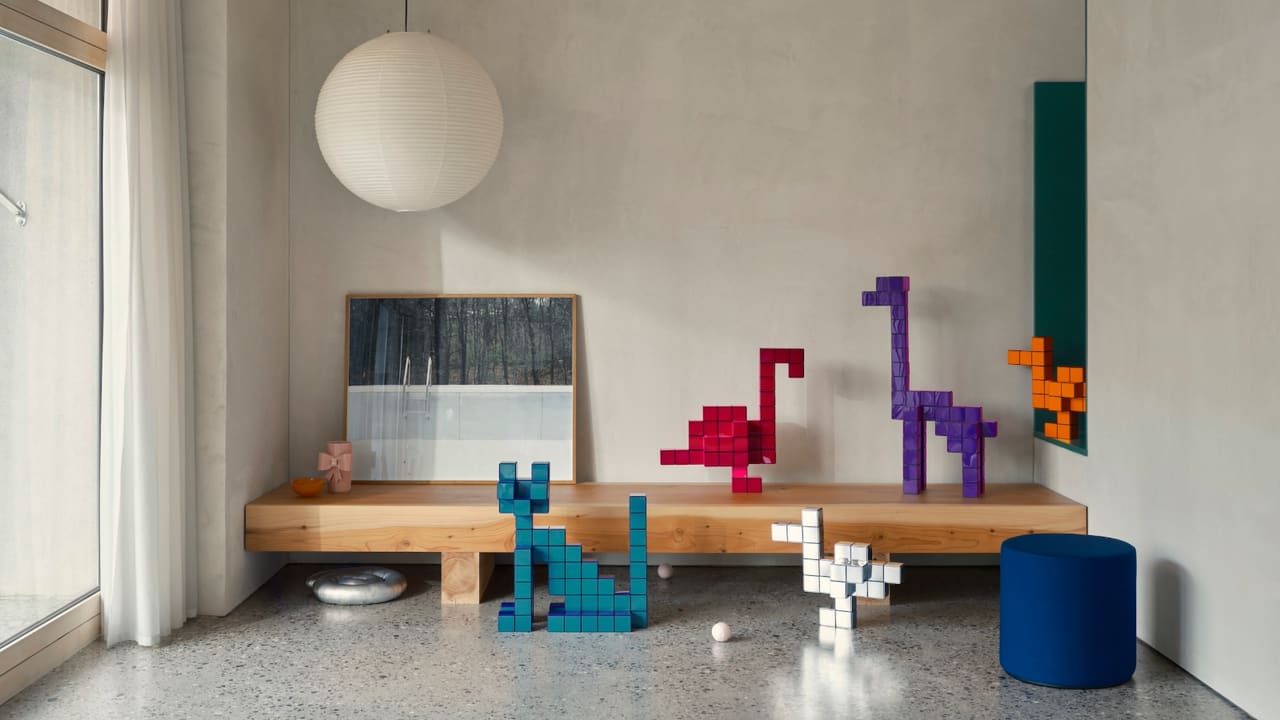
The best design toys refuse to settle. They ask you to reconfigure, reimagine, and occasionally abandon the instruction sheet altogether. Verner Panton understood this impulse, and his modular animal sculptures operated at the intersection of furniture, plaything, and spatial experiment. Now, as the Danish architect's centenary unfolds, Vitra is reissuing four of these clip-together creatures in a format that preserves their geometric restlessness.
The original system emerged in the 1970s through collaboration with Swiss toy maker Naef, under the name Pantonaef. It comprised square frames that snapped into cubes, then linked with clips and fitted with coloured panels. The result was a kit that could become a duck, a flamingo, a cat, a giraffe, or whatever else the builder's spatial intuition suggested. Panton designed it primarily for adults, though its influence on later modular toys, from the Rubik Snake onward, is unmistakable.
From Matte to Mirror
Vitra's re-edition, developed with Verner Panton Design, retains the core assembly logic but shifts the surface treatment. Where the originals came in matte finishes, the new Panton Cubes arrive in glossy chrome or duo-tone colour combinations. Each palette draws from Panton's own chromatic archive, selected in close consultation with his estate.
The shift to gloss is not purely cosmetic. Reflective surfaces interact with ambient light and surrounding colour in ways that matte panels cannot. A chrome duck placed near a window becomes a shifting field of refracted geometry; a flamingo in magenta and orange alters the perceived temperature of a room. Panton spent much of his career exploring how colour and reflection could manipulate spatial perception, and these kits extend that inquiry into the hands of the user.
Geometry as Open Invitation
At their simplest, the kits are assembly puzzles. Each animal comes with the exact number of frames, clips, and panels needed to replicate the intended form. But Panton's real ambition was never replication. The system was designed to be disassembled and recombined, allowing builders to construct hybrids, abstract compositions, or entirely new creatures.
This openness places the Panton Cubes in a lineage of architect-designed toys that prioritize spatial reasoning over narrative. Like Froebel's gifts or the Eames House of Cards, they reward an understanding of balance, modularity, and three-dimensional thinking. The difference is that Panton's system foregrounds colour and surface as active agents in the composition, not just decorative afterthoughts.
A Lesser-Known Facet of a Prolific Career
Panton is best remembered for his sinuous furniture, saturated interiors, and the cantilevered chair that bears his name. The modular sculptures occupy a quieter corner of his output, but they reveal a consistent preoccupation with how geometric systems can generate both order and surprise. Stine Liv Burr, design manager of Classics at Vitra, describes the reissue as highlighting this playful exploration of geometry, colour, and reflection, qualities that run through Panton's entire body of work.
The Panton Cubes also underscore his interest in user participation. Unlike a fixed chair or lamp, these kits demand engagement. They are incomplete without someone willing to clip, adjust, and experiment. In that sense, they align with Panton's broader conviction that design should provoke imagination rather than dictate experience.
Launch and Context
Vitra will introduce the Panton Cubes at the London Design Festival in September 2026, alongside new work from Studio Œ, Erwan Bouroullec, Edward Barber and Jay Osgerby, and Panter & Tourron. The launch takes place at Tramshed, the company's Shoreditch showroom, a venue that has hosted several centenary-related events over the past year.
Meanwhile, archival versions of the original kits remain on view at the Vitra Design Museum's Schaudepot near Basel, as part of a comprehensive survey running until May 2027. That exhibition traces Panton's evolution from architectural draughtsman to colour theorist, situating the modular sculptures within a broader investigation of form, material, and spatial atmosphere.
Why Reissue Now
Centenary tributes often lean toward retrospective reverence, but the Panton Cubes reissue suggests something more active. By updating the finish and reintroducing the system to a contemporary audience, Vitra is not simply memorializing a designer. It is testing whether his ideas about modularity, colour, and user-driven form-making still hold traction in an era of parametric design and digital fabrication.
The answer, at least in material terms, seems to be yes. The kits offer a tactile counterpoint to screen-based spatial exploration, a way to think through geometry with your hands rather than your cursor. And because the system is open-ended, it resists the kind of ossification that often accompanies reissues. Each builder's giraffe will be slightly different, each hybrid creature a one-off.
Reflection as Design Strategy
Panton's use of chrome and glossy finishes was never purely aesthetic. He understood that reflective surfaces could dissolve the boundary between object and environment, making a piece of furniture or a sculpture feel embedded in its context rather than imposed upon it. The Panton Cubes exploit this quality at a smaller scale, turning each animal into a kind of optical instrument that registers and refracts its surroundings.
This strategy aligns with Panton's broader interest in immersive environments. His interiors, from the Spiegel publishing house canteen to the Varna installation, used colour, light, and reflection to create spaces that felt psychologically expansive. The modular sculptures compress that ambition into a handheld format, but the underlying principle remains: design should alter perception, not just occupy space.
A Toy for Architects
The Panton Cubes sit in an ambiguous category. They are too sculptural to be dismissed as toys, too playful to be treated as pure art objects, and too functional, in their way, to be considered merely decorative. This ambiguity is productive. It allows the kits to move between contexts, living rooms, design studios, museum vitrines, without losing coherence.
For architects and designers, the appeal is straightforward. The system offers a quick, low-stakes way to explore massing, proportion, and colour relationships in three dimensions. For everyone else, it is an invitation to think like a designer, to see how a few simple elements can generate complex, surprising forms. Either way, the kits fulfill Panton's original brief: they provoke imagination, and they do so without instruction or constraint.
Save this story. A free account keeps your reading list and the 07:00 email in one place.
CREATE FREE ACCOUNT →SIGN IN