
The Convergence of Typologies
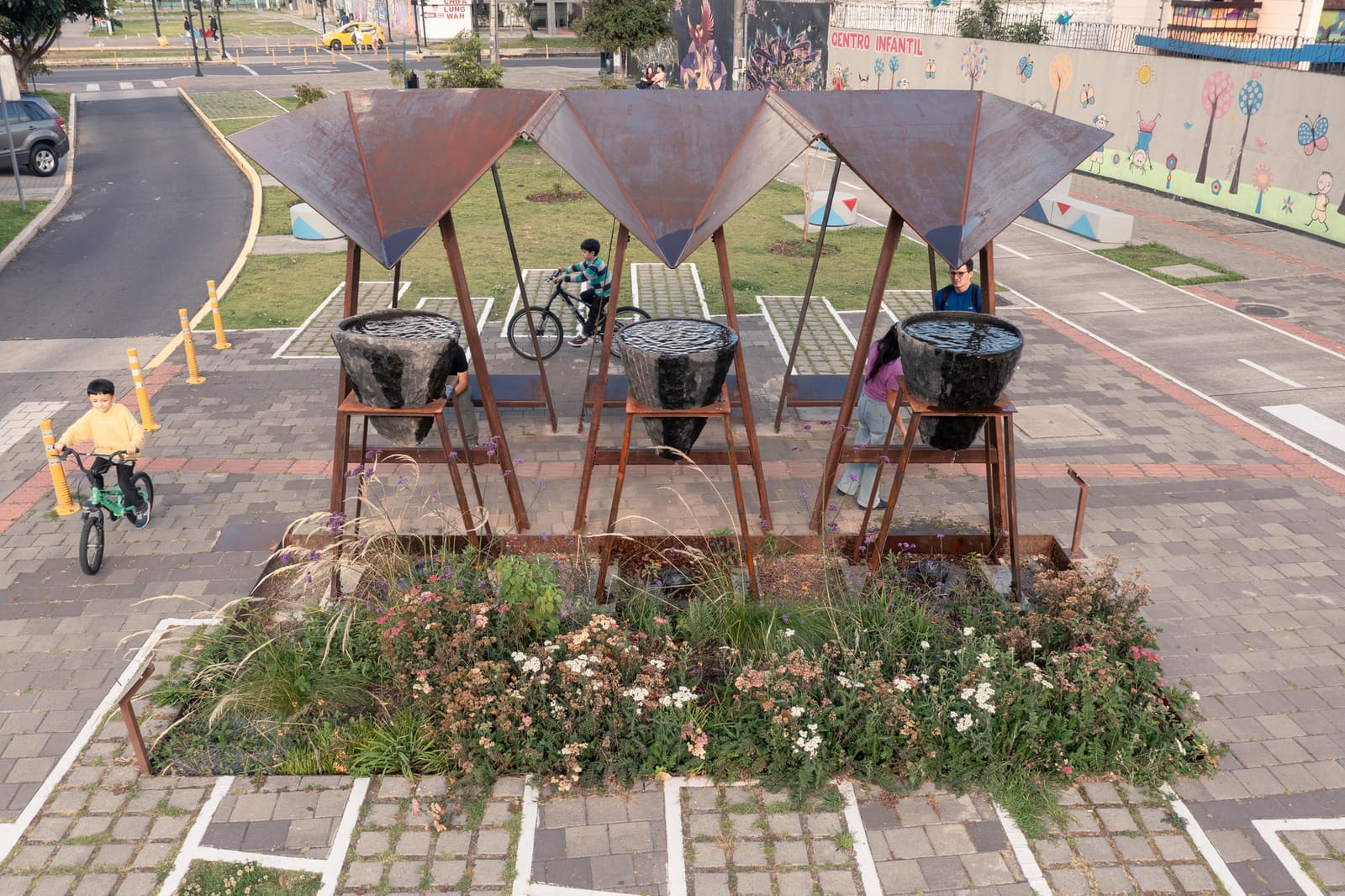
Street furniture rarely performs more than one job. A bench hosts bodies; a planter holds soil. Yet at Isla Tortuga Park in northern Quito, a 27-square-meter installation collapses those categories entirely. Designed by El Sindicato Arquitectura and completed in 2024, the project named Yaku (Kichwa for "water") functions simultaneously as seating, water infrastructure, and ecological pedagogy. Its form is unassuming: modular components in muted tones, arranged to suggest neither monument nor machine. But beneath that restraint lies a hydraulic logic refined over centuries in Andean landscapes, now adapted to the pressures of dense, high-altitude urbanism.
The prototype was developed in collaboration with Cities LAB of the Inter-American Development Bank and Quito's Secretariat of Habitat and Territorial Planning. Xavier Duque, María Reinoso, and Nicolás Viteri led the design team, with technical input from Pedro Ospina and project management oversight from municipal agencies. The choice of site was deliberate: Isla Tortuga Park sits in a neighborhood where impervious surfaces dominate and stormwater systems are overburdened. Here, the module does not merely decorate public space; it intercepts runoff before it enters the municipal network.
Hydraulic Geometry and Material Choices
The module's footprint is compact, yet its capacity to capture and store precipitation is disproportionate to its size. Rainwater is funneled through a series of sloped surfaces into a subsurface reservoir, where it is held temporarily before being released into the ground at a controlled rate. This mimics the infiltration patterns of vegetated watersheds, a hydrological model that urbanization typically erases. The design does not rely on pumps or electronic controls; gravity and grading do the work.
Materials were selected for durability and local sourcing. Plastigama, an Ecuadorean manufacturer, supplied components that resist UV degradation and thermal cycling, both critical at Quito's 2,850-meter elevation. The palette avoids the bright pastels common in Latin American public furniture, opting instead for earth tones that recede visually, allowing the water-harvesting function to remain legible without didactic signage.
The modular system is designed for flexibility. Units can be arrayed in linear configurations, clustered around existing trees, or dispersed across plazas. Each module is self-contained, requiring no connection to municipal water or drainage lines. This portability makes the system adaptable to informal settlements, where infrastructure is often patchwork and ad hoc.
Precedents in Integrated Landscape Systems
Yaku belongs to a lineage of projects that blur the boundary between furniture and infrastructure. In Rotterdam, the Benthemplein water plaza by De Urbanisten transforms a schoolyard into a cascading basin during storms. In Philadelphia, stormwater tree trenches along Green Street function as both shade canopy and bioswale. These precedents share a common premise: that public space can absorb environmental pressures without sacrificing social function.
What distinguishes the Quito prototype is its scale and replicability. Where the Rotterdam plaza spans several thousand square meters and required significant excavation, Yaku's modules can be installed on existing pavements with minimal site preparation. The design team has documented assembly sequences and material specifications with an eye toward replication across Ecuador and neighboring Andean cities, where water scarcity and flash flooding coexist as twin crises.
The project also engages with vernacular water management traditions. Pre-Columbian societies in the Andes engineered terraces, canals, and infiltration basins that sustained agriculture in arid highlands. While Yaku does not mimic those forms directly, it revives the underlying principle: that water should be held, slowed, and absorbed rather than rushed away. In a city where colonial-era drainage systems were designed to expel water as quickly as possible, this represents a conceptual shift.
Performance and User Interaction
Since its installation, the module has been monitored for both hydraulic performance and social use. Preliminary data collected by the technical team indicates that the system can intercept approximately 80 percent of rainfall from a ten-square-meter catchment area during typical storm events. Excess water overflows into adjacent planted zones, extending the infiltration network beyond the module itself.
User behavior has been equally telling. The seating surfaces are occupied throughout the day, suggesting that the module functions legibly as public furniture. Informational plaques explain the water-harvesting mechanism, though observation suggests that many visitors engage with the system intuitively, tracing the flow paths with their eyes or hands. This dual legibility, both functional and pedagogical, is rare in infrastructure projects, which tend to hide their operations behind walls or underground.
The project does not claim to solve Quito's water challenges at scale. A single module in a single park cannot reverse decades of hydrological disruption. But it offers a template. If replicated across the city's 400-plus public parks and plazas, the cumulative effect could be substantial: reduced strain on stormwater networks, recharged aquifers, cooler microclimates, and a visible reminder that urban water is not waste but resource.
Implications for High-Altitude Urbanism
Quito's geography presents unique constraints. The city sprawls along a narrow valley flanked by volcanic peaks, with limited horizontal expansion possible. Density is increasing, yet green infrastructure lags. Rainfall is seasonal and intense; runoff carves gullies through informal settlements on the valley slopes. In this context, distributed, low-tech interventions like Yaku may prove more effective than centralized gray infrastructure.
The prototype also raises questions about authorship and ownership. Public furniture is typically procured through municipal contracts and maintained by city agencies. Yaku, by contrast, was designed by a private studio, funded by an international development bank, and installed on public land. This hybrid model reflects broader shifts in how cities finance and implement climate-adaptive infrastructure, particularly in the Global South, where municipal budgets are constrained.
At World Archi Design, we have tracked similar projects in Medellín, Lima, and Bogotá, cities grappling with rapid growth and environmental volatility. What links them is a pragmatic turn toward multifunctional design: infrastructure that earns its place in the public realm not through monumentality but through quiet, persistent service. Yaku exemplifies that ethic. It does not announce itself; it works.
Save this story. A free account keeps your reading list and the 07:00 email in one place.
CREATE FREE ACCOUNT →SIGN IN