When Production Design Meets Prefabrication
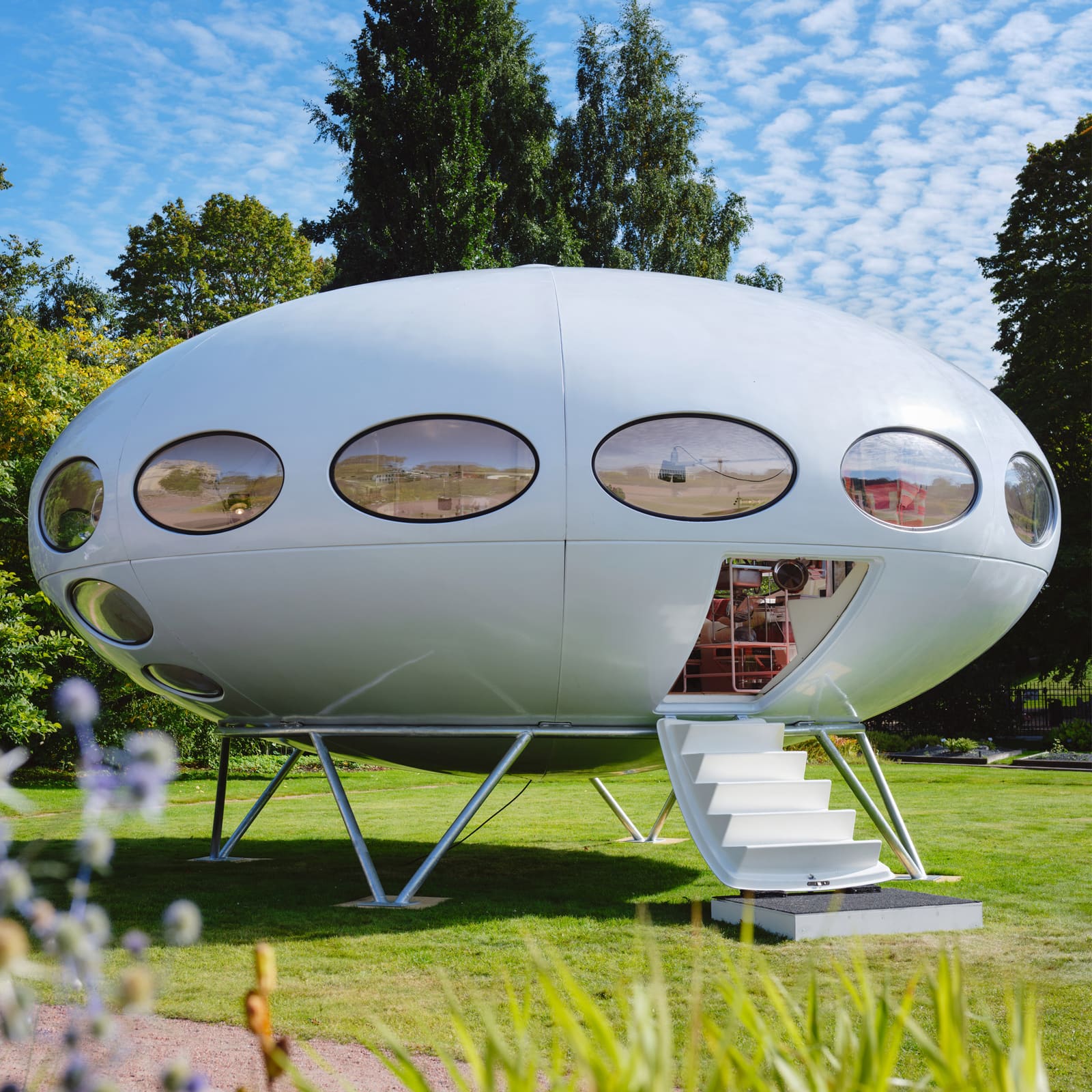
Some buildings refuse to die quietly. Matti Suuronen's Futuro House, that fibreglass-reinforced plastic disc conceived in 1968 as a transportable ski cabin, has occupied an odd position in architectural memory: too famous to forget, too impractical to reproduce, and scattered across continents in fewer than 60 surviving examples. The original production run, which yielded fewer than 100 units worldwide, ceased shortly after the 1973 oil crisis sent resin prices soaring. For decades, the Futuro existed primarily as a relic, a shorthand for space-age optimism that never quite found its mass market.
That changed in 2024, when a materials executive at Exel Composites in Finland posted the original Futuro moulds for sale on Facebook. The moulds had been sitting in storage since the early 1990s, when Exel acquired the assets of PolyKem, the plastics company that had fabricated 20 Futuros in Finland before bankruptcy. Jan van Dijs, a Dutch-American preservation architect who has spent much of his career restoring mid-century houses in California, was alerted to the listing by a friend. At the time, he knew the Futuro only in passing. What followed was a five-month fabrication effort that resulted in the first new Futuro House in half a century, unveiled in late June 2026 and installed in Helsinki's Kaisaniemi Botanical Gardens for Helsinki Design Week.
The Challenge of One-Part Moulds
When van Dijs flew to Finland in May 2025 to inspect the moulds, they were languishing in a field, covered in moss and grass. The exterior looked, in his words, "like hell". The pieces had been moved periodically between storage facilities over the decades, without purpose or care. Yet the decision to proceed was made quickly. Working with Finnish plastic fabrication company Ekin Muovi, van Dijs set about restoring the moulds and recasting the panels with the aim of producing a faithful reconstruction of Suuronen's design, down to the original paint colours matched from scraps that remained on the mould surfaces.
The fabrication process proved more complex than anticipated. Contemporary plastic moulding relies on two-part moulds: one to pour the cast into, one to press over it to eliminate air. Suuronen's moulds are single-part, meaning air bubbles must be worked out by hand. Casting a single panel took days instead of hours, a labour-intensive approach that van Dijs suggests was a significant contributor to the Futuro's commercial failure in the 1970s. Nobody fabricates this way anymore. The entire process, including mould restoration, cost approximately 450,000 euros, though van Dijs estimates future units could be produced for under 300,000.
One unexpected discovery: the moulds included furniture designs by Suuronen that had never been widely documented. Built-in lounge chairs, a dining table, and the Orbit chair were reproduced as part of the project, offering a more complete picture of Suuronen's vision for the interior.
Marimekko and the Question of Contemporary Use
For the Helsinki Design Week installation, Finnish design brand Marimekko was invited to create an interior for the new Futuro. Creative director Rebekka Bay divided the open circular plan into three zones: lounging and sleeping, eating and working, and a kitchenette. The brand's products were displayed on perspex shelving units that function as transparent room dividers, while stripy prints created by Danish textile artist Vibeke Rohland during a recent residency were used to upholster the furniture.
Bay's approach was deliberate in its rejection of period nostalgia. Rather than mining Marimekko's 1968 archives for prints contemporary to the Futuro's original production, the team used brand-new textile designs. The aim, Bay explained, was to propose a lived-in, tactile quality that speaks to current trends towards downscaling rather than merely recreating a 1960s aesthetic. The result is an interior that reads as a proposal for how one might inhabit the Futuro today, not how it was inhabited half a century ago.
Yet the practical question remains unanswered. Suuronen designed the Futuro to be quick to assemble, quick to heat, and suitable for difficult terrain. It succeeds on those fronts. But it is also cramped, tricky to transport in practice, and poorly insulated by contemporary standards. Its original market, ski resorts in remote locations, has largely moved on. Bay suggested the structure might work well as a summer cabin in the Finnish countryside. Van Dijs proposed alternative uses: a small office, a yoga studio, an architectural bookshop. These are plausible, if modest, ambitions for a structure once imagined as a mass-produced housing solution.
The Limits of Resurrection
Van Dijs plans to produce new Futuro Houses to order, but the run will be limited. Casting moulds, like printing plates, are designed for a finite number of editions. The original moulds were likely near the end of their lifespan when production stopped in the 1970s. Through restoration, van Dijs and Ekin Muovi have extended that life, but not indefinitely. Van Dijs estimates the moulds will support between four and six new units. After that, they will be destroyed, marking what he calls "the end of the original Futuros".
This built-in obsolescence is, in a sense, fitting. The Futuro was always a product of its moment: a time when fibreglass-reinforced plastic seemed like the material of the future, when prefabrication promised to democratise design, and when the formal language of aerospace and consumer products felt applicable to architecture. British critic Justin McGuirk once described the Futuro as "the closest housing ever came to product design", a comment that captures both its appeal and its limitations. The Futuro succeeded as an object, a sculptural emblem of a particular strain of mid-century optimism. It struggled as a building.
Van Dijs regards the Futuro as an important touchstone for post-war creativity, the same conditions from which Marimekko emerged in 1951. He sees his project as a reigniting of that spirit, and he argues that the Futuro should be considered an icon of Finnish design, a status it did not hold during its original production. There is merit in this view. The Futuro's formal clarity and commitment to prefabrication align it with a lineage that includes Buckminster Fuller's Dymaxion House and the Monsanto House of the Future, structures that proposed radically different relationships between architecture, industry, and everyday life.
What Remains
With Helsinki Design Week concluded, discussions about the new Futuro's permanent home are ongoing. Van Dijs has expressed a preference for it to remain on public display in Finland. Bay hopes it will move to the countryside, perhaps fulfilling Suuronen's original vision of a transportable cabin. Either outcome would be defensible. The Futuro is both a public symbol and a private retreat, and its cultural value exists in tension with its intended domestic scale.
The project raises broader questions about what we choose to preserve and reproduce. Suuronen's design was a commercial failure, a victim of bad timing and economic forces beyond its control. Its resurrection is not driven by practical demand but by cultural interest, a desire to see and inhabit a piece of architectural history that never fully materialised. This is preservation as speculation, an attempt to complete a trajectory that was interrupted rather than resolved.
At World Archi Design, we have tracked similar efforts: the reconstruction of Buckminster Fuller's Dymaxion prototypes, the ongoing restoration of Jean Prouvé's prefabricated houses, the attempts to revive Archigram's unbuilt proposals through digital modelling. These projects operate in a grey zone between historicism and invention, using contemporary methods to realise or re-realise visions that were either abandoned or never fully executed. The Futuro's return is part of this pattern, a reminder that some ideas remain compelling even when their practical justification has long since evaporated.
Whether the Futuro will find a sustainable use in 2026 remains uncertain. What is clear is that Suuronen's moulds, rescued from a field in Finland and coaxed back into production, have yielded one more iteration of a design that refuses to be entirely forgotten. Four to six more may follow. After that, the moulds will be destroyed, and the Futuro will return to the status it has occupied for decades: a fixed set of objects, scattered across the globe, each one a fragment of a future that never arrived.
Save this story. A free account keeps your reading list and the 07:00 email in one place.
CREATE FREE ACCOUNT →SIGN IN