
The Interlude as Destination
There's a moment in every museum visit when the eyes tire, when the procession of artworks demands a pause. For decades, institutions treated this need as logistical necessity, tucking cafeterias into back corners or basements. Yet the most thoughtful cultural institutions now recognize what should have been obvious all along: the break between galleries offers its own opportunity for design to speak.
At World Archi Design, we've observed a shift in how museums approach their dining spaces. Rather than afterthoughts, these rooms have become extensions of curatorial vision, places where visitors can metabolize what they've seen while inhabiting architecture that rewards sustained attention. The best of them strike a delicate balance between honoring their context and asserting their own aesthetic position.
The Victorian Prototype: Ornament as Infrastructure
When the V&A Museum opened its dining rooms in 1868, it established a precedent that still resonates. Designer James Gamble conceived the central Gamble Room not as mere decoration but as applied problem-solving. The Italian Renaissance-inspired majolica tiles, enameled iron ceiling panels, and stained glass served dual purposes: they created visual splendor while remaining impervious to the steam, grease, and odors endemic to 19th-century food service.
Adjacent spaces extended this logic. William Morris's design for what became the Morris Room wove Gothic and Elizabethan references into a cohesive environment, while the Poynter Room's blue-and-white tilework nodded toward Middle Eastern ceramic traditions, all materials chosen for their durability as much as their beauty. The approach reveals an early understanding that museum dining spaces should embody institutional values. If the V&A championed decorative arts, its café needed to demonstrate how ornament could be functional, how beauty could withstand daily use.
This principle of purposeful decoration has echoed through subsequent museum dining design, though contemporary approaches often invert the equation, using restraint rather than abundance to make their point.
Cinematic Nostalgia in a Contemporary Art Setting
Wes Anderson's 2015 design for Bar Luce at Milan's Fondazione Prada operates differently. Here, the director translated his signature aesthetic into three dimensions, creating what he described as fulfilling a childhood fantasy. The space reads as a film set made permanent: retro wooden paneling, pistachio-green and pink Formica surfaces, and architectural murals that reimagine the glass decoration of the Galleria Vittorio Emanuele.
The intervention is pure pastiche, yet it works precisely because of its context within a contemporary art foundation. Where a traditional museum might demand reverence, Fondazione Prada's programming embraces the intersection of high and popular culture. Anderson's design acknowledges the classic Milanese café typology while rendering it through his distinctly mannered lens. The result feels simultaneously familiar and uncanny, a space that could exist only in this particular cultural moment.
This approach represents one pole of museum dining design: the bold insertion that declares its difference from surrounding collections. It's a strategy that requires confidence and institutional backing, a willingness to let a singular vision dominate a public space.
The Courtyard as Respite: Layering Eras in Paris
The Petit Palais, built for the 1900 Universal Exposition, demonstrates an alternative approach. Its Café 1902 occupies a tree-filled courtyard, maintaining the building's Belle Époque grandeur while introducing contemporary materials. Wood, marble, cane work, and petrol-blue accents create an understated modern intervention that doesn't compete with the surrounding architecture.
This restraint serves the space well. Museum fatigue is real, and visitors often need visual quiet as much as physical rest. The courtyard setting provides exactly this: a buffer zone where classical French architecture frames greenery and contemporary design elements add warmth without demanding attention. The café becomes a transitional space, neither fully inside the museum nor entirely separate from it.
Similarly, Le Nélie at the Musée Jacquemart-André preserves the 19th-century mansion's original grandeur while functioning as a modern tea room. Gilt-framed tapestries and antique paneling create continuity with the museum's collection of decorative arts, while the menu draws inspiration from artists represented in the galleries. Here, the dining experience extends curatorial themes rather than contrasting with them.
Jean Nouvel's Latticework and the Choreography of Light
The Louvre Abu Dhabi presents a more complex case. Jean Nouvel's architecture centers on a massive latticework dome that filters sunlight into geometric patterns, creating what the architect calls a "rain of light." The museum's dining program responds to this with multiple interventions: a permanent café, seasonal pop-ups like the Trio coffee shop positioned beneath the dome, and the Art Lounge, which opens on the rooftop during cooler months.
This multiplicity reflects the building's relationship to its desert and maritime context. Rather than a single grand statement, Nouvel's design creates varied experiences of light, shadow, and views. The dining spaces follow suit, offering different vantage points on the Abu Dhabi skyline and coastline. The Art Lounge, particularly, functions as an architectural viewing platform, a place to observe how the building performs at sunset.
This choreography of dining experiences within a single institution suggests another model: the museum as a landscape of varied spatial experiences, where eating and drinking provide excuses to inhabit different architectural conditions.
Historic Palaces and Contemporary Insertions
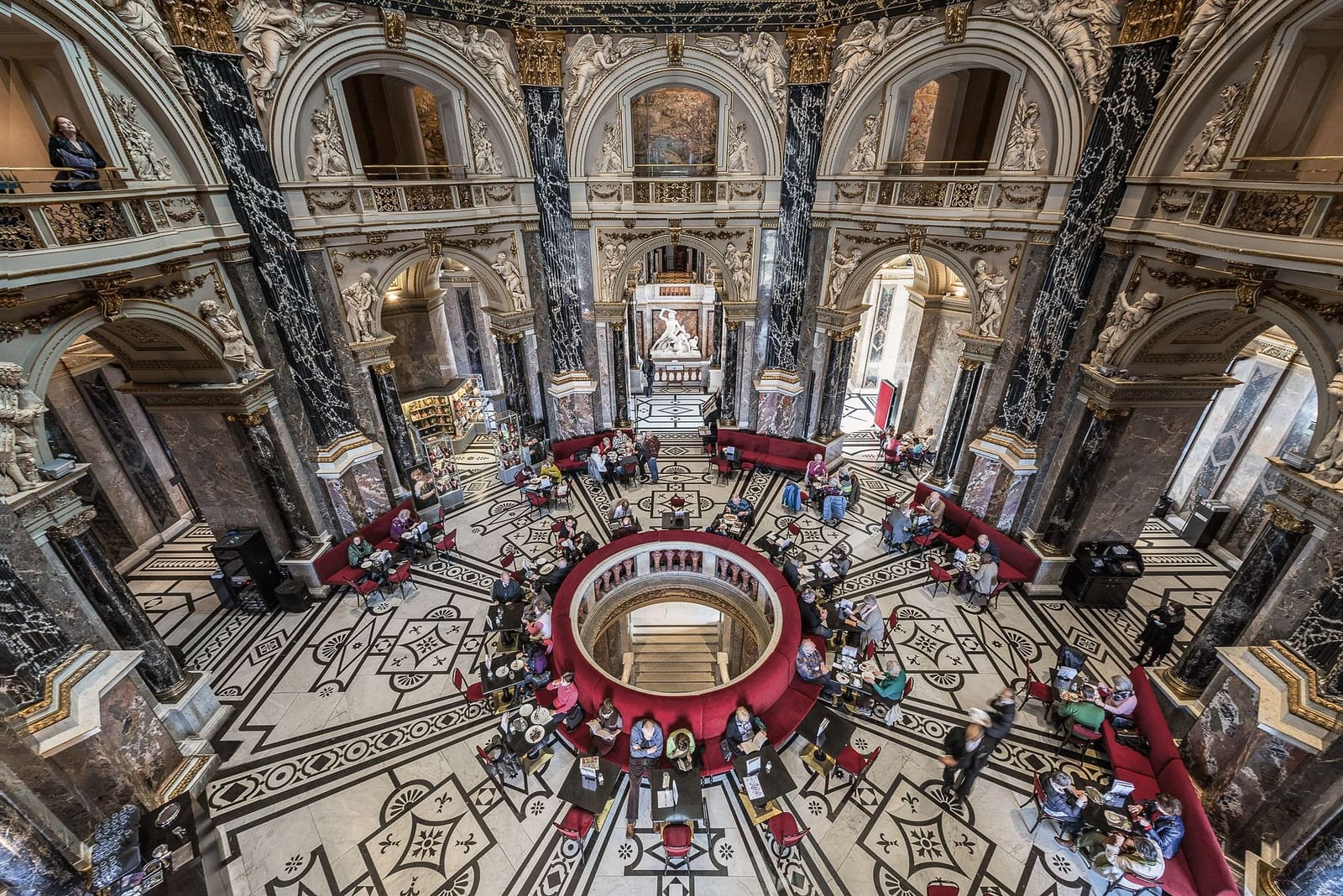
When museums occupy former palaces or civic buildings, designers face the question of how to mark contemporary use without compromising historical fabric. At Vienna's Kunsthistorisches Museum, the solution was minimal intervention. The 1890s octagonal cupola with its gilded archways and ornate floor tilework simply hosts red sofas and black marble columns. The architecture does the work; furniture and service create the café.
The Museo Correr in Venice takes a similar approach, preserving classical tableaux on the walls while adding amethyst velvet banquettes and geometric marble floor patterns. Its location overlooking St. Mark's Square turns the act of dining into a viewing opportunity, the café functioning as a frame for observing the piazza below.
Absis Restaurant at Barcelona's Museu Nacional d'Art de Catalunya offers a more assertive contemporary gesture. Occupying the Palau Nacional's former marble-clad throne room, the design contrasts original stone with a slanting mirrored ceiling and partitions in timber and gold. The mirror expands and fragments the historic space, creating a perceptual complexity that prevents the room from feeling like a period piece. It's an intervention that announces itself while respecting the envelope it inhabits.
Regional Identity Through Material and Menu
Several museum dining spaces use local materials and culinary traditions to assert regional identity. At Marrakech's Dar El Bacha Museum, housed in the former Pasha's palace, Bacha Coffee employs fretwork screens, palm trees in elaborate planters, and checkered flooring to honor traditional Moroccan architecture. The space also functions as a coffee museum of sorts, offering over 200 single-origin varieties.
Singapore's National Gallery, occupying the restored Supreme Court and City Hall buildings, takes this approach further through chef Violet Oon's National Kitchen. The menu focuses on Singaporean culinary heritage, blending Chinese, Malaysian, and Indian influences through what Oon calls heirloom recipes. The interior matches this cultural synthesis with dark, opulent materials in black, gold, and emerald green, illuminated by mirrors and crystal chandeliers. The Singapore High Tea reimagines British colonial tradition through local ingredients, a culinary parallel to the adaptive reuse architecture.
The French-Egyptian Hybrid: Ladurée at the Pyramids
Ladurée's outpost at the Grand Egyptian Museum in Giza presents a curious case of cultural transplantation. The Parisian patisserie brings its signature white and gold filigree interiors, crystal chandeliers, and neoclassical detailing to a contemporary museum building with views of the pyramids. It's a deliberate juxtaposition: French luxury goods aesthetics against ancient Egyptian monuments and 21st-century architecture.
The contrast could read as jarring, yet it reflects the reality of contemporary cultural institutions, which increasingly operate as global brands while serving local and tourist audiences. The museum also offers Beano's Café, designed with regional materials including Aswan granite, alabaster, and basswood, providing an alternative for visitors seeking a more contextually rooted experience.
This dual approach acknowledges that museum dining serves multiple purposes: as architectural experience, as cultural statement, and as practical necessity for visitors spending hours in galleries. Different audiences will gravitate toward different options based on their own cultural reference points.
What Museum Dining Reveals About Institutional Values
The attention institutions now devote to their dining spaces reflects broader shifts in how museums understand their mission. These are no longer solely repositories of objects but social spaces, places where people gather, linger, and form memories that may have little to do with the collections themselves.
The architecture of museum dining rooms signals what institutions value beyond their core holdings. A meticulously restored historic café suggests commitment to preserving all aspects of a building's heritage. A bold contemporary insertion demonstrates willingness to layer eras and aesthetics. Regional materials and menus assert local identity in an increasingly globalized museum landscape.
For architects and designers, these spaces present particular challenges. They must accommodate high volumes of visitors and the operational requirements of food service while creating environments worthy of sustained attention. The best solutions recognize that museum dining occupies a liminal zone: not quite gallery, not quite restaurant, but something that draws from both typologies.
The Pause That Completes the Visit
We return to the original premise: these spaces function as aesthetic aperitifs, preparing visitors for what follows or helping them process what came before. Yet the metaphor only goes so far. Unlike an aperitif, which stimulates appetite for the main course, the best museum dining rooms offer something complete in themselves, experiences that justify a visit even for those who never enter the galleries.
This dual function represents perhaps the most successful outcome for museum dining design. When these spaces achieve architectural distinction while serving practical needs, they expand what a museum can be. They transform the necessary pause into an opportunity, the logistical requirement into a destination. And they remind us that cultural experience encompasses more than the objects on display, extending to every space visitors inhabit and every moment they spend within institutional walls.
Save this story. A free account keeps your reading list and the 07:00 email in one place.
CREATE FREE ACCOUNT →SIGN IN