
A Question of Spatial Inheritance
When a young architecture studio sets out to design a bar, the temptation to mimic celebrated precedents can be overwhelming. Yet in the case of Bar Bardo, a 55-square-metre listening bar situated across from Milan's well-known Bar Basso, the local practice NM3 chose a more nuanced path: understanding the spatial logic of early modernist interiors without replicating their aesthetic signatures. Co-founder Francesco Zorzi frames the project as an aspiration rather than homage, citing Adolf Loos's American Bar in Vienna (completed in 1908) and Robert and Trix Haussmann's Kronenhalle bar in Zurich as conceptual touchstones. The aim, according to Zorzi, was to develop a bar with distinct architectural character suited to Milan, not to transpose historical forms into a contemporary setting.
This approach reflects a broader shift in how emerging practices engage with modernist heritage. Rather than treating iconic interiors as stylistic templates, NM3 extracts principles: compact planning, material restraint, and the orchestration of reflection and enclosure. The result is a project that feels rooted in a lineage without appearing derivative.
Material Continuity and Acoustic Performance
The walls and ceiling of Bar Bardo are clad entirely in polished rosewood panels, a decision driven by both spatial and acoustic considerations. In a single-room venue of this scale, hard surfaces can amplify conversation and music to uncomfortable levels. The rosewood, with its natural density and warm finish, absorbs mid-range frequencies while contributing visual warmth. The choice of wood also establishes a tonal continuity across the interior, unifying disparate elements under a single material logic.
At the centre of the room sits a custom stainless steel bar, a signature element for NM3 since the studio's founding in 2020. The gleaming surface reflects a series of globular pendant lamps designed by Luigi Caccia Dominioni in the 1950s, the only vintage objects in the space. NM3 modified these fixtures by replacing their original suspension chains with longer black versions, adjusting their height to suit the room's proportions and enhance the interplay between light and reflective steel.
This layering of materials - polished wood, mirror-finish metal, and suspended glass - recalls the spatial tactics employed by Loos in his American Bar, where mirrors and onyx multiplied the perceived volume of a diminutive interior. Here, the effect is less about illusion and more about calibrating brightness and texture across a compact footprint.
Adaptability Through Restraint
Built-in banquette seating upholstered in red velvet lines the perimeter of the space, matched by crimson curtains and a series of bright red speakers distributed throughout the room. The speakers accommodate a stainless steel DJ booth and metal shelving for vinyl records, reinforcing Bar Bardo's identity as a listening venue. Yet the interior was conceived with flexibility in mind. With the exception of the bar and banquettes, every element is movable. By removing freestanding furniture, the space can transition from cocktail bar to club without structural intervention.
This strategy aligns with a growing interest in adaptive interiors, particularly in urban contexts where rental agreements and programme needs shift frequently. NM3's solution is architectural rather than mechanical: fixed elements define the spatial envelope, while loose furnishings allow for reconfiguration. The simplicity of the approach belies its effectiveness.
The Bathroom as Material Study
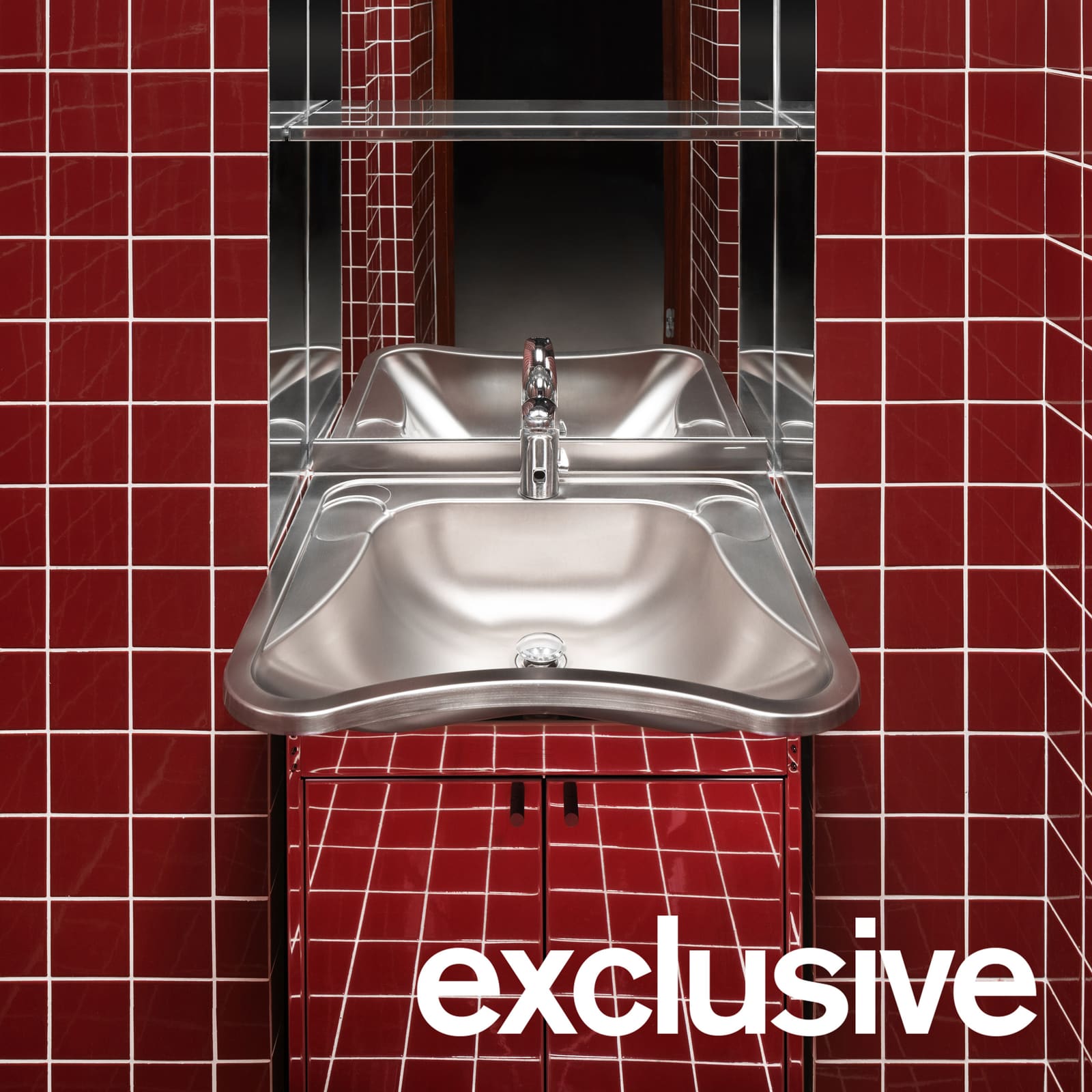
At the rear of the bar, the bathroom presents a striking contrast. Bright red tiles measuring ten centimetres by ten centimetres cover every surface from floor to ceiling, creating an immersive monochrome environment. Stainless steel reappears in the toilets, sink, and fixtures, maintaining material consistency with the main space. Minimal sconce lights illuminate the cubicles, their pared-back design emphasising utility over ornament.
The bathroom functions as a compressed material study, isolating two elements - tile and steel - and exploring their interaction at close range. The intensity of the red, amplified by repetition and enclosure, offers a moment of sensory shift within the otherwise restrained palette of the bar. It is a small gesture, but one that demonstrates NM3's interest in modulating experience through material and colour.
Positioning Within NM3's Trajectory
Bar Bardo represents a departure from the studio's earlier projects, which leaned towards raw, industrial finishes. In 2024, NM3 completed an interior for Galleria Montegani in Milan, characterised by exposed surfaces and utilitarian detailing. A subsequent project for fashion brand Miss Sixty employed a similarly metal-heavy vocabulary. By contrast, Bar Bardo introduces softness through velvet, wood, and carefully modulated lighting, suggesting an evolving design language.
This shift may reflect the studio's growing confidence in balancing its signature stainless steel elements with warmer, more tactile materials. The use of rosewood and red velvet does not dilute NM3's identity; rather, it expands the studio's material range while retaining a commitment to custom fabrication and spatial precision.
Precedent Without Pastiche
The challenge in referencing modernist precedents lies in avoiding pastiche. Loos's American Bar succeeded because it responded to specific urban and cultural conditions in early 20th-century Vienna: a compact site, a clientele drawn to American cocktail culture, and a design ethos that prioritised spatial clarity over decorative excess. NM3's approach acknowledges these conditions without attempting to recreate them. The studio extracts a set of principles - material continuity, reflective surfaces, compact planning - and applies them to a contemporary Milanese context.
This method aligns with recent discourse around adaptive reuse and historical reference in architecture, where the goal is not to replicate but to reinterpret. At World Archi Design, we've observed a similar sensibility in projects ranging from David Chipperfield's adaptive reuse of Neues Museum in Berlin to Studio Mumbai's use of vernacular craft in contemporary residential work. The common thread is an engagement with history that remains critically aware of present conditions.
Bar Bardo demonstrates that small-scale interiors can serve as laboratories for testing ideas about spatial inheritance, material performance, and programmatic flexibility. For a studio still in its early years, the project marks a confident step towards a more nuanced design language - one that honours modernist precedents without being constrained by them.
Save this story. A free account keeps your reading list and the 07:00 email in one place.
CREATE FREE ACCOUNT →SIGN IN