
A Question of Translation
How does one honour cultural lineage without resorting to pastiche? For Bétyle Studio, the challenge at Arcane 17 lay not in reproducing the signifiers of a traditional Spanish restaurant but in distilling the sensory qualities of Iberian taverns into a contemporary idiom. The 4th arrondissement eatery, nestled within a centuries-old Le Marais structure, serves Basque and Catalan cuisine, and its interiors needed to reflect the owners' heritage without collapsing into literalism. The result is a study in restraint: an environment where timber becomes both structure and narrative, where patination suggests age, and where playful marquetry injects levity into an otherwise sombre palette.
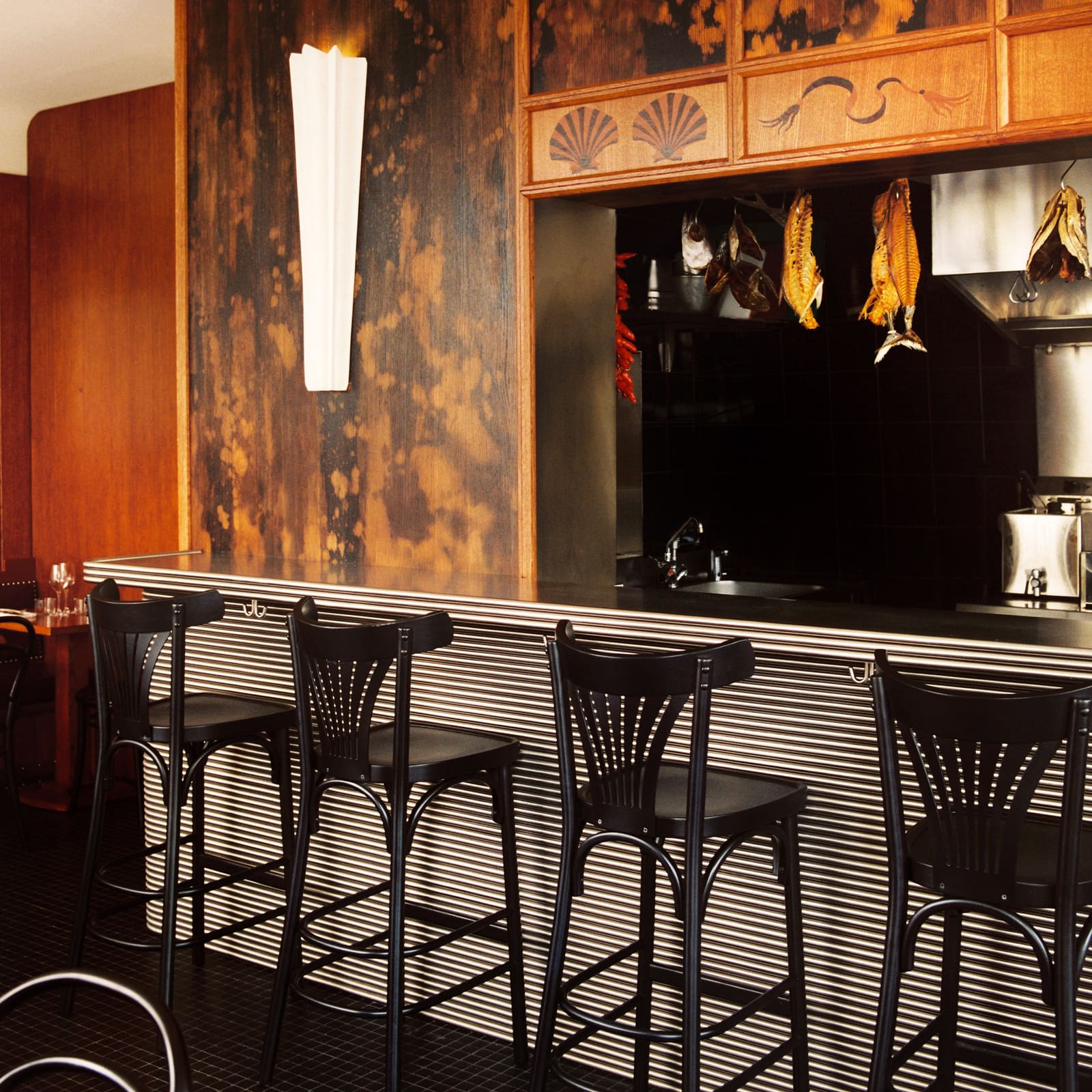
Carla Romano and Nicolas Cazenave de la Roche, who founded the Marseille practice in January 2025, approached the brief with a focus on materiality over motif. Rather than hanging azulejos or deploying wrought-iron grilles, they turned to wood as the primary medium, treating it with techniques that lend depth and temporal ambiguity. The dining area is defined by ebonised panelling that absorbs light, creating an enveloping quality reminiscent of rural chapels. Against this backdrop, the bar emerges as a counterpoint: a tubular stainless steel frame topped with marquetry slabs depicting shooting stars and a cartoonish lobster, elements that resist the solemnity of the surrounding surfaces.
Bespoke Joinery as Spatial Strategy
Every piece of joinery within Arcane 17 was conceived specifically for the project, executed by a Marseille-based carpenter with whom the studio maintains an ongoing collaboration. This approach allows for a degree of control over finish and detail rarely achievable with off-the-shelf components. Romano and Cazenave de la Roche employed multiple timber species, experimenting with staining, ebonising, and patinating techniques to generate surfaces that appear weathered, as though they had inhabited the space for decades rather than months.
The effect is one of accumulated time, a quality that hospitality interiors often strive for but seldom achieve without either archaeological salvage or unconvincing distressing. Here, the patina feels earned rather than applied, a function of thoughtful material selection and craft. The uniform timber tables and classic bentwood chairs reinforce this sensibility, their simplicity allowing the panelling and bar to anchor the spatial composition. In one corner, a red-clad banquette offers a subtle nod to Parisian bistro typology, grounding the Iberian references within the local context.
Motif and Materiality in Dialogue
The marquetry atop the bar deserves closer attention. Its motifs, shooting stars and a stylised lobster among them, introduce a note of whimsy that could easily veer into kitsch. Yet the execution, rendered in fine wood inlay, elevates these elements into a form of decorative restraint. The choice of marquetry itself is significant: a technique with deep roots in both French and Spanish craft traditions, it serves as a bridge between the two cultures without announcing itself as such. The playful imagery prevents the space from becoming overly austere, offering moments of visual respite within an otherwise monochromatic scheme.
Lighting, too, plays a critical role. Parisian studio Côme Clérino designed a series of chunky plaster sconces for the project, their forms loosely recalling elongated seashells. These fixtures provide ambient illumination while contributing to the tactile richness of the interior, their organic contours softening the rectilinear geometry of the panelling.
Precedent and Context
Bétyle Studio's approach at Arcane 17 aligns with a broader trend within European hospitality design: the reinterpretation of vernacular typologies through contemporary materiality. This method avoids the trap of theme-park historicism while still engaging with cultural memory. The studio cites rural churches, dark woods, and traditional fans as inspirations, yet none of these references manifest literally. Instead, they emerge through texture and form, present but not insistent.
The project invites comparison with other recent interventions in Paris where timber has been deployed as a primary material. Cyrus Ardalan's renovation of a corner apartment, for instance, similarly relies on wood to generate warmth and coherence, though with a nautical inflection achieved through porthole-style openings. Bétyle Studio's work, by contrast, leans into terrestrial rather than maritime associations, grounding the space in the mountainous regions of the Basque Country and Catalonia.
It is worth noting that the studio's prior work includes the conversion of an old farm building in Marseille into a compact, timber-lined residence, suggesting a sustained interest in wood as a medium capable of mediating between past and present. At Arcane 17, this interest finds expression in a more public context, where the demands of hospitality, durability and atmosphere, inflect the material palette.
Atmosphere as Architectural Product
What Bétyle Studio has achieved at Arcane 17 is the creation of an interior that feels both specific and adaptable, rooted in a particular cultural lineage yet legible within its Parisian setting. The ebonised panelling and patinated timber generate an atmosphere of intimacy without claustrophobia, while the marquetry and sconces introduce moments of visual interest that prevent the space from becoming monotonous. The design does not shout its references; it absorbs them, allowing diners to experience the spatial qualities of an Iberian tavern without the distracting overlay of folkloric decoration.
In a city where restaurant interiors often oscillate between minimalist austerity and baroque excess, Arcane 17 occupies a middle ground. It demonstrates that cultural specificity need not rely on overt symbolism, and that materiality, when handled with precision, can carry narrative weight. For a young practice, the project signals a mature understanding of how interiors can honour tradition while remaining firmly anchored in the present.
Save this story. A free account keeps your reading list and the 07:00 email in one place.
CREATE FREE ACCOUNT →SIGN IN