
The Wall That Sits
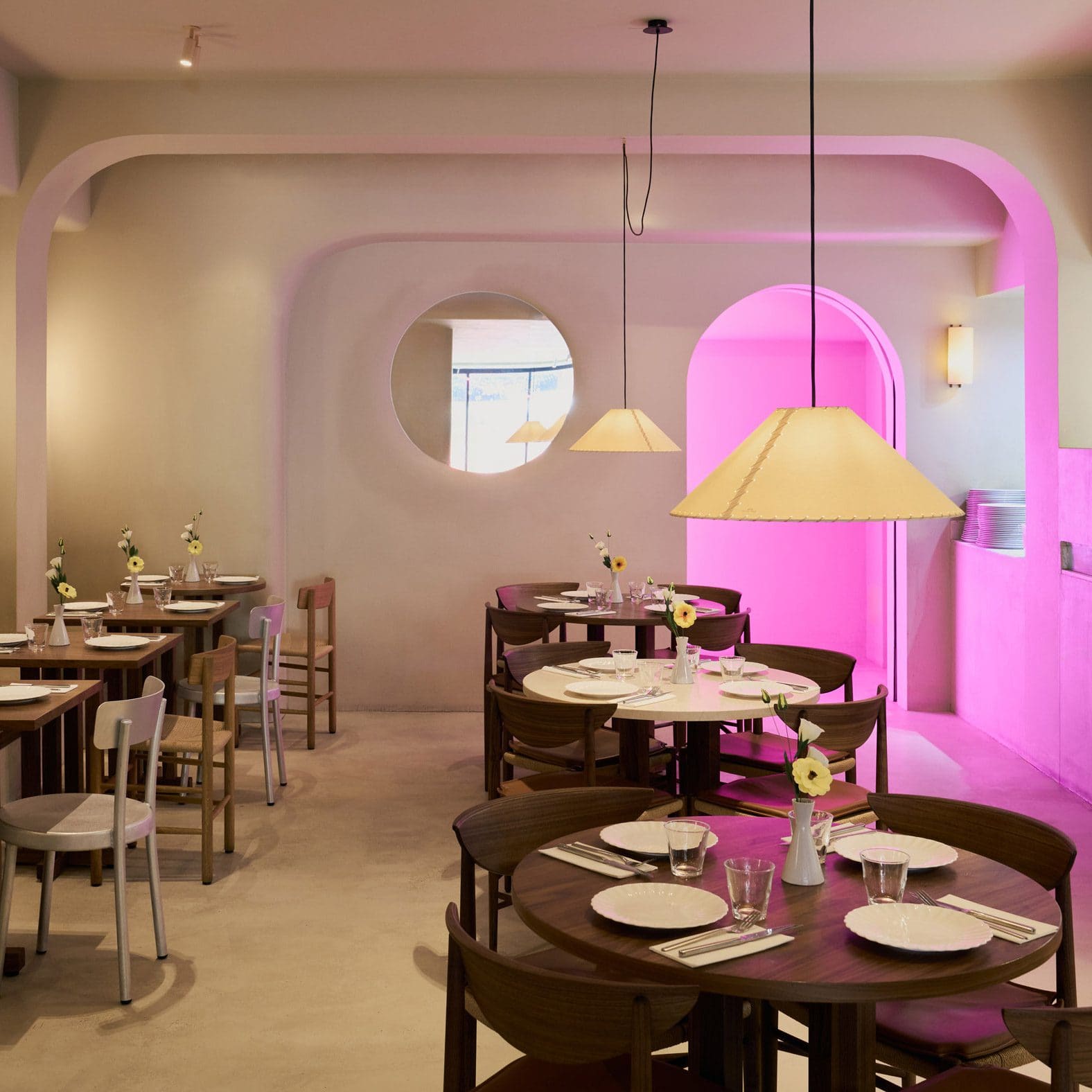
There is a moment in the design of Napoli on the Road where the distinction between architecture and furniture quietly dissolves. Seating emerges from plaster walls. Niches become shelving. The floor runs uninterrupted across 115 square meters, refusing to acknowledge the threshold between ground level and basement. Spanish designer Isern Serra has orchestrated an interior where function is absorbed into structure, and the result is a pizzeria that feels less like a decorated room and more like a carved-out volume.
Located in London's Soho, the restaurant serves as both a culinary outpost for chef Michele Pascarella and a spatial experiment in restraint. Serra's approach draws from the vernacular architecture of the Mediterranean, a tradition in which buildings respond to climate, material availability, and the rhythms of daily life rather than stylistic trends. Here, that sensibility translates into an interior defined not by objects placed within it, but by the architecture itself performing multiple roles.
Continuity as Strategy
At the heart of Serra's design is a deliberate rejection of visual interruption. The flooring, a neutral surface that flows seamlessly from entrance to basement, establishes a sense of spatial continuity. By eliminating changes in material or level, the floor functions as both foundation and unifying element, visually expanding the footprint while anchoring the eye. It is a decision that privileges calm over incident, permanence over novelty.
This strategy extends to the material palette. Walls are constructed from metal frames finished with plasterboard, their surfaces left bare to catch and reflect natural light. Wood and stone appear in furniture and countertops, but sparingly. The restraint is intentional: Serra avoids decorative layering in favor of a tonal consistency that allows proportion and light to shape the atmosphere. In this, the design echoes the work of architects like Álvaro Siza, whose interiors rely on the interplay of volume and luminosity rather than ornament.
Built-In Logic
The decision to integrate furniture into the walls themselves is perhaps the most defining gesture of the project. Seating, shelving, and display areas are not freestanding but carved into the architecture, a move that reduces visual clutter while lending the space a sculptural quality. This approach has precedent in Mediterranean vernacular construction, where built-in benches and storage niches are common responses to limited space and material economy.
Serra's reinterpretation, however, is not purely nostalgic. The built-in elements at Napoli on the Road are rendered with a contemporary precision, their forms simplified and their edges softened. The effect is a spatial language that feels both timeless and distinctly current, a negotiation between craft tradition and modern sensibility. It is a design that privileges the total environment over the individual object, a philosophy that aligns with the Gesamtkunstwerk ambitions of early modernism but executed with a softer, more tactile hand.
The Geometry of Gathering
Rounded corners and curved transitions appear throughout the restaurant, a formal motif that serves both aesthetic and spatial purposes. In traditional Mediterranean architecture, such shapes often emerge from construction techniques, lime plaster molded by hand, stone arches supporting load. Serra adopts this vocabulary but abstracts it, using curvature to guide movement and soften the interior's visual rhythm.
The result is a space that feels less rigid, more inviting. Curved built-in seating encourages lingering. Archways frame sightlines without harsh delineation. Even the metal bar counter, a contemporary element in brushed stainless steel, is given rounded edges to harmonize with the surrounding softness. The absence of sharp corners contributes to what Serra describes as a more relaxed atmosphere, one that tempers the formality often associated with architectural interiors.
This formal strategy also has practical implications. In a compact urban site, where the ground floor measures 80 square meters and the basement 35, the use of curves and continuous surfaces helps to visually enlarge the space. The eye moves fluidly, unimpeded by abrupt transitions or competing geometries. It is a lesson in how form can shape perception, making a small footprint feel more generous.
Contrast and Texture
Yet the project is not monolithic. Serra introduces moments of material contrast that punctuate the otherwise cohesive palette. The basement dining and events space is painted a deep red, a chromatic shift that signals a change in program without disrupting the spatial logic. The stainless steel bar counter, industrial in its precision, offers a counterpoint to the warm, mineral finishes that dominate the ground floor.
These contrasts are calibrated carefully. The metal surface reflects light differently than plaster, introducing a layer of visual complexity while maintaining the overall sense of restraint. The red walls activate the lower level, creating a more intimate, enveloping atmosphere that distinguishes it from the lighter, more open ground floor. Together, these elements generate a material dialogue that enriches the interior without fragmenting it.
Precedent and Reinterpretation
Serra's work at Napoli on the Road can be situated within a broader conversation about the reinterpretation of vernacular forms in contemporary design. Projects like David Chipperfield's refurbishment of the Neues Museum in Berlin or Studio KO's Musée Yves Saint Laurent in Marrakech similarly engage with local building traditions, translating them into modern spatial languages. What distinguishes Serra's approach is the intimacy of scale and the specificity of reference, a design that speaks to the everyday rituals of gathering and eating rather than the monumental gestures of institutional architecture.
The Mediterranean vernacular, with its emphasis on honest materials, climatic responsiveness, and spatial informality, offers a rich vocabulary for designers seeking alternatives to the slick minimalism that has dominated much of contemporary hospitality design. Serra's pizzeria is a case study in how that vocabulary can be adapted to an urban context, retaining its essential qualities while responding to the constraints and opportunities of a dense, cosmopolitan setting.
A Timeless Atmosphere
At World Archi Design, we have long observed that the most enduring interiors are those that prioritize spatial experience over stylistic fashion. Napoli on the Road succeeds not because it deploys a novel aesthetic, but because it commits fully to a coherent design philosophy. The pared-back material palette, the integration of furniture into architecture, the careful modulation of light and proportion, all contribute to an environment that feels both considered and effortless.
Serra's design invites a slower pace, a quality increasingly rare in the hurried context of central London dining. The absence of decorative distraction focuses attention on the essentials: the quality of light, the texture of surfaces, the way a curve can guide the body through space. It is an interior that trusts architecture to do the work of atmosphere, and in doing so, offers a quiet argument for restraint in an era of visual excess.
Save this story. A free account keeps your reading list and the 07:00 email in one place.
CREATE FREE ACCOUNT →SIGN IN