
When the User Rewrites Your Brief
A furniture designer walked into a room with a prototype and a three-year-old girl. By the time she finished drawing on it, climbing through it, and dragging it across the floor, his design had changed completely. This is the story of how real-world testing transformed a university project into something far more robust than the original concept suggested.
James Murphy set out to create furniture that would encourage extended play for children between three and eight years old. His background included time with LEGO, where he developed an appreciation for designing objects that invite rather than dictate. The challenge was to build something that wouldn't exhaust its novelty in a single afternoon, something that could absorb a child's shifting interests rather than prescribe them.
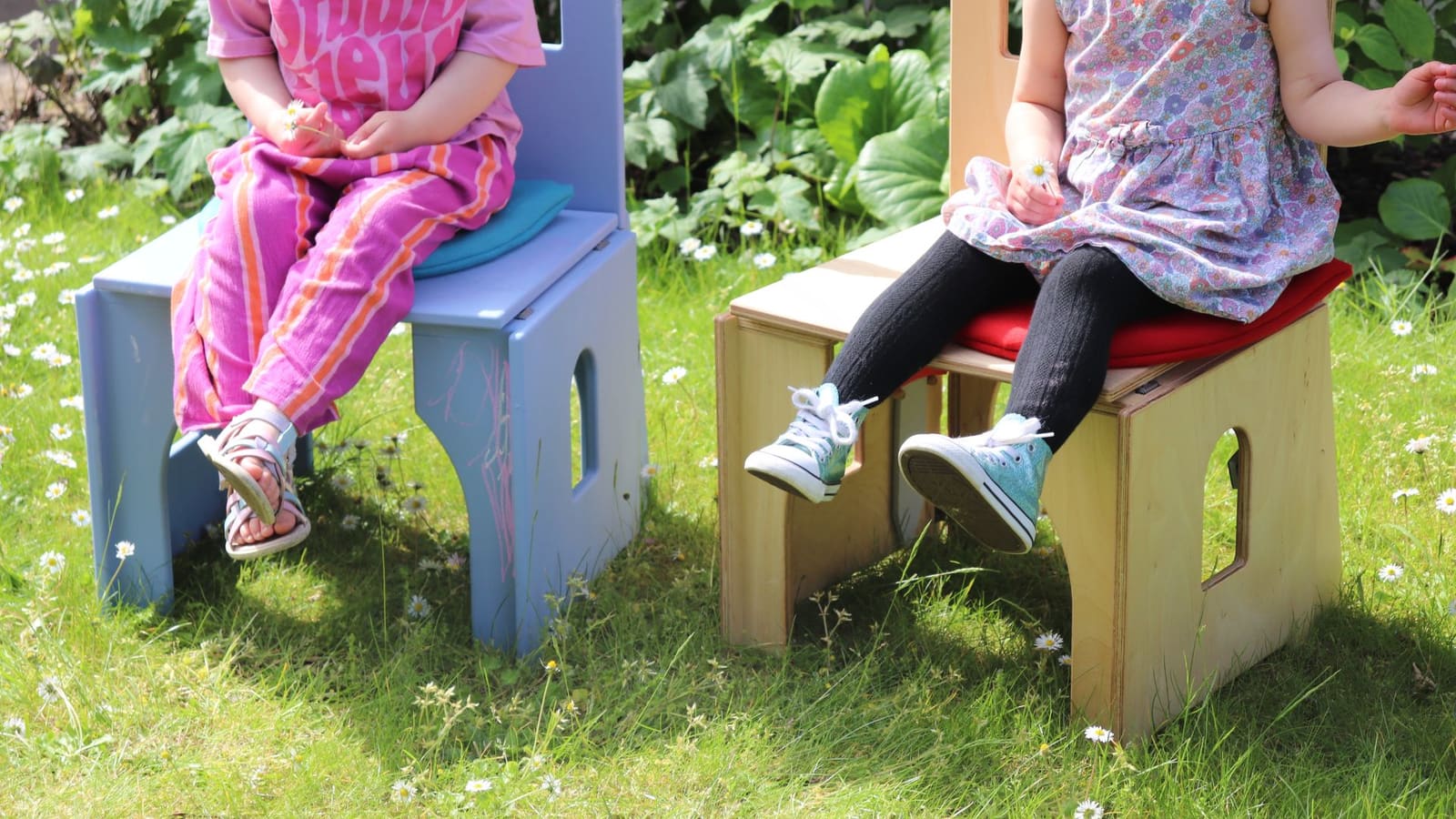
The outcome, Casul, is a plywood chair that converts into a castle in two movements. It earned Murphy the Habitat Future Design Award at the New Designers showcase in London, but the real education happened long before the accolades arrived.
Designing for Chaos
Murphy began with a set of parameters. The piece needed to work for children of either gender, support imaginative scenarios, allow for creative expression, and function whether a child played alone or with others. These criteria sound straightforward until you put them in front of actual children, who have little interest in honoring your design intent.
The first test subject was a three-year-old girl. She managed the transformation from chair to castle almost independently, which confirmed the design's legibility at the younger end of the age spectrum. Then she began improvising. She hauled the object around the room, used the seat as a launching platform, and covered every available surface with marks. That last action prompted Murphy to develop a chalkboard variant, a decision that would split the project into two distinct versions.
The second round of testing involved three boys who immediately recognized the castle as Bowser's stronghold from Super Mario Bros. They decorated the panels, scrawled messages across the surfaces, and incorporated LEGO Duplo bricks into an elaborate siege scenario. They also climbed through the archway repeatedly, subjecting the structure to forces no adult tester would have considered. Murphy learned two things: the design successfully welcomed other toys into the play ecosystem, and children would stress-test the piece far beyond standard furniture protocols.
Two Versions, One Logic
The testing sessions clarified that Casul required two expressions. The natural birch version includes a pair of cushions that serve as backrest and seat in chair mode, then transform into shields once the piece unfolds. Two foam swords hide inside the structure as a surprise element, designed for paired play. When the session ends, the swords slide back into their compartments, turning the chair into a tidy storage solution. The wood receives a finish of Osmo Polyx-Oil, a food-safe treatment that preserves the tactile quality of the plywood grain rather than coating it in a synthetic film.
The second iteration uses chalkboard paint, converting the entire surface into a drawing field that can be wiped clean after use. This version accommodates multiple color options depending on the available paint finishes, and it responds directly to the behavior Murphy observed during testing: children will mark their territory.
Both versions share the same underlying mechanics, and this is where Murphy's industrial design training becomes legible. Back legs provide stability in chair configuration. Small blocks prevent the structure from collapsing completely flat. Torque hinges on the seat panels are calibrated to prevent finger entrapment during transformation, a detail that speaks to safety standards rather than aesthetic preference. In castle mode, cut-out turrets in the seat panels align precisely with a window in the backrest, creating a visual coherence that rewards the child's effort. Two larger cutouts in the side panels are sized for adult hands, acknowledging that parents will need to move the piece without disrupting play.
Manufacturing as Design Constraint
Casul was conceived with commercial production in mind from the outset, which distinguishes it from the majority of student furniture projects that remain hypothetical. Every component machines from a single face of a birch sheet, reducing CNC time and operator intervention. This constraint shaped the design rather than compromising it, a principle that recalls the Eameses' plywood experiments or Enzo Mari's Autoprogettazione series, where fabrication logic becomes part of the formal language.
At World Archi Design, we've been tracking a shift in how younger designers approach children's furniture. The category has historically oscillated between twee pastels and miniaturized adult forms, neither of which takes children's spatial intelligence seriously. Murphy's project sits in a different tradition, one that acknowledges children as competent users with their own priorities.
What Iteration Actually Looks Like
The chair-to-castle transformation is appealing, but it's not the project's primary achievement. What matters more is the discipline of designing something genuinely open-ended, tested against real behavior, and viable for production. Many designers, at every career stage, chase the singular wow moment. Murphy chose a different path: he built something, watched it fail in small ways, then rebuilt it to accommodate what he learned.
This is a slower process. It requires access to users, willingness to abandon assumptions, and enough technical fluency to translate observations into revised geometry. It also produces better objects. The chalkboard version exists because a three-year-old girl drew on a prototype. The dual-sword storage emerged from watching boys incorporate external toys into their scenarios. These weren't features Murphy invented in isolation; they were responses to documented behavior.
The project also demonstrates that designing for children demands a different kind of rigor. Adults will tolerate minor inconveniences or unclear interactions. Children will simply ignore your object and find something else to play with. They won't read instructions, they won't honor your intended use case, and they will discover every structural weakness within the first ten minutes. This makes them unforgiving collaborators and excellent editors.
The Discipline Behind the Play
Casul succeeds because Murphy treated play as a design problem rather than a marketing angle. He didn't begin with a formal concept and then search for a justification. He started with observed needs, tested against real users, and iterated based on evidence. The result is a piece that invites extended engagement not because it's clever, but because it's sufficiently flexible to absorb a child's shifting interests.
This approach has precedents. The Stokke Tripp Trapp grows with a child by adjusting seat and footrest heights. Matali Crasset's furniture for children emphasizes modular configurations that adapt to different play scenarios. Kay Bojesen's wooden toys endure because they suggest rather than dictate. What these objects share is a respect for the user's intelligence and a recognition that longevity comes from adaptability, not novelty.
Murphy's work also raises questions about how we evaluate design education. The project succeeded not because it looked good in renderings, but because it survived contact with its intended users. This suggests that design programs might benefit from embedding testing protocols earlier in the curriculum, treating user feedback as a material constraint rather than a final validation step.
Beyond the Prototype
The Habitat Future Design Award signals industry interest, but the real test will be whether Casul reaches production. Many award-winning student projects stall at this stage, defeated by cost pressures, supply chain realities, or the gap between prototype and scalable manufacture. Murphy's attention to fabrication logic improves his odds, but challenges remain. Retail pricing for children's furniture is brutally competitive, and parents often prioritize durability over design nuance.
If the chair does reach market, it will enter a crowded category. IKEA's children's range offers functional pieces at low price points. Specialty brands like Sirch and Ooh Noo provide higher-end options with Scandinavian aesthetics. Murphy's design would need to communicate its dual-use value quickly, likely through demonstration rather than explanation. The transformation needs to be intuitive enough that a child can manage it independently, but secure enough that it won't collapse during vigorous play.
There's also the question of how long a child will remain interested. The piece targets ages three to eight, a span that covers significant developmental shifts. A three-year-old engages with objects through gross motor exploration; an eight-year-old has more complex narrative requirements. Whether Casul can hold attention across that range depends on factors Murphy can't entirely control: the child's other toys, their exposure to media, the space available for play, and the presence of siblings or playmates.
What We Can Learn From a Chair
The project's broader lesson concerns the value of constraints. Murphy didn't set out to design a transforming chair; he set out to solve a specific problem for a defined user group. The transformation emerged as a solution to the brief's longevity requirement, not as a formal exercise. This sequence matters. When transformation serves function, it reads as purposeful. When function serves transformation, it reads as gimmick.
We see this distinction throughout design history. Achille Castiglioni's Mezzadro stool repurposes a tractor seat not for novelty, but because the form already solved the ergonomic problem he faced. Verner Panton's stacking chair uses a single-piece molded form because the material and manufacturing process enabled it, not because the shape was conceptually interesting. Murphy's chair folds because children's play requires spatial flexibility, and a piece that can shift between seating and scenery extends its useful life.
This is the discipline that keeps design relevant: the ability to subordinate formal preferences to functional requirements, to test assumptions against reality, and to iterate based on evidence rather than intuition. It's less dramatic than the mythology of the lone genius sketching a perfect form, but it produces objects that actually work.
Murphy's Casul chair proves that considered design isn't about complexity or cleverness. It's about watching a three-year-old draw on your prototype and having the sense to redesign accordingly.
Save this story. A free account keeps your reading list and the 07:00 email in one place.
CREATE FREE ACCOUNT →SIGN IN