
The Expanding Brief for Domestic Lighting
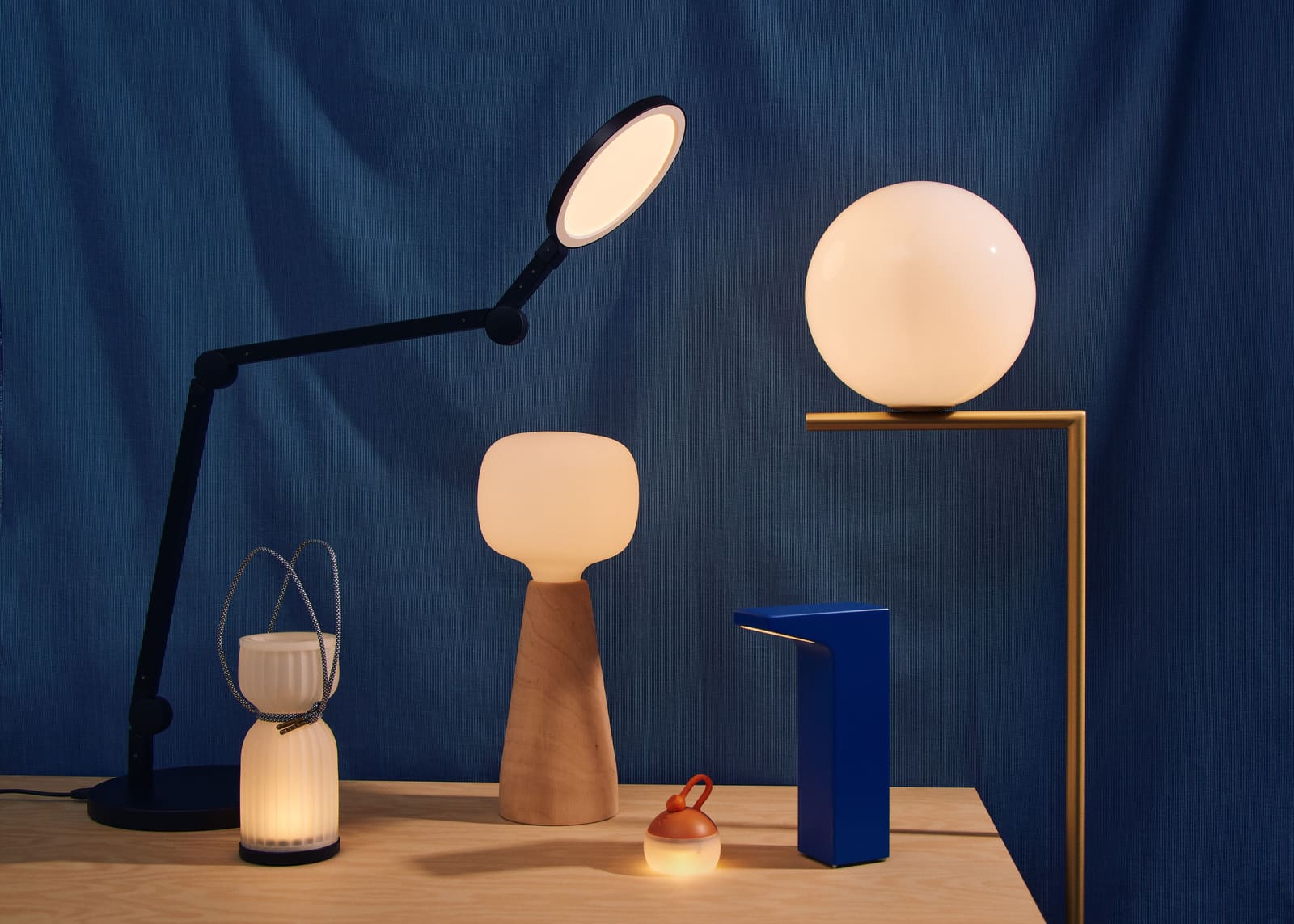
Lighting design has quietly absorbed a set of expectations that would have seemed contradictory a decade ago. We ask luminaires to be portable yet refined, energy-efficient yet warm, functional across multiple contexts yet visually distinct. At World Archi Design, we've been tracking how manufacturers are responding - not with compromise, but with a layered approach that treats each fixture as a small system. The seven lamps examined here represent that shift: objects that negotiate between performance, materiality, and the increasingly fluid boundaries of domestic space.
What unites them is less a shared aesthetic than a shared ambition. They deploy LED technology not as a cost-saving afterthought but as a design enabler, opening up new form factors and use cases. They embrace portability without sacrificing presence. And they signal, through material choice and manufacturing process, a nascent awareness that lighting - like architecture - carries ecological consequences.
Flos IC Floor Lamp: Tension and Equilibrium
IC Floor Lamp / Flos, multiple finishes and heights available
The IC series, designed by Michael Anastassiades, operates on a principle of apparent precariousness. A frosted glass sphere hovers at the end of a slender metal arm, cantilevered at a right angle from a vertical stem. The geometry suggests imminent collapse; the engineering delivers absolute stability. That tension - between fragility and permanence - gives the lamp its character.
Offered in two heights (53 inches and 73 inches), the IC Floor Lamp adapts to different spatial scales. The shorter version suits intimate reading corners; the taller iteration anchors a room, its orb floating at eye level when seated. The finish options - brushed brass, black, or chrome - allow for tonal integration or deliberate contrast. In plan, the lamp occupies minimal floor area; in elevation, it commands attention. It's a study in how to achieve visual weight without mass.
The IC series has precedents in mid-century Italian design, particularly the work of Gino Sarfatti, who explored similar themes of counterbalance and asymmetry. But where Sarfatti's lamps often employed multiple light sources and complex armatures, Anastassiades pares the vocabulary down to two elements: arm and sphere. The reduction feels contemporary, even austere, yet the warm glow diffused through the frosted glass softens the geometry.
Gantri Pier Small Wireless: Additive Manufacturing and Regional Identity
Pier Small Wireless / Gantri in collaboration with Ammunition, San Francisco, 2026
Gantri's collaboration with Ammunition yields a lamp that foregrounds both place and process. The Pier series draws explicit inspiration from San Francisco's bayside infrastructure - the structural rhythms of pier supports, the curved cornices of Chinatown's older buildings. These references are abstracted into a compact, 8-inch-tall form that reads as sculpture when unlit.
The manufacturing process is notable. Gantri 3D-prints each lamp body from a polymer derived from sugarcane, then hand-finishes and paints it in one of 25 colors. This approach allows for batch customization without the tooling costs of traditional injection molding. The result is a matte, seamless surface that feels warmer to the touch than metal or ceramic.
Cordless operation extends the lamp's utility. A wireless charging base replenishes the internal battery, which supports over 10 hours of continuous use. The absence of a cord transforms the object into something between a lamp and a lantern - movable, adaptable, responsive to shifting needs. It's a small gesture toward the kind of spatial flexibility that architects have long pursued through modular furniture and movable partitions.
The choice of sugarcane-based polymer is more than branding. Polylactic acid (PLA) derived from plant sugars is compostable under industrial conditions and requires less energy to produce than petroleum-based plastics. Gantri's model - on-demand fabrication, localized production - also reduces waste. The lamp becomes a case study in how additive manufacturing can align with environmental objectives without sacrificing design coherence.
Wooj Cordless Camp Lantern: Cross-Cultural Form and Material Recovery
Cordless Camp Lantern / Wooj, Brooklyn, 2026
Wooj, a Brooklyn-based studio, cites dual influences: West African water gourds and Japanese sake vessels. The resulting form - a bulbous shade atop a narrow base - carries echoes of both. A paracord sling handle reinforces the lantern's portability, inviting use indoors or outdoors with equal ease.
The material composition reflects a commitment to recovery and reuse. The shade is fabricated from recycled thermoplastic; the base, from recycled aluminum. Both materials retain structural integrity through multiple lifecycles, and the lamp's construction is designed for disassembly, facilitating future recycling.
Battery performance is calibrated across three brightness settings. At the lowest setting, the lamp operates for up to 80 hours on a single USB-C charge. At maximum brightness, runtime drops to approximately 15 hours. The dim-to-warm function shifts color temperature as brightness decreases, mimicking the behavior of incandescent bulbs and halogen lamps - a subtle detail that enhances perceptual comfort.
The lantern's 7-inch height and cylindrical profile allow it to occupy narrow surfaces - a windowsill, a stair tread, a bookshelf edge. It's dimensioned for interstitial spaces, the kinds of spots that resist conventional table lamps but benefit from localized light. In this sense, the Wooj lantern addresses a gap in the typology: portable task lighting that doesn't read as utilitarian.
Snow Peak Rechargeable Mini Hozuki: Candlelight Simulation and Magnetic Attachment
Rechargeable Mini Hozuki / Snow Peak, Japan
At 2.4 inches in diameter, the Mini Hozuki is less a lamp than a luminous object. Snow Peak, a Japanese outdoor equipment manufacturer, designed it to replicate candlelight in camping contexts, but its application extends to any setting where low-level ambience is desired.
The soft silicone shade encloses an LED that emits up to 60 lumens - roughly equivalent to three or four candles. A flicker mode emulates the irregular oscillation of a flame, introducing a temporal dimension to the light. The effect is subtle, bordering on the subliminal, but it shifts the lamp's presence from static to animate.
A magnetic clip at the top enables hanging from ferrous surfaces or overhead lines. The USB-C charge port is concealed beneath the shade, preserving the sphere's uninterrupted geometry. Battery life extends to 100 hours at the lowest setting, making the Hozuki viable for extended use without frequent recharging.
The lamp's minimalism recalls the Japanese concept of ma - the thoughtful use of negative space and restraint. It doesn't compete for attention; it punctuates a room or landscape with a small, warm presence. Clustered in multiples, the Hozuki creates a constellation of light points, a strategy borrowed from landscape lighting but scaled to the domestic interior.
Lume Cube Edge Light 2.0 and Humanscale Nova: Task Lighting as Ergonomic Infrastructure
Edge Light 2.0 / Lume Cube
Nova Task Light / Humanscale
Task lighting occupies a distinct category within residential illumination, prioritized for function over form. The Edge Light 2.0 and the Humanscale Nova represent two approaches to the same brief: adjustable, directional light for workspaces.
The Lume Cube Edge Light 2.0 offers affordability and flexibility. Four pivot points allow the user to reposition the 6-inch light head, though the articulation requires two-handed adjustment - a minor friction point. Touch-sensitive controls on the base enable color temperature shifts from 2,700K (warm white) to 7,500K (daylight), with a continuous dimmer for brightness. The light head rotates, converting the lamp from a downward-facing task light to a forward-facing fill light for video calls. It's a pragmatic solution to the hybrid work environment, where a single fixture must serve multiple functions.
The Humanscale Nova operates at a different scale of refinement. Its articulation is nearly frictionless, achieved through a counterbalance system that holds the arm and head in position without tension knobs or locking mechanisms. The light diffusion technology - a lightguide that distributes LED output evenly across a surface - eliminates hotspots and shadows. An infrared sensor detects the user's presence, powering the lamp on automatically and shutting it off 15 minutes after departure. The Nova is available in black, white, or gray, with mounting options including a round base, wall mount, or desk clamp.
Where the Edge Light 2.0 prioritizes versatility and cost, the Nova prioritizes seamlessness. Both are valid responses to the same problem, differentiated by budget, aesthetic preference, and tolerance for mechanical complexity. The Nova's design language echoes the work of Dieter Rams and Naoto Fukasawa - restrained, precise, and committed to the idea that good design recedes into utility.
Soltech Aura Ambient Grow Light: Full-Spectrum Illumination for Plant and Human
Aura Ambient Grow Light / Soltech, designed by Matteo Ragni, Turin, Italy
Grow lights have historically prioritized plant biology over human perception, resulting in fixtures that emit harsh, magenta-tinted light. The Soltech Aura inverts that hierarchy, delivering full-spectrum illumination at 3,000K - a warm white with a slight yellow cast that supports photosynthesis while remaining comfortable for human occupants.
The Aura's 360-degree output distinguishes it from directional grow lights. Mounted on an alder base, the 13-inch glass globe diffuses light evenly, making it suitable for placement among clustered plants rather than overhead. The dimmable output allows adjustment based on plant species and proximity.
Matteo Ragni, the Italian designer behind the Aura, brings a background in product design and industrial aesthetics. His work often balances technical performance with sculptural presence, and the Aura reflects that sensibility. The lamp functions as a horticultural tool, but it doesn't announce that function through aggressive styling. Instead, it reads as a warm, ambient light source that happens to benefit plants - a reversal of the typical grow-light paradigm.
The Aura also gestures toward the increasing overlap between biophilic design and residential interiors. As urban dwellers integrate more greenery into living spaces, the demand for lighting that serves both plants and people will grow. The Aura anticipates that convergence, offering a solution that doesn't require visual or spatial compromise.
Material Trajectories and Spatial Fluidity
Across these seven lamps, several patterns emerge. The first is material innovation driven by environmental considerations - sugarcane polymers, recycled thermoplastics, recycled aluminum. These choices are not yet universal, but they signal a shift in how manufacturers approach sourcing and lifecycle planning.
The second is the embrace of cordless operation. Battery technology and LED efficiency have matured to the point where wireless lamps can operate for days or weeks between charges. This liberates lighting from fixed electrical infrastructure, enabling more flexible spatial arrangements and temporary installations.
The third is the blurring of indoor and outdoor use. Several of these lamps are designed to migrate between contexts, responding to the increasingly porous boundary between interior and exterior in contemporary residential architecture. The lantern, historically an outdoor typology, is reimagined as an indoor accent; the task lamp, traditionally tethered to a desk, becomes a mobile tool.
These are incremental shifts, not revolutions. But they reflect a broader recalibration of what domestic lighting can be: not merely a fixed utility, but a responsive, adaptable element of the spatial experience.
Save this story. A free account keeps your reading list and the 07:00 email in one place.
CREATE FREE ACCOUNT →SIGN IN