
The Craft Renaissance Hiding in Plain Sight
There is a particular kind of intelligence embedded in objects that refuse to hurry. This month's most compelling product launches share something beyond aesthetic novelty: they privilege process, embrace imperfection, and quietly challenge the assumption that good design must scale effortlessly. From a meticulously reupholstered 1970s sofa to hand-cast gold jewellery made using centuries-old techniques, July's releases suggest that the pendulum is swinging back toward material honesty and tactile depth.
At World Archi Design, we have been tracking this shift across residential interiors, hospitality projects, and now product design. What emerges is not simply a revival of craft, but a more sophisticated engagement with making itself: designers choosing automotive-grade finishes for kitchen appliances, sourcing reclaimed gemstones for small-batch jewellery, and hand-weaving rugs inspired by constructivist geometry. These are not objects designed to go viral. They are designed to endure.
Material Intelligence in Furniture and Textiles
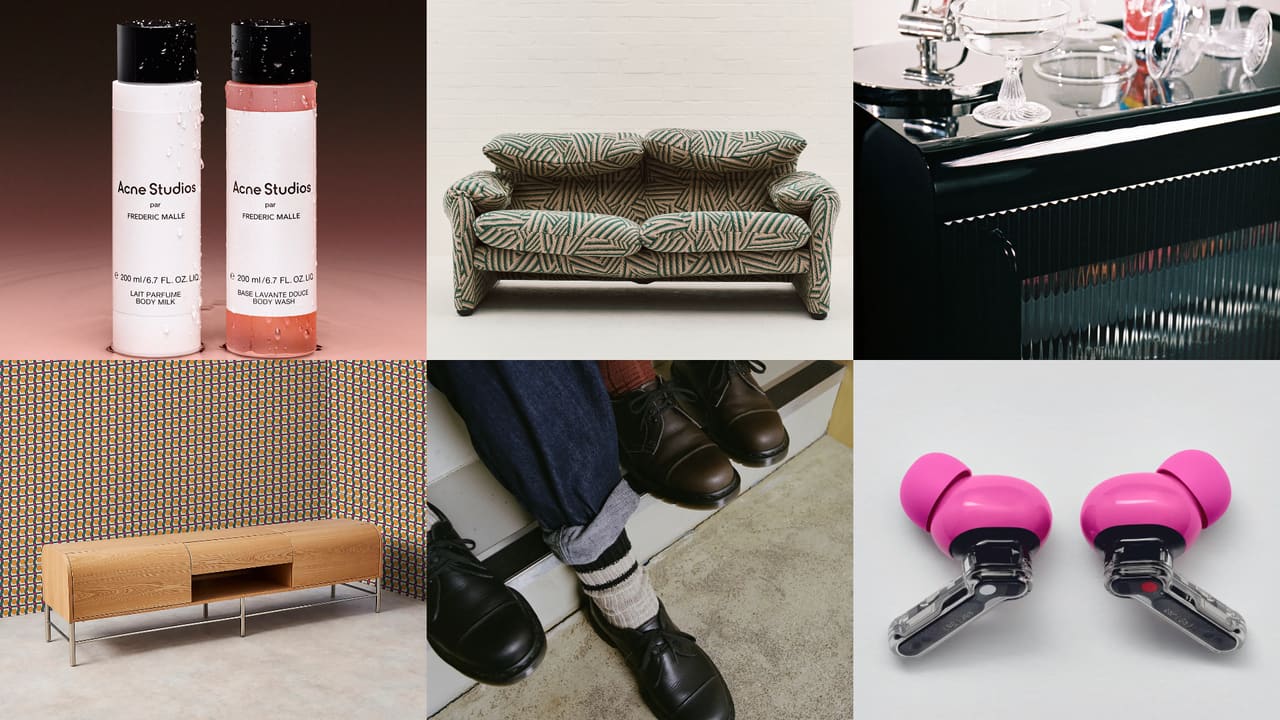
The collaboration between vintage furniture platform Vinterior and Liberty London has yielded a five-piece midcentury capsule that treats restoration as an act of curation. The standout piece is a reupholstered Cassina Maralunga sofa, originally designed by Vico Magistretti in the 1970s. The sofa's engineering remains remarkable: its high-back headrest converts seamlessly to a low-back position, a feat of mechanical ingenuity that required no digital modelling, only precise understanding of form and function.
Liberty has reupholstered the piece in Shadow Stripe Weave, a textile inspired by Futurist and Vorticist movements. The choice is deliberate. Rather than opting for neutral linen or boucle, the fabric introduces pattern and historical reference, transforming the sofa into a layered object that speaks across decades. This is adaptive reuse applied to furniture: honouring the original design while giving it contemporary relevance through material intervention.
Similarly, Yinka Ilori's collection for Dunelm demonstrates how mass-market accessibility need not mean visual homogeneity. The Half-Log Sideboard takes its rounded silhouette from the organic form of a sliced log, finished in ash veneer and elevated on chrome legs. The wider collection spans forty pieces, from furniture to soft furnishings, and references Leicester's textile history and the working-class communities that shaped the city's industrial identity. Ilori's work has always operated at the intersection of public art and functional design; here, that sensibility translates into accessible homeware that retains narrative depth.
The Return of Hand-Making in Jewellery
Designer Jess Hannah Révész has stepped back from her nail lacquer line to return to the jeweller's bench with JH Editions, a small-batch collection made using lost-wax casting in 14-carat and 18-carat gold. Each piece is set with antique diamonds and reclaimed sapphires, materials chosen for their history as much as their beauty. The process is slow, the output intentionally imperfect. Révész draws loosely on signets, seal fobs, and talismans, jewellery forms historically tied to identity and permanence rather than fashion cycles.
This approach stands in stark contrast to the algorithmic precision of CAD-designed jewellery. Lost-wax casting allows for subtle variation; no two pieces are identical. The imperfections are not flaws but evidence of human touch, a quality increasingly rare in contemporary jewellery design. Révész prioritises the act of making over commercial cohesion, a risky but refreshing stance in a market that rewards repeatability.
When Appliances Borrow from Automotive Design
Smeg has introduced a new finish across its breakfast range: Moonlight, a matte off-white that echoes Pantone's 2026 Colour of the Year, Cloud Dancer. The kettle, toaster, and drip filter coffee machine now come in this warmer take on classic white, reflecting a broader appetite for creamy neutrals in residential interiors. The shift is subtle but significant. Appliance colour trends have long lagged behind furniture and textile trends; Smeg's responsiveness suggests that even utilitarian objects are now subject to the same aesthetic scrutiny as statement pieces.
More audacious is the collaboration between smart fridge brand Rocco and tabletop design label Gohar World. The limited-edition Mirror Black drinks fridge employs an automotive-grade finishing process: premium lacquer, ceramic coating, three-stage polishing, and a final wax. The result is a reflective, almost liquid surface typically reserved for luxury vehicles. Each unit includes a pair of champagne coupes designed by Laila and Nadia Gohar, encapsulating their whimsical, slightly surreal approach to entertaining.
This is not the first time appliance manufacturers have looked to automotive design for inspiration, but the execution here is unusually committed. The fridge becomes a sculptural object, a conversation piece that happens to keep drinks cold. It challenges the assumption that kitchen appliances should recede into the background, instead positioning them as central to the aesthetic composition of a space.
Architecture Books as Material Archives
Thames & Hudson has released a second monograph on Kengo Kuma, following 2012's Complete Works. The new volume presents forty projects chosen by Kuma himself, organised by building use rather than chronology. The selection ranges from Japan's Olympic Stadium, constructed with timber sourced from every region of the country, to a small community centre in Yusuhara and a fairytale museum in Denmark.
Kuma's work has always been characterised by a deep engagement with natural materials and vernacular building techniques. The new monograph emphasises his focus on disaster resilience and community, themes increasingly urgent in the context of climate instability. The book functions not only as a visual archive but as a material study, documenting Kuma's experiments with timber, stone, and bamboo across diverse climates and programmatic contexts.
For designers working in interiors or product design, Kuma's approach offers a useful precedent: the insistence that materials carry cultural and environmental meaning, that their selection is never purely aesthetic. This is tectonic thinking applied at every scale, from the envelope of a building to the grain of a table.
Fragrance as Architectural Memory
Dior's new unisex fragrance, Dior Paradise, was created by in-house perfumer Francis Kurkdjian. The scent blends almond and mandarin with a strong dose of vanilla, resulting in a fresh, woody, gourmand profile. Kurkdjian drew inspiration from Christian Dior's Provençal holiday home, whose garden was once filled with hundreds of almond trees.
Fragrance design and spatial design share more than metaphor. Both operate through layering, both create memory, and both rely on an understanding of how sensory experience unfolds over time. Kurkdjian's reference to a specific place, a specific landscape, grounds the fragrance in a kind of olfactory site-specificity. The result is a scent that functions less as personal adornment and more as atmospheric architecture, shaping the ambient experience of a room or body.
Similarly, Acne Studios and Frédéric Malle have expanded their collaboration beyond fragrance into bath and body. The new Body Wash carries the original scent's rose, peach, and sandalwood-musk notes, while a companion Body Milk hydrates with shea butter. The move reflects a broader trend in luxury beauty: the extension of a single olfactory identity across multiple product formats, creating a cohesive sensory environment rather than isolated moments of scent.
Tech Design's Emotive Turn
Samsung introduced a new form factor this month: the Galaxy Z Fold8, which unfolds into a 7.6-inch tablet-shaped screen. The device is wider but shorter than a standard phone, a proportion that mobile design head Hubert Lee describes as part of Samsung's Emotive Geometry approach. The goal, according to Lee, is to create devices that feel more intuitive, comfortable, and suited to everyday use alongside artificial intelligence features.
The term Emotive Geometry is worth unpacking. It suggests a shift away from purely functional or technical design criteria toward something more embodied, more responsive to how people actually hold and interact with devices. This is not unlike the shift in architectural discourse from modernist rationalism to phenomenology, where the experience of a space matters as much as its structural logic.
Nothing's Ear 3a upgrades its entry-level earbuds with an Audio Snapshot feature, allowing users to capture and save audio clips directly to the Nothing X app, where they can be transcribed and shared. The earbuds are available in black, white, yellow, and a new hot pink, with improved bass, noise cancellation, and up to 42 hours of playback. The design remains minimal, almost austere, in keeping with Nothing's brand ethos of transparency and simplicity.
Both examples point to a maturing understanding of tech design: that functionality must be wrapped in legibility, that form factors can communicate care, and that colour and proportion are not superficial concerns but essential to how a product integrates into daily life.
Archive Logic and Contemporary Craft
Margaret Howell's workwear-inspired MHL line has reworked the Dr Martens 1461 shoe with minimal intervention: a padded heel collar and tab, unwaxed cotton laces, and a double-stitched toe cap, all drawn from the brand's archive. The shoe is constructed at Dr Martens' Made in England factory in Northamptonshire and arrives in black and brown colourways designed to patina over time.
This is archive logic applied with restraint. Rather than reissuing a historical model unchanged, MHL isolates specific details and reintroduces them in a way that feels both familiar and fresh. The emphasis on patina, on the shoe's ability to age beautifully, reflects a broader shift in consumer values: a preference for objects that improve with use rather than degrade.
Design Within Reach has collaborated with Little Wing Lee, an honoree of the Wallpaper US400, to produce round and rectangular rugs handcrafted in India using wool from New Zealand. Inspired by traditional kilims and a striped rug from Lee's own family home, the Semita rug features a spiral motif that nods to constructivist painting and broken geometry, creating a maze-like pattern.
The rug functions as both functional object and visual anchor, grounding a space while introducing complexity. Lee's reference to constructivism is not purely formal; it signals an interest in how abstract geometry can carry emotional weight, how pattern can disrupt and unify simultaneously. This is textile design operating at the level of spatial composition, aware of its role in shaping how a room is read and experienced.
What Slowing Down Reveals
The objects that stood out this month share a common thread: they resist the pressure to simplify, to flatten, to scale without friction. They are made using processes that take time, that require skill, that leave traces of human decision-making. This does not mean they are inaccessible or elitist; many are produced at accessible price points or in collaboration with mass-market retailers. What they offer instead is a different value proposition: depth over novelty, durability over disposability, material intelligence over visual trend-chasing.
In residential and hospitality design, we have seen this shift play out in the return of natural materials, the revival of artisan techniques, and the growing emphasis on provenance. Product design is catching up. The result is a landscape where a fridge can be finished like a supercar, where a sofa can carry two design histories at once, and where jewellery can be made slowly, imperfectly, and all the more compelling for it.
These are not objects designed to disappear into algorithmic feeds. They are designed to be held, used, and remembered. And in a market saturated with the ephemeral, that might be the most radical position of all.
Save this story. A free account keeps your reading list and the 07:00 email in one place.
CREATE FREE ACCOUNT →SIGN IN