
The Question of Place in Floating Hospitality
When a vessel moves through water, its relationship to place becomes inherently unstable. Unlike a building anchored to a site, a boat drifts, docks, departs. Yet the most compelling examples of riverboat architecture resist this transience by embedding themselves in the cultural and material landscape they traverse. Studio Ibsen's work on the Pure Amazon, a 12-suite luxury riverboat now operating within Peru's Pacaya Samiria National Reserve, offers a case study in how interiors can ground a mobile structure in a specific geography without resorting to pastiche or surface decoration.
Founder Adriana Granato has approached the vessel as what she describes as a "floating gallery," though the term risks underselling the tectonic ambition at play. This is not simply a boat adorned with art; it is an interior environment constructed from the materials, techniques, and visual languages of the Amazon basin itself. The result is a rare synthesis of hospitality design and regional craft tradition, one that raises questions about authenticity, extraction, and the ethics of luxury travel in ecologically fragile zones.
A Vessel Designed for Convergence
Pure Amazon / Studio Ibsen, Pacaya Samiria National Reserve, Peru, 2025
The riverboat launched in 2025 as part of Abercrombie & Kent's A&K Sanctuary collection, a portfolio of curated safari and riverboat experiences. Its itineraries center on the Pacaya Samiria National Reserve, a five-million-acre protected area in northeast Peru where the Marañón and Ucayali rivers converge to form the Amazon. Sailings typically span four nights, with the vessel docking at multiple points to allow guests access to guided excursions via smaller skiff boats.
The design challenge, then, was to create an interior that could serve as both retreat and interpretive lens. Granato has spoken of wanting guests to feel immersed in a natural environment while maintaining a deliberate contrast with the wildness beyond the hull. The tension between enclosure and openness, between craft and wilderness, structures the entire project.
Material as Argument
Studio Ibsen's material palette is drawn almost entirely from the region. Locally sourced mahogany forms the primary structural and finish wood throughout the vessel, from furniture frames to wall paneling. Peruvian travertine and Amazonian quartzite appear as flooring and bathroom countertops, their geological origins legible in veining and color variation. Woven ceiling panels, constructed from dried grass, introduce texture and acoustic softening while referencing traditional Amazonian building techniques.
Granato has described these materials as "site-specific works of art," a framing that shifts attention from decoration to tectonic expression. The mahogany is not merely a finish; it is a material argument about provenance and craft labor. The quartzite counters are not neutral surfaces but geological documents. This approach aligns with a broader movement in contemporary architecture toward material honesty and regional specificity, though it also invites scrutiny. Sourcing locally can reduce environmental impact, but it can also place pressure on ecosystems and artisan communities if not managed with care.
The green accents in upholstery and bathroom tiles extend the material logic, echoing the dense canopy visible through the panoramic windows that line the 12 guest suites. These suites occupy the central deck, arranged along either side of a central circulation spine. The fenestration strategy is straightforward: maximize visual connection to the passing landscape while maintaining privacy and climate control. The windows are large enough to frame the river and forest as a constantly shifting backdrop, a strategy familiar from rail and cruise design but executed here with restraint.
Art as Infrastructure
The vessel's interior also functions as an exhibition space for contemporary Peruvian art, most notably works by Silvana Pestana. Pestana's practice explores the environmental and social consequences of illegal gold mining in the Amazon, using materials such as gold leaf, bronze, and traditional textiles. The inclusion of her work is not incidental; it introduces a critical dimension to the otherwise celebratory tone of luxury travel. Guests are confronted, however gently, with the extractive forces that threaten the very ecosystem they have come to admire.
A second major installation, titled Manto de Escamas de Paiche, comprises wall-mounted triangular tiles in bronze and clay that mimic the scales of the paiche, a giant fish native to the Amazon. These tiles appear prominently in the lower-deck dining room, where buffet breakfasts, lunches, and five-course dinners are served. The dining room is bright and airy, with the tiled installation providing both visual interest and thematic continuity. The reference to the paiche is apt: the fish is both a staple of local cuisine and a symbol of the river's biodiversity.
At the opposite end of the lower deck, a bar and lounge space employs pale green tones in carpet and walls, with a ceiling clad in feathery adornments. This room also serves as a venue for nightly briefings and educational sessions, blurring the line between social space and interpretive center. The feathery ceiling treatment recalls avian plumage, another nod to the region's wildlife, though the abstraction prevents the space from veering into theme-park literalism.
The Upper Deck as Cultural Platform
The top deck houses a small gym, a spa treatment room, and a larger bar area furnished with woven chairs and pillows covered in kené textiles. These textiles, characterized by their geometric patterns and vibrant colors, were created by artist Deysi Ramírez in collaboration with the Beneai collective, a group of indigenous women artists. The partnership represents a direct engagement with living craft traditions, though it also raises questions about representation and compensation. Who benefits from the inclusion of indigenous art in luxury hospitality? How are artisans credited and remunerated? These are not questions the design itself can answer, but they hover over the project nonetheless.
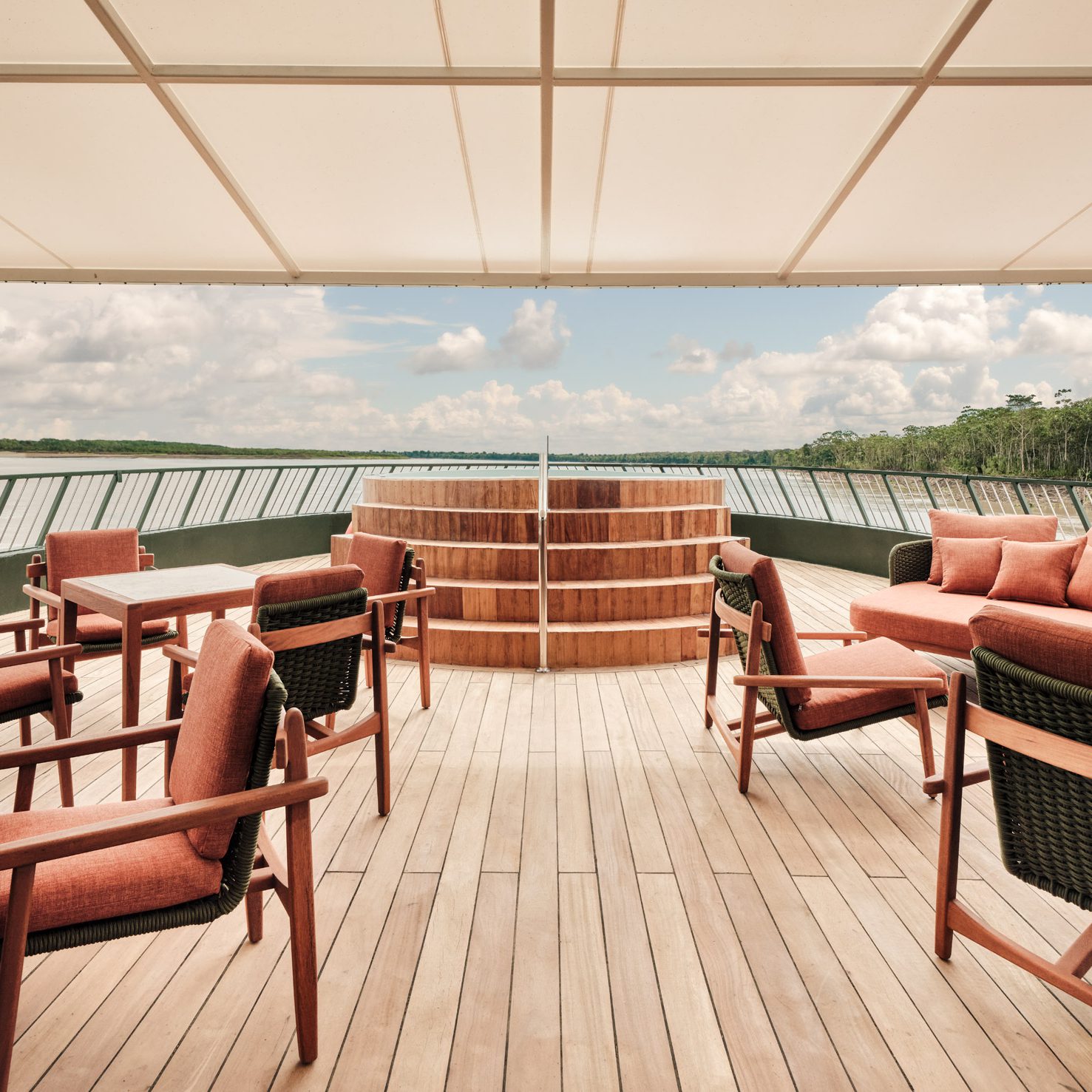
The upper bow deck includes lounge seating and a hot tub, offering guests a place to unwind after excursions that may include wildlife spotting, piranha fishing, kayaking, and visits to local villages. The hot tub is a standard feature of luxury riverboat design, but its placement here, overlooking the river and forest, underscores the voyeuristic dimension of ecotourism. Guests observe from a position of comfort and safety, their engagement with the environment mediated by guides, schedules, and amenities.
Embarkation as Prelude
The Pure Amazon launches from Iquitos, a city in northeastern Peru that serves as the primary gateway to the Amazon. According to Abercrombie & Kent, a small building lined with reeds, sticks, grass, and various woods functions as a check-in area, introducing guests to the material and aesthetic language they will encounter on board. This embarkation structure is an architectural prelude, preparing visitors for the immersive experience that follows. The use of natural materials in the check-in building also signals a commitment to continuity, ensuring that the journey begins before guests step onto the vessel.
Precedents and Departures
Studio Ibsen's approach to the Pure Amazon invites comparison with other recent examples of culturally grounded cruise and riverboat design. BG Studio's work on a luxury cruise ship sailing the Galápagos Islands, for instance, draws design cues from reptiles, translating biological forms into spatial and material strategies. Both projects share a commitment to regional specificity, but they differ in their methods: BG Studio leans toward biomorphic abstraction, while Studio Ibsen emphasizes material and craft lineage.
The Pure Amazon also recalls earlier precedents in riverboat design, particularly vessels operating in Southeast Asia's Mekong Delta and Myanmar's Irrawaddy River. These boats have long employed local wood, textiles, and decorative motifs, though often in ways that prioritize colonial nostalgia over contemporary cultural engagement. Studio Ibsen's project, by contrast, centers living artists and artisans, positioning the vessel as a platform for ongoing cultural production rather than a museum of the past.
Yet the project is not without its contradictions. Luxury riverboat travel, however sensitively designed, remains a form of consumption. The vessel burns fuel, generates waste, and concentrates wealth in ways that may or may not benefit local communities. The inclusion of indigenous art and craft does not, by itself, resolve these tensions. It does, however, suggest a model in which design can serve as a bridge between visitors and the cultures they encounter, provided that bridge is built on equitable terms.
Forward Implications
At World Archi Design, we have been tracking the rise of culturally embedded hospitality interiors, particularly in ecologically sensitive regions where tourism and conservation intersect. The Pure Amazon represents a step toward what might be called "contextual luxury," a mode of design that derives its value not from imported finishes or generic opulence but from deep engagement with place.
The success of this approach will depend on factors beyond architecture: labor practices, environmental impact assessments, revenue-sharing agreements with indigenous communities, and long-term commitments to conservation. Design can set the stage, but it cannot guarantee ethical outcomes. What Studio Ibsen has demonstrated, however, is that riverboat architecture need not default to neutrality or nostalgia. It can engage, critique, and celebrate the landscapes it moves through, offering passengers not just a view but a framework for understanding.
As cruise and riverboat travel continues to expand into remote and fragile ecosystems, the question of how design mediates that encounter will only grow more urgent. The Pure Amazon offers one answer: root the work in materials, collaborate with living craft traditions, and resist the temptation to simplify or sanitize. Whether that answer is sufficient remains to be seen, but it is, at the very least, a serious attempt to reconcile mobility with place, luxury with responsibility, and architecture with the rivers that carry it.
Save this story. A free account keeps your reading list and the 07:00 email in one place.
CREATE FREE ACCOUNT →SIGN IN