
When Retail Feels Like Home
The contemporary fragrance store has become a testing ground for spatial typology. Where do we draw the line between commerce and cultural institution, between showroom and living room? Costa Brazil's new Hudson Yards location suggests that the most compelling answer might be to stop drawing lines altogether.
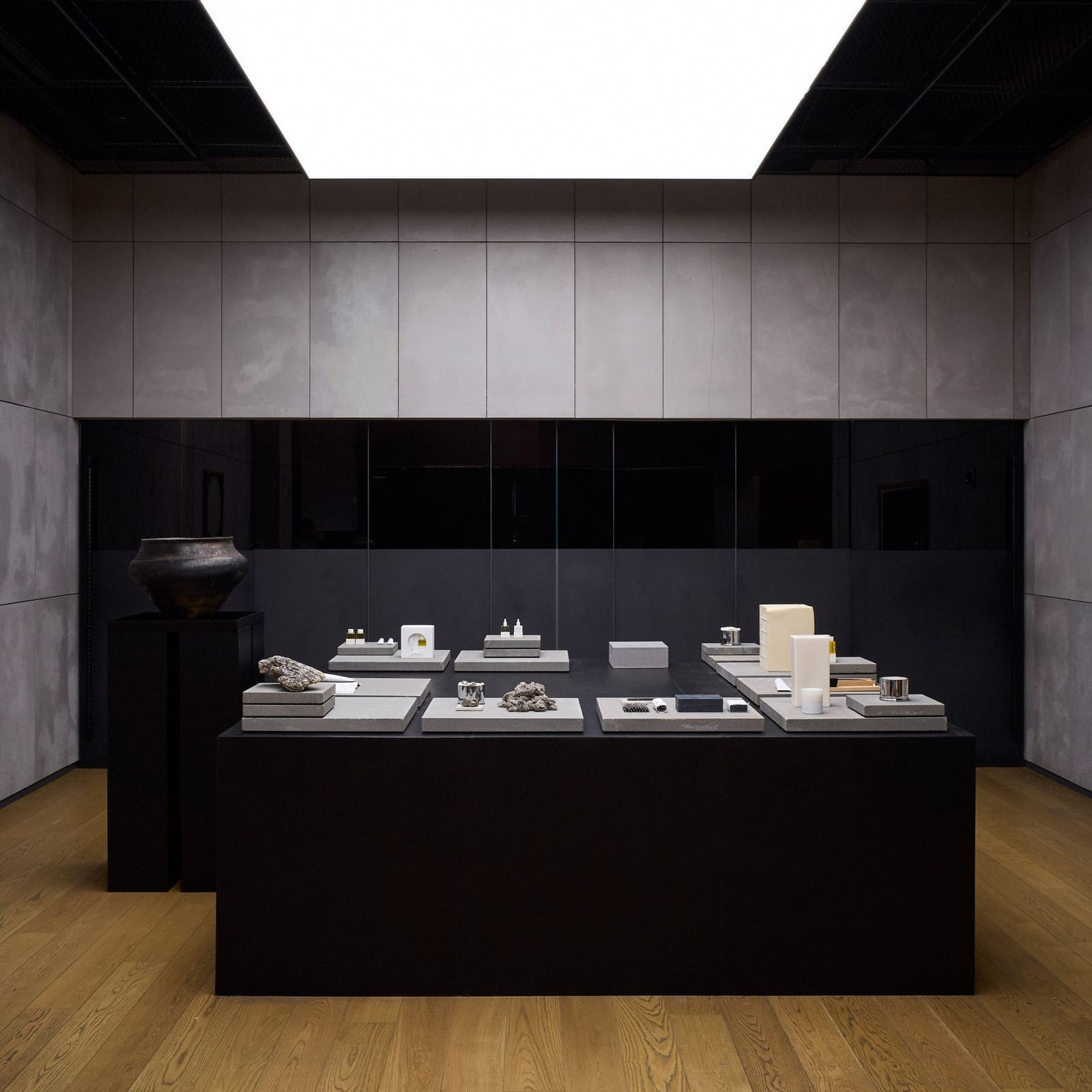
Occupying the first level of The Shops & Restaurants at Hudson Yards, the flagship store reads less as a conventional retail environment and more as a carefully curated domestic interior accidentally opened to the public. Founder Francisco Costa, working alongside creative director Alexander May, has constructed a space that foregrounds intimacy and slowness, qualities increasingly rare in high-traffic mall contexts.
The decision to populate the store with objects from Costa's personal collection at his Bellport home is not merely decorative. It establishes an editorial voice, a curatorial stance that positions the brand's fragrance and skincare lines within a broader constellation of aesthetic and ethical commitments. This approach has precedent: Aesop has long employed residential cues in its stores, and Le Labo's apothecary theatrics perform a similar function. But Costa Brazil pushes further, collapsing the distance between brand identity and personal biography.
Material Restraint, Spatial Warmth
The material palette is deliberately minimal: concrete tiles line the walls, concrete and black-wood plates form display surfaces, and large black plinths anchor the central floor space. Wooden flooring introduces warmth and acoustic softness, preventing the space from reading as sterile or overly austere. Thirty-foot shelving elements span wall to wall, creating horizontal continuity and emphasizing the room's proportions.
Ceiling-mounted light boxes illuminate the display podiums from above, a strategy that avoids the clutter of task lighting and maintains visual clarity. The effect is gallery-like, which is appropriate given the nature of what's on display. Products share shelf space with polychrome pottery vessels crafted by the Shipibo-Konibo people of the Upper Amazon River Basin, curated by Peter Koepke. Brazilian design objects sourced from Bossa Gallery and AALVO Gallery punctuate the arrangement, alongside books from Costa's personal library.
This intermingling of product and artifact is central to the spatial concept. The store does not segregate "art" from "merchandise." Instead, it presents both as part of a continuous material and cultural narrative rooted in the Amazon Rainforest, the source of the brand's sustainably harvested ingredients. The Shipibo-Konibo vessels, in particular, carry significant weight: their geometric patterns are cosmological maps, encoding knowledge systems developed over centuries. Placing them alongside skincare products is not merely aesthetic juxtaposition; it's an argument about lineage and stewardship.
Furniture as Program
Custom-designed furnishings include platform daybeds, sofas, and low tables, elements that invite visitors to linger. This is spatial programming through furniture rather than through signage or explicit invitation. The daybeds, in particular, signal a departure from transactional retail logic. They are not fitting rooms or consultation areas; they are simply places to sit, to pause, to experience the space without the expectation of immediate purchase.
The team behind the project describes the result as "a coherent environment that reflects Costa's personal aesthetic while introducing a more structured spatial language." That tension between personal and structured is productive. The space feels lived-in, yet it is clearly designed. It avoids the staginess of showroom domesticity through the authenticity of its objects and the restraint of its architecture.
A Rotating Gallery Model
Costa Brazil plans to introduce a rotating series of installations showcasing Brazilian furniture designers and art galleries. This positions the store as a platform, not just a point of sale. It acknowledges that contemporary consumers, particularly those engaging with luxury fragrance and skincare, are seeking experience and context as much as product. The store becomes a venue for discovery, a place where design literacy is cultivated alongside brand affinity.
This model has been explored elsewhere in the fragrance sector. Xinú's Oaxaca showroom, designed by Esrawe + Cadena, employs dramatically lit, temple-like interiors to frame scent as ritual. Nonfiction's New York store, designed by Charlap Hyman & Herrero, leans into boutique intimacy. Elorea converted a 1920s Spanish Colonial Revival bell tower for its Los Angeles location, embedding the brand in architectural heritage. Costa Brazil's contribution to this evolving typology is its emphasis on curatorial rotation and Indigenous craft, extending the conversation beyond European or North American design traditions.
Retail as Ritual Space
Costa himself frames the project in terms of ritual: "We created this space to invite guests to slow down and experience the rituals that define Costa Brazil, rituals that ground us and help us reconnect with nature." This language of ritual is not incidental. It reflects a broader shift in how luxury brands position their products, particularly in the wellness and beauty sectors, where efficacy alone is insufficient. Products must carry meaning, must participate in narratives of care, connection, and intentionality.
The spatial design supports this framing. The concrete and wood palette evokes earthiness without resorting to literal botanicals or jungle motifs. The lighting is even and soft, conducive to contemplation rather than stimulation. The inclusion of Indigenous craft grounds the brand's claims about Amazonian sourcing in tangible material culture, offering visitors a direct encounter with the aesthetic traditions of the region.
Beyond Transaction
The Costa Brazil store introduces what the team calls "a new format, one that emphasises gathering and experience as much as commerce." This is aspirational language, but the spatial decisions bear it out. The store does not hide its commercial function, but it does not foreground it either. Products are present, accessible, but not aggressively merchandised. The architecture creates conditions for browsing, for conversation, for sitting and thinking.
In an era when e-commerce has displaced much of the practical function of physical retail, stores increasingly justify their existence through experiential value. Costa Brazil's Hudson Yards location succeeds by refusing to perform retail theater. It is quiet, personal, and curatorially coherent. It treats visitors as guests, not as targets. And it positions the brand not as a purveyor of luxury goods, but as a steward of craft, culture, and considered design.
Whether this model can scale, or whether it depends on the singularity of Costa's personal collection and curatorial eye, remains to be seen. But as a prototype for what fragrance retail might become, it offers a compelling alternative to the sensory overload and transactional urgency that define so much of contemporary shopping. It suggests that the future of retail may lie not in spectacle, but in restraint, not in novelty, but in depth.
Photo: Björn Wallander
Save this story. A free account keeps your reading list and the 07:00 email in one place.
CREATE FREE ACCOUNT →SIGN IN