
The Problem That Won't Go Away
More than three decades after the end of formal apartheid, South African cities still bear the physical scars of forced segregation. The Group Areas Act may have been repealed in 1991, but its spatial logic persists: townships remain distant from economic centers, infrastructure remains unequally distributed, and the built environment continues to reinforce divisions that policy has officially abandoned. For architects working in this context, every project is shadowed by a question: can design undo what design helped create?
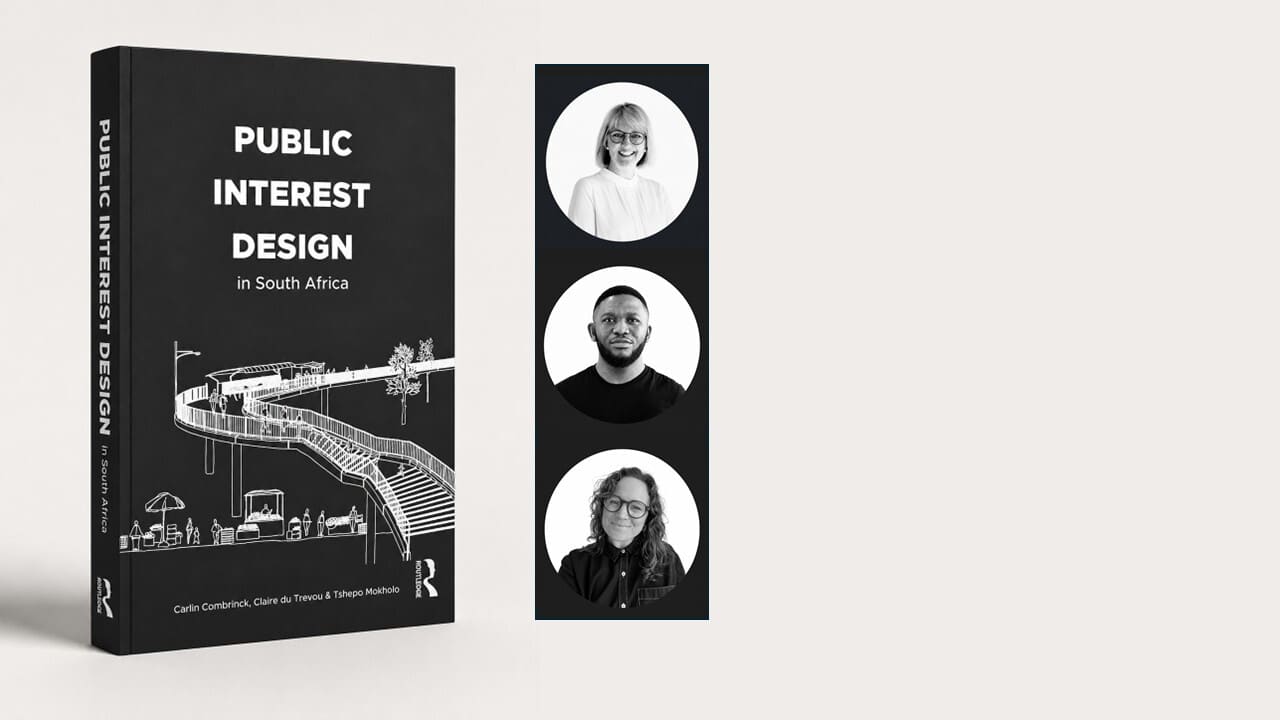
A recently published volume explores how a generation of South African practitioners has approached that question, not through grand gestures or iconic buildings, but through sustained, collaborative work at the margins of conventional practice. The book positions these efforts within the framework of public interest design, a paradigm that prioritizes collective benefit over private gain and situates architectural expertise within broader systems of social and political change.
Reframing the Profession
The publication draws on Samuel Mockbee's legacy at Rural Studio and the conceptual scaffolding provided by researchers like Sam Awan, Tatjana Schneider, and Jeremy Till, whose work on spatial agency has reframed how we understand architectural authorship. In the South African context, this means recognizing that the most urgent design challenges are rarely about aesthetics or individual expression. They are about access, dignity, safety, and the slow, difficult work of repairing urban fabric torn apart by decades of legislated inequality.
The architects featured in the volume operate far from the glossy pages of international design magazines. Their work is embedded in communities, responsive to local needs, and often invisible to the profession's mainstream institutions. This marginalization is not incidental. It reflects a broader tension within architecture between the allure of signature projects and the unglamorous, incremental labor required to address structural injustice.
Warwick Markets and the Politics of Informality
One of the key projects examined is the redevelopment of Warwick Junction in eThekwini (Durban), a sprawling informal market that serves as an economic lifeline for thousands of street traders. The site has long been contested terrain, caught between municipal desires for order and the organic, adaptive systems that traders have developed over decades. Rather than imposing a top-down master plan, the intervention took a different approach: working with existing social structures, understanding the spatial logic of informal trade, and designing infrastructure that supports rather than displaces.
The Warwick project exemplifies a shift in methodology. Instead of the architect as lone author, the role becomes one of facilitator and translator, mediating between government agencies, community organizations, and traders themselves. The resulting architecture is hybrid, pragmatic, and deliberately incomplete, leaving room for the market to continue evolving. This is not the tectonic clarity celebrated in academic discourse, but it is architecture that matters in material ways to people's livelihoods.
Violence Prevention Through Spatial Intervention
In Cape Town, the Violence Prevention through Urban Upgrade (VPUU) program has taken on one of the city's most intractable problems: endemic violence in low-income neighborhoods. The program operates on the premise that spatial design can influence social behavior, not deterministically, but by creating conditions that enable safer public life. Interventions include improved street lighting, the creation of active edges along pedestrian routes, and the introduction of community facilities that draw people into shared space.
VPUU's work is grounded in extensive community engagement and crime data analysis. The program does not claim that architecture alone can solve violence, but it demonstrates how thoughtful spatial interventions can be part of a broader ecosystem of social programs, policing reform, and economic development. The design language is modest: durable materials, clear sightlines, spaces that can be maintained by local residents. The ambition, however, is anything but modest. It is an attempt to reclaim public space in neighborhoods where decades of disinvestment have made streets feel dangerous and isolation feels safer than community.
Carin Smuts and the Art of Incremental Change
The work of Carin Smuts and CS Studio represents another strand of public interest practice in South Africa. Smuts has spent years working on housing and community infrastructure projects, often in contexts where budgets are minimal and client communities have been historically excluded from design processes. Her approach is characterized by deep listening, long timelines, and a willingness to let community priorities shape architectural outcomes.
One of the challenges Smuts navigates is the tension between professional standards and community resources. South African building regulations, inherited largely from colonial and apartheid-era codes, often reflect middle-class assumptions about construction quality and spatial norms. In low-income contexts, strict adherence to these standards can price communities out of formal housing altogether, pushing them back into informal settlements. Smuts's work involves negotiating these regulatory frameworks while advocating for flexibility and context-appropriate solutions.
Her projects are not portfolio showpieces. They are modest in scale, built with local labor, and designed to be adaptable over time. This is architecture as a form of care, attentive to the specific conditions of each site and community. It requires a different kind of expertise than what is typically taught in architecture schools: an understanding of participatory processes, knowledge of alternative construction techniques, and the patience to work within bureaucratic systems that were not designed to accommodate innovation.
Small Interventions, Systemic Implications
Beyond the larger case studies, the publication highlights a range of smaller projects scattered across the country. These include community centers, public parks, educational facilities, and housing prototypes. What unites them is a shared commitment to process as much as product. Architects working in this mode spend as much time in community meetings as they do at the drafting table. They collaborate with social workers, urban planners, NGOs, and local government officials. They accept that their role is not to impose solutions but to co-create them.
This approach challenges the romantic notion of the architect as solitary genius. It also challenges the economic model that underpins much of conventional practice, where fees are tied to construction budgets and timelines are compressed to maximize efficiency. Public interest design, by contrast, often involves extended engagement periods, smaller budgets, and fee structures that do not easily fit within standard professional frameworks. The result is that practitioners in this space are frequently under-resourced and overextended.
The Institutional Gap
One of the book's implicit arguments is that the South African architectural profession has failed to adequately support or recognize public interest work. Professional bodies remain focused on protecting traditional practice models, while architecture schools continue to emphasize formal experimentation over social engagement. The result is a disconnect between the challenges facing South African cities and the training and reward structures available to architects who want to address them.
This is not unique to South Africa. Globally, architecture has struggled to reconcile its self-image as a liberal profession concerned with the public good and its economic reality as a service industry catering primarily to wealthy clients. But in South Africa, where the need for socially responsive design is so acute, the gap feels particularly urgent. The practitioners featured in this volume are, in many ways, working against the grain of their own profession.
Learning from Precedent
The book situates South African practice within a broader international discourse on public interest design. References to Rural Studio in Alabama, the work of Teddy Cruz and Fonna Forman on the US-Mexico border, and the participatory design movements in Latin America provide useful context. But the publication also insists on the specificity of the South African situation. The scale of spatial inequality, the complexity of land tenure, the persistence of informal settlements, and the political legacy of apartheid create conditions that demand locally grounded responses.
International precedents offer methodologies and frameworks, but they cannot be directly transplanted. The challenge for South African architects is to develop a practice language that is both informed by global conversations and deeply rooted in local realities. This requires critical engagement with theory, but also a willingness to get one's hands dirty, literally and figuratively.
A Quiet Revolution
What emerges from the publication is a portrait of a practice culture that is both hopeful and pragmatic. The architects featured are not naive about the limits of design. They understand that architecture cannot solve poverty, undo centuries of dispossession, or transform political systems. But they also believe that thoughtful, community-engaged design can make a tangible difference in people's daily lives. It can create safer streets, more dignified housing, more accessible public facilities. It can, in small but meaningful ways, begin to repair the spatial injustices that apartheid embedded in the landscape.
This is not the architecture of spectacle or signature. It is architecture as patient, collaborative labor. It requires different skills, different timelines, and different measures of success. It also requires a profession willing to value this work, support it institutionally, and recognize it as central rather than marginal to architecture's social purpose.
The Path Forward
The publication arrives at a moment when South African cities face compounding pressures: rapid urbanization, climate change, economic inequality, and the ongoing spatial legacies of segregation. Business-as-usual development will not address these challenges. What is needed is a fundamental rethinking of how cities are planned, who gets to participate in design decisions, and what role architects can play in processes of urban transformation.
The projects documented in this volume offer one possible path. They demonstrate that public interest design is not a niche specialty but a necessary orientation for any architect working in contexts of deep inequality. They show that meaningful change happens through sustained engagement, not one-off interventions. And they suggest that the profession's future relevance depends on its willingness to embrace new models of practice, new forms of collaboration, and new definitions of architectural success.
For those of us tracking the evolution of socially engaged practice globally, South Africa offers both cautionary tales and inspiring examples. The country's spatial challenges are immense, but so is the creativity and commitment of the practitioners working to address them. This book makes their work visible, and in doing so, makes a case for architecture's continued relevance in the project of building more just cities.
Save this story. A free account keeps your reading list and the 07:00 email in one place.
CREATE FREE ACCOUNT →SIGN IN