
When Structure Becomes Strategy
What if furniture could be designed the way architects approach buildings: not as isolated objects, but as systems that respond to underlying principles? At World Archi Design, we've been tracking how architectural studios translate their spatial thinking into smaller scales, and the results often reveal more about their design philosophy than their landmark buildings do. The MTM collection, developed by the Basel-based practice Herzog & de Meuron for Italian manufacturer UniFor, offers a case study in how structural logic can generate variety without sacrificing coherence.
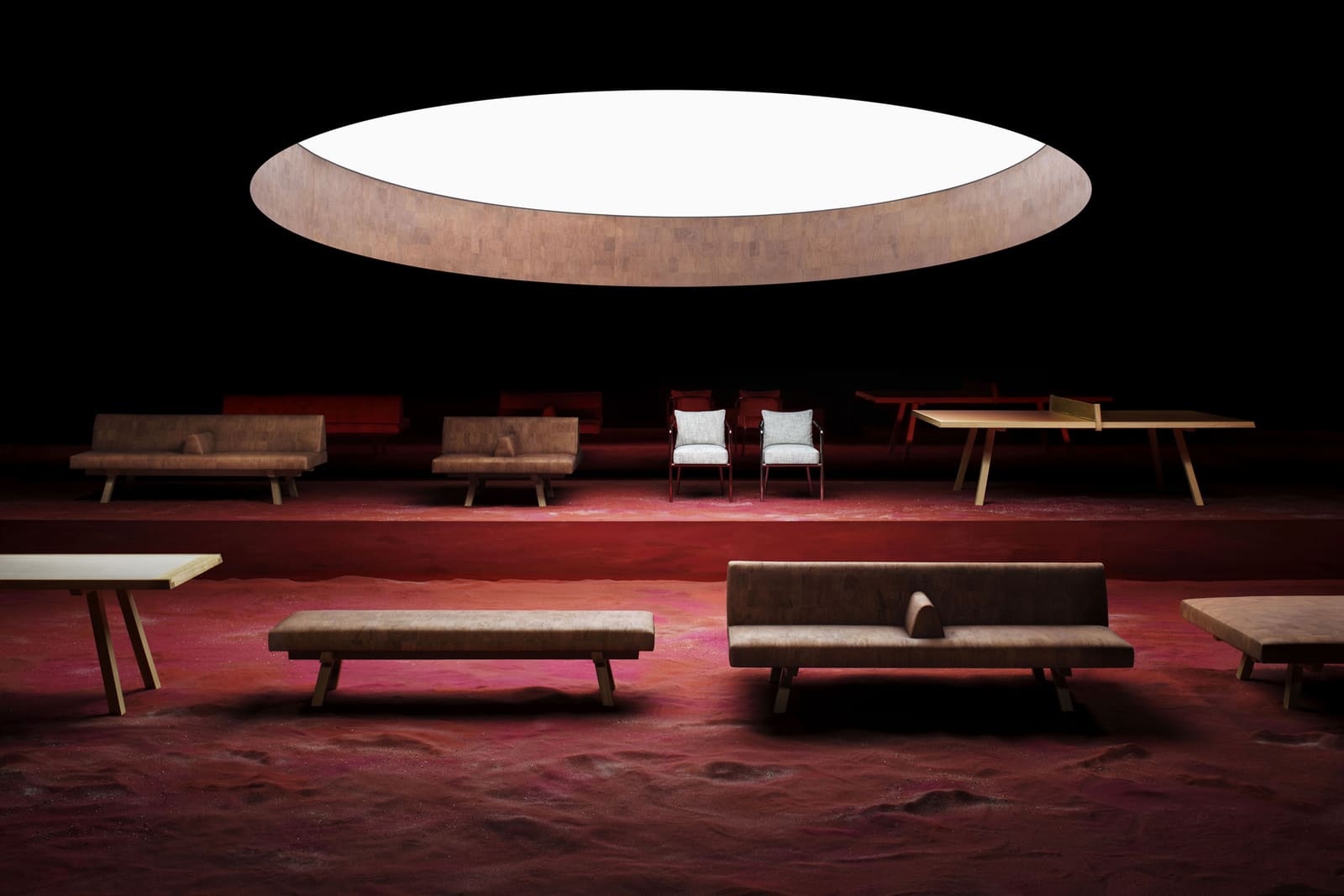
The collection premiered during Milan Design Week 2026 within an installation titled Non Places, conceived by Studio Klass. Rather than designing discrete furniture pieces, the practice began with a constructional question: how can a single structural decision accommodate different programs while maintaining internal consistency? The answer lies in a twelve-degree geometry and a three-dimensional timber joint that becomes the foundation for tables, benches, sofas, a daybed, coffee tables, and even a table tennis table, all available in varying lengths.
The Hidden Detail That Organizes Everything
The most critical element of MTM sits at the intersection of four solid timber beams: a reinterpreted castle joint. Traditional castle joints, used in timber framing for centuries, connect four components at a central crossing through precisely cut notches and extensions. The geometry alone distributes forces in multiple directions, creating stability without additional fasteners. Historically, this technique demanded exceptional precision; minor inaccuracies in any component could compromise the entire connection.
Herzog & de Meuron, working with UniFor, adapted this principle through contemporary engineering. Concealed metal rods integrated into the timber beams create a pre-tensioning system that permits larger spans while preserving the visual clarity of the wooden structure. The joint is not hidden or treated as a technical afterthought; it becomes the constructive logic from which the entire system develops. This approach echoes what we see in the practice's recent projects such as Titlis Tower and Hortus, where construction details are treated as part of the architectural expression rather than purely functional necessities.
The castle joint's adaptation here demonstrates a sophisticated understanding of timber behavior. Wood moves with changes in humidity and temperature, and traditional joinery accommodates this movement through its geometry. By introducing concealed metal reinforcement, the designers maintain the joint's visual purity while addressing the structural demands of contemporary furniture that must span greater distances and support varied loads.
Material Palette as Variable Within Constant
Solid wood defines the load-bearing frame throughout the collection, making the construction legible and emphasizing structural precision. But MTM introduces variation through surface treatments and inserts. Tabletops can incorporate natural oak, colored glass, travertine, or Lepanto Red stone, allowing different material expressions to coexist within the same structural framework. A steel version with polished mirror finish further tests the principle's adaptability, translating the timber structure into an entirely different material language.
The upholstered elements introduce cork, selected for its tactile quality and ability to absorb traces of use over time. Cork adds softness to a collection otherwise defined by structural clarity, creating a material conversation between precision and patina. As Ascan Mergenthaler, Senior Partner at Herzog & de Meuron, noted, the strength of MTM lies in its versatility: it is conceived to be genuinely made to measure in use, dimensions, and material quality.
This material strategy reflects a broader architectural principle: that variation can occur within a consistent tectonic system. The same structural grid that organizes a building can accommodate different programmatic requirements; here, the same joint geometry accommodates different surfaces and uses. The cork ages; the stone remains static; the glass reflects. Each material responds differently to time and touch, yet the underlying structure remains constant.
From Project-Specific to System-Specific Thinking
Herzog & de Meuron, founded in Basel in 1978 by Jacques Herzog and Pierre de Meuron, has consistently resisted applying a fixed architectural language across different projects. Each building emerges from its own set of conditions related to material, structure, program, or context. As Jacques Herzog has articulated, the practice rejects the model of the heroic architect with one idea for every occasion, preferring instead to treat every project according to its own situation.
MTM applies this same principle at the scale of furniture, but with an inverted logic. Where their buildings develop identity from the specific realities of each site, MTM develops identity by responding to a different reality: the need for a furniture system that can adapt to varied spatial conditions while retaining coherent character. The collection consists of individual pieces, but it is conceived as a connected system. The structural matrix can be extended, reduced, and reconfigured depending on spatial requirements.
This shift from project-specific to system-specific thinking is significant. Many architects who design furniture simply scale down their architectural vocabulary, producing miniature versions of their buildings. MTM extracts the underlying method: establishing rules that can accommodate different outcomes. It is architectural thinking applied to a design challenge rather than architectural aesthetics applied to objects.
Furniture Within Architectural Environments
The design of MTM also continues a broader aspect of Herzog & de Meuron's practice: the development of objects within architectural environments. Throughout their work, the practice has designed furniture, lighting, textiles, and architectural details such as handles and fittings for specific projects. These elements contribute to how spaces are experienced and used.
UniFor's history aligns with this relationship between architecture and furniture. Since its founding in 1969, the company has collaborated with architects and designers to develop systems for workplaces, cultural institutions, education, research, and public environments. The Giuditta seating family, presented alongside MTM during Milan Design Week, developed from a specific architectural project: the bistro at Villa Roccabruna, now part of Mandarin Oriental, Lake Como. MTM, by contrast, begins with a more open-ended principle, designed to move between different contexts rather than respond to a singular site.
This distinction matters. Many furniture collections designed by architects remain tied to the buildings they were created for, functioning as site-specific installations rather than adaptable systems. MTM tests whether a structural principle can maintain its identity while accommodating varied programs and spaces. The answer appears to be yes, but only because the principle is rooted in construction rather than aesthetics. The twelve-degree geometry and the castle joint connection are not stylistic choices; they are structural decisions that generate formal outcomes.
Precedent and Adaptation
The castle joint itself has precedent in both traditional timber framing and contemporary furniture design. Japanese joinery, particularly the complex interlocking joints used in temple construction, shares similar principles: components that support each other through geometry alone, distributing forces without fasteners. George Nakashima, the Japanese-American woodworker and furniture designer, employed visible joinery in his work, treating the connection as an expressive element rather than a hidden detail.
What distinguishes MTM is the integration of contemporary engineering within a traditional principle. The concealed metal rods allow the joint to perform at a scale and span that traditional timber joinery could not achieve, while the visible structure maintains the logic of the original technique. This approach parallels adaptive reuse in architecture: retaining the essential character of a historic system while introducing new technology to meet contemporary requirements.
The twelve-degree geometry also introduces a subtle visual tension. Most furniture sits at ninety-degree angles; the slight deviation here creates a dynamic that is perceptible without being overtly expressive. The geometry is not arbitrary; it emerges from the structural requirements of the joint and the spans the collection must accommodate. Form follows construction, which in turn follows structural logic.
System as Identity
MTM raises a question relevant beyond furniture design: can identity emerge from process rather than appearance? Most design collections are unified by formal language, a consistent visual style that makes each piece recognizable as part of the same family. MTM is unified by structural logic. The pieces look related not because they share decorative elements, but because they share a constructional principle.
This distinction becomes clearer when considering how the collection might be extended. A designer could add new pieces to MTM by applying the same structural rules: the twelve-degree geometry, the castle joint connection, the solid timber frame. The new pieces would belong to the collection not because they look like the existing ones, but because they follow the same constructive thinking. This is closer to how architectural styles historically developed, through shared construction techniques and material practices rather than purely visual conventions.
In this sense, MTM approaches furniture as architectural thinking in miniature: measured, structural, and open to change. The collection demonstrates that the same principles organizing architecture at building scale can organize objects at furniture scale, provided those principles are rooted in construction rather than aesthetics. Whether this approach will influence how other practices think about furniture systems remains to be seen, but the method is clear: begin with structure, establish rules, allow variation to emerge from application rather than invention.
The castle joint, adapted and reinforced, becomes not just a connection detail but a generative principle. And perhaps that is the most architectural aspect of MTM: understanding that the right detail, properly developed, can organize everything that follows.
Save this story. A free account keeps your reading list and the 07:00 email in one place.
CREATE FREE ACCOUNT →SIGN IN