
The Illusion of Availability
When we consider materials in architecture, we tend to start at the moment they arrive. Limestone already cut, aggregates already sorted, metal already refined. This professional habit treats procurement as administrative logistics rather than territorial transformation. Yet the spatial decisions embedded in a building's materiality begin long before any foundation is poured, in places most designers will never visit and under conditions few specifications acknowledge.
The notion that materials simply exist, ready for specification, obscures the most consequential phase of their lifecycle. Every cubic meter of concrete, every stone cladding panel, every conductive element in a building management system originates in a specific landscape, extracted under particular political and economic arrangements. Those arrangements determine not only environmental impact but also who remains in place and who must leave, whose water supply endures and whose aquifer runs dry, which labor is valued and which becomes disposable.
At World Archi Design, we have been tracking how design discourse addresses material sourcing, and the pattern is consistent: immense attention to finish and performance, minimal scrutiny of provenance. This gap is not merely ethical oversight. It represents a fundamental misunderstanding of where architecture actually begins.
The River as Quarry
Consider the scale at which sand moves through global construction. Current consumption sits near fifty billion metric tons annually, positioning sand as the planet's largest extraction industry by volume. Projections suggest this figure could climb forty-five percent by the next decade. The material seems ubiquitous, yet most of what covers the earth's deserts cannot be used. Wind-polished grains lack the angular profile necessary for concrete bonding. Only fluvial and coastal deposits, shaped by water and geological friction, possess the correct morphology. This creates a paradox: vast sand deserts exist alongside acute shortages of usable material.
That scarcity has generated a trade estimated by Brazilian federal specialists at two hundred to three hundred fifty billion dollars yearly in its illicit dimension alone, surpassing black-market timber, gold, and fisheries combined. The lack of public attention stems partly from sand's visual neutrality. Once it reaches a mixing plant or job site, legal and illegal sources become indistinguishable. There is no hallmark, no certifying stamp, no forensic test conducted at the loading dock.
In India, illegal sand operations have evolved into the country's most extensive organized criminal enterprise. Between 2000 and 2017, national demand tripled. The country now requires eight hundred million square meters of new urban fabric each year merely to accommodate demographic and economic expansion. That velocity sustains extraction networks willing to operate outside regulatory frameworks. In 2019, a journalist investigating corruption within the trade was killed. Hundreds of others, including activists and local officials, have died in related conflicts over the past decade.
The Mekong basin illustrates the geopolitical dimension. Cambodia and Vietnam experience the most intensive dredging, driven by construction demand across rapidly urbanizing Southeast Asia. Singapore, which has restricted domestic extraction and faces export bans from Malaysia, sources material through supply chains that reach deep into the Mekong's lower reaches. The city-state's celebrated land reclamation projects depend on geology transferred from riparian communities whose shorelines are literally disappearing.
An ecologist studying the delta has argued that sand is misclassified under mining law. It is treated as an ordinary commodity when it functions as structural infrastructure for the territory itself. Continued removal at present rates will require redrawing the region's cartography as coastlines retreat and riverbeds collapse.
The human cost mirrors the environmental one. In extraction zones, families lose homes as riverbanks erode beneath them. Water tables drop, rendering farmland unviable. Displaced rural populations migrate to cities whose construction appetite created the displacement in the first place. The cycle is self-reinforcing: urbanization generates demand, extraction displaces people, displacement accelerates urban migration, migration increases construction demand.
The Mountain Hollowed Out
Marble offers a different trajectory but a similar political structure. The Apuan Alps above Carrara now contain evidence of at least six hundred fifty separate quarry sites. Annual extraction from the region exceeds four million tons, a figure that dwarfs the few hundred thousand tons typical of the early twentieth century. More stone has been removed in recent decades than in the previous two millennia combined.
This acceleration required labor willing to work under conditions few would accept. By the late nineteenth century, Carrara's quarries employed a workforce composed largely of ex-convicts and fugitives. The work was brutal enough that conventional recruitment failed. These workers eventually organized along anarchist lines, culminating in the Lunigiana revolt. The Italian state's suppression was so thorough that many quarrymen fled to the United States, finding employment in Vermont's marble and granite operations. That connection persists institutionally: two Carrara-based firms now own Vermont's Danby quarry, the world's largest underground marble operation.
The material itself no longer stays local. Large blocks are shipped to China and other markets with lower labor costs, where they are processed into tiles, countertops, and decorative elements. Carrara, once synonymous with marble craftsmanship, has lost nearly all of its artisanal finishing industry. China now purchases more than half of certain export categories in raw form. The United States remains a primary market for finished products that may have traveled twice around the globe: first as rough blocks to Asia, then as polished surfaces back to North America.
This routing reveals something essential about contemporary material economics. What is expensive about marble is no longer the stone's geological rarity but the logistical choreography required to move it through jurisdictions with different labor rates, regulatory environments, and market access. A kitchen countertop is as much a map of global wage differentials as it is a piece of metamorphic rock.
The environmental legacy is localized. Marble dust infiltrates regional aquifers, rendering water undrinkable. Quarry-destabilized slopes increase the risk of mudslides and floods. In 2014, flooding linked to quarry erosion required the rescue of four hundred people. Anna Marson, a former Tuscany regional minister who advanced stricter environmental regulation in 2014, faced organized opposition from quarry owners who purchased full-page newspaper advertisements to discredit her proposals.
The Desert Transformed
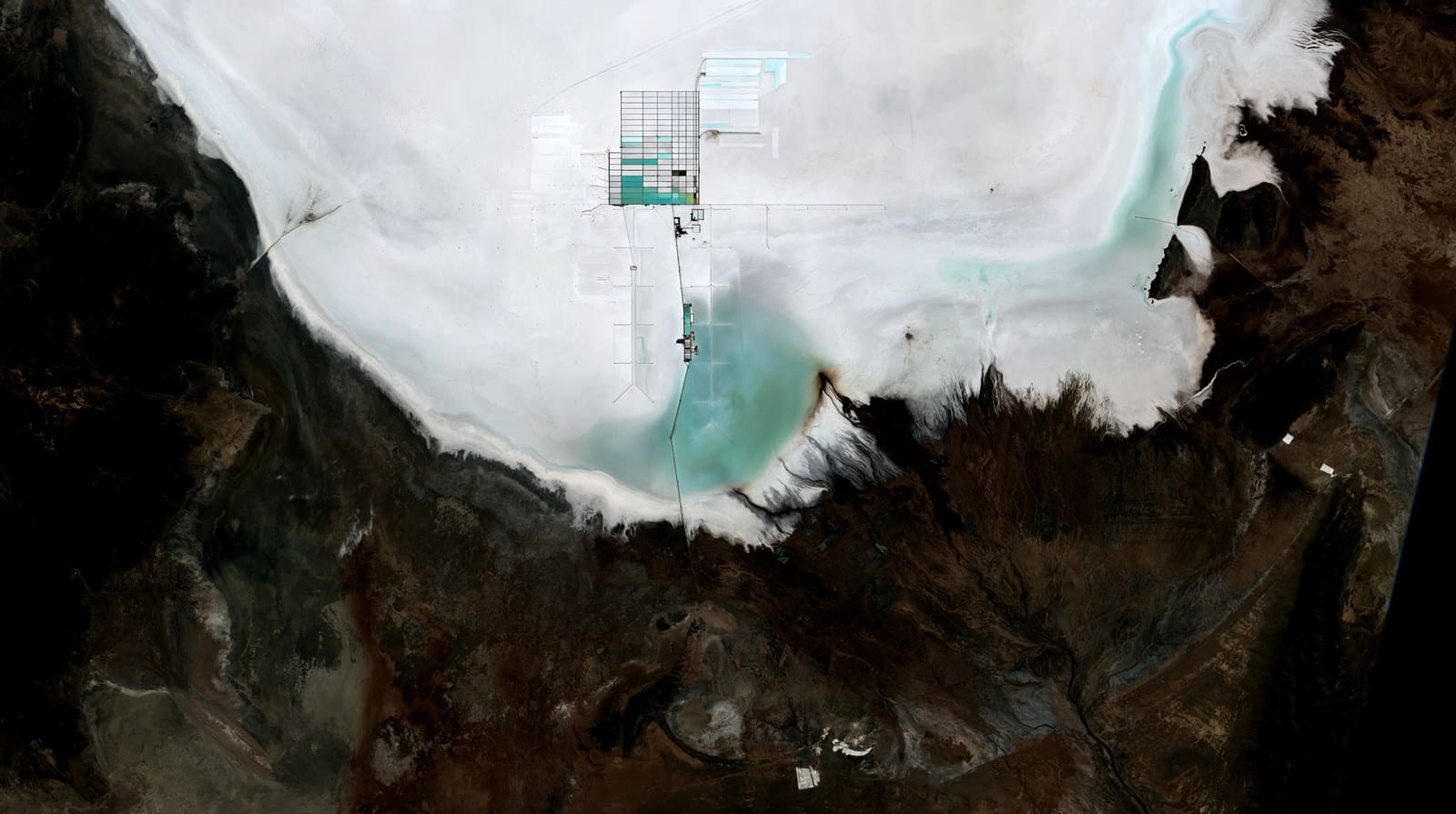
Lithium extraction represents the newest chapter in this long territorial history, and the one most laden with ideological contradiction. Meeting net-zero targets by 2030 will require global lithium production to expand more than fivefold, demanding over one hundred billion dollars in new investment. The mineral that promises to decarbonize transportation and energy storage is itself extracted through processes that fundamentally alter hydrology, displace Indigenous populations, and consume resources at scales difficult to reconcile with sustainability rhetoric.
Argentina, Bolivia, and Chile control more than half of known global reserves, concentrated in high-altitude brine deposits beneath shared salt flats. Chile alone holds roughly a quarter of the world's reserve base, much of it beneath the Salar de Atacama, ancestral territory of the Lickanantay people. Extraction involves pumping ancient underground brine to the surface and distributing it across evaporation ponds that can span thousands of hectares. Water evaporates into the desert air over months, leaving lithium salts behind for processing.
This method consumes between four hundred fifty thousand and six hundred fifty thousand liters of water per ton of lithium carbonate produced. In the Atacama, mining operations have been accused of depleting up to sixty-five percent of vital regional water supplies. These are not renewable resources on any human timescale. The brine aquifers accumulated over millennia. Once drawn down, they will not refill within generations.
The asymmetry is stark. Lithium extracted from the Atacama powers vehicles in Berlin, batteries in California, grid storage in South Korea. The water depletion remains local. Indigenous communities whose livelihoods depend on scarce desert water face a future where that resource has been converted into a commodity serving distant markets. The transaction is presented as economic development. It functions, in practice, as a transfer of hydrological wealth from one population to another, mediated by contracts negotiated far from the communities bearing the cost.
What Specification Conceals
Architectural practice has developed sophisticated frameworks for evaluating material performance: thermal mass, embodied carbon, structural capacity, durability, maintenance intervals. These metrics are essential, but they are also incomplete. They measure properties of the material as it exists at the point of installation, not the territorial transformations that brought it there.
A specification line reading "Carrara marble, honed finish" encodes a supply chain that begins in a mountain range being systematically dismantled, passes through a labor history rooted in anarchist revolt and state suppression, and terminates in a processing facility eight thousand kilometers from the quarry. It implies water contamination in Tuscany, geopolitical negotiations over export quotas, and wage arbitrage spanning three continents. None of this appears in the spec sheet, yet all of it is materially present in the stone.
Similarly, a concrete mix design that calls for river sand may be specifying material dredged illegally from the Mekong, transported through criminal networks, and extracted at the direct expense of farming communities whose land is collapsing into the water. The designer specifying that mix likely has no knowledge of this chain, but ignorance does not sever the connection. The building still embodies that geography.
Lithium-ion battery systems for energy storage or electric vehicle infrastructure carry the same concealed history. The specification enables a building to reduce operational carbon, but the mineral inside the battery came from a salt flat where water tables are dropping and Indigenous communities are losing access to resources their ancestors relied upon for thousands of years. The trade-off is real, even if it remains invisible within the project's sustainability documentation.
Toward a Territorial Literacy
The challenge is not to abandon these materials. Sand, stone, and lithium are not inherently extractive in the pejorative sense; they are geological realities that human societies have always used. The issue is the political and economic structures governing their removal, the distances they travel, the communities excluded from decisions about their use, and the degree to which architectural practice treats these questions as external to design.
A more honest material practice would begin with the acknowledgment that every building is also a geopolitical act. Choosing a material is choosing a landscape, a labor arrangement, a water table, a set of winners and losers in a transaction that architecture rarely names but always participates in. This does not mean every project must source everything locally or eliminate all industrial materials. It means understanding that locality, distance, extraction, and displacement are design variables, not external conditions.
Designers already possess the intellectual tools for this shift. Precedent studies trace formal and spatial lineages; a similar rigor could be applied to material provenance. Life-cycle assessments quantify carbon and energy; they could be expanded to include territorial impact and social equity. Site analysis investigates local conditions; it could also investigate the remote sites from which a project's materials originate.
The goal is not moral purity but spatial and political clarity. To know that the façade material came from a specific quarry, under specific labor conditions, leaving a specific landscape altered in specific ways. To understand that the concrete in the foundation may have displaced people, that the battery in the basement may have depleted someone's water, that distance and opacity are not accidents but features of a supply system designed to make these connections invisible.
Architecture begins not with the first stake in the ground but with the first cut into a distant hillside, the first dredge of a riverbed, the first brine pumped from beneath a salt flat. Recognizing that beginning is the first step toward a practice that takes responsibility for the full territory it occupies, not just the parcel it is built on.
Photo: Oton Barros / INPE
Save this story. A free account keeps your reading list and the 07:00 email in one place.
CREATE FREE ACCOUNT →SIGN IN