The Vertical Plane Nobody Discusses
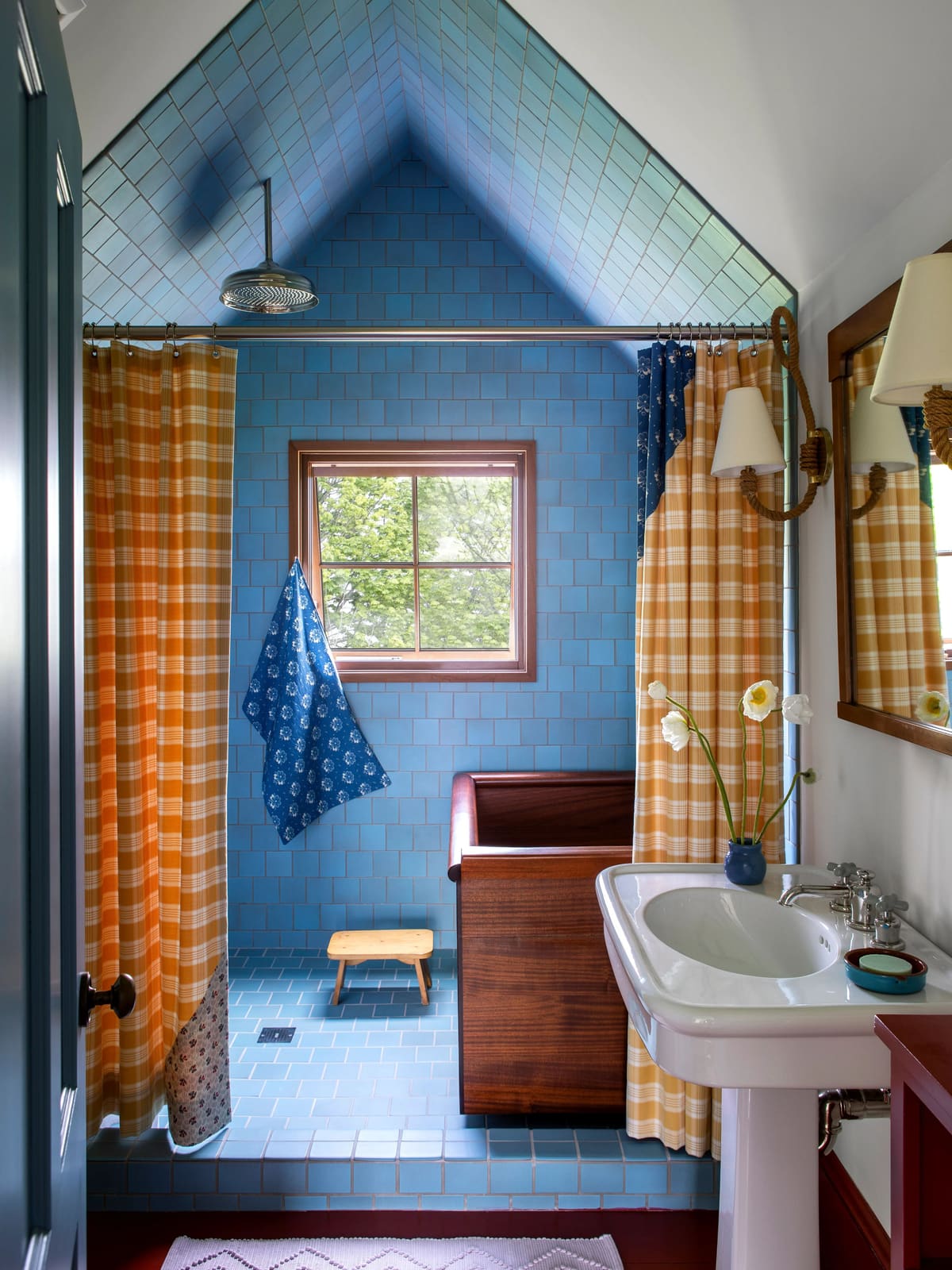
Walk into most bathrooms and your eye registers tile, fixtures, mirrors. Yet the largest uninterrupted vertical surface often goes unexamined: the shower curtain. It occupies more visual territory than a vanity, more than cabinetry, and unlike those fixed elements, it moves. At World Archi Design, we've been tracking how designers approach this transitional membrane, the one that separates wet from dry, private from semi-public, and increasingly, mundane from intentional.
The curtain is not merely functional. It is a tectonic hinge, a soft wall that must negotiate moisture, mildew, light transmission, and the daily choreography of human movement. When chosen well, it becomes an exercise in material honesty. When ignored, it reduces an otherwise thoughtful space to an afterthought.
Translucency as Spatial Strategy
Quiet Town's Sun Shower curtain, fabricated from EVA plastic rather than PVC, presents a case study in how transparency can recalibrate a room's perceived volume. The material is free of BPA and chlorine, a shift away from the off-gassing polyvinyl chloride that has long dominated budget options. But the real intelligence lies in its optical properties.
In compact bathrooms, particularly those carved from older building stock where natural light is scarce, an opaque curtain acts as a visual barrier. It chops the room into segments. A translucent plane, by contrast, allows light to diffuse through the shower enclosure, maintaining sightlines and a sense of continuity. The curtain becomes a filter rather than a blockade. It is reminiscent of the rice-paper shoji screens in traditional Japanese architecture, where partition and permeability coexist.
The caveat: EVA plastic alone will eventually succumb to soap scum and the biofilm that thrives in perpetually damp environments. Pairing it with a liner extends its lifespan, a layered system that separates the decorative from the purely defensive.
Texture Over Ornament
Boll & Branch's waffle-weave curtain, constructed from long-staple organic cotton, operates on a different principle. Here, surface modulation does the work that pattern might otherwise attempt. The three-dimensional grid of the waffle weave catches light at varying angles, creating subtle shadows that shift throughout the day. It is a technique borrowed from textile traditions where relief, not color, generates visual interest.
The curtain measures 73 by 73.5 inches, slightly taller than the standard 72-inch square, a small but meaningful adjustment that ensures the fabric pools slightly or hangs with more presence. Cotton, unlike polyester, breathes. It does not trap moisture in the same way synthetic fibers do, though it requires vigilance. Periodic bleaching, as some practitioners recommend, resets the fabric to its original neutral state, a maintenance ritual that reinforces the material's natural origin.
What makes this approach versatile is its refusal to commit to a stylistic camp. It reads as minimalist in a Scandinavian context, farmhouse in a rural American setting, and spa-like in a wellness-oriented interior. The waffle weave is a chameleon, its identity shaped by adjacency.
Pattern as Cultural Archive
Autumn Sonata's Bibi curtain pulls from a more complex lineage. The print references late 19th-century Japanese paper impressions, themselves adaptations of Indian sarasa textiles that traveled trade routes centuries earlier. This is pattern as palimpsest, where each motif carries the memory of its predecessors.
The curtain is made from 100 percent organic cotton, treated for mildew resistance and water repellency. The treatment is critical. Untreated cotton in a high-humidity environment will degrade rapidly, fibers weakening as they absorb and release moisture in endless cycles. The chemical intervention here is not about aesthetics but durability, ensuring the textile can withstand the environment it inhabits.
What distinguishes this piece is its refusal to simplify. The pattern is dense, layered, requiring the eye to parse multiple scales of information. It transforms the shower curtain from backdrop to focal point, a move that demands restraint elsewhere in the room. Pair it with plain tile, simple fixtures, minimal color variation. Let the curtain carry the narrative weight.
Stripe as Structural Language
Stripes are deceptively complex. They establish rhythm, directionality, scale. The Urban Outfitters multi-striped curtain, certified by Oeko-Tex, uses horizontal bands to emphasize width, making a narrow bathroom feel broader. The cotton is lightweight, which introduces a different kind of movement. Heavier fabrics hang stiffly; lighter ones respond to air currents, to the opening of a door, to the ventilation system kicking in.
This responsiveness is not trivial. A curtain that moves subtly, that registers the invisible flows of air within a space, reminds you that a bathroom is not a static box but a dynamic environment. It breathes, or it should.
The stripe also carries cultural associations. Thin, evenly spaced lines suggest maritime references, ticking fabric, French workwear. Wider, irregular stripes read as more contemporary, less tied to a specific vernacular. The choice is not neutral.
Color Blocking and Craft Economy
Bolé Road Textiles, working with Ethiopian artisans, produces a curtain where the stripe becomes a signature of hand labor. The color-blocked bands at the bottom are woven, not printed, a distinction that matters. Woven patterns are integral to the fabric structure; they cannot be separated or worn away. They are the fabric.
This curtain measures 72 inches square, standard dimensions, but the handwoven detail disrupts the industrial uniformity that dimension implies. It is a reminder that textiles, even those serving utilitarian functions, can encode human skill and regional craft traditions. The rainbow gradient at the hem is joyful, yes, but it is also a record of process, of decisions made at the loom.
Linen's Quiet Authority
Pottery Barn's Belgian flax linen curtain with hemstitch detailing offers something else: restraint. Linen, particularly Belgian flax, has a reputation for quality rooted in centuries of cultivation and processing refinement. The fiber is strong, absorbent, and develops a patina over time, softening with each wash rather than deteriorating.
The hemstitch, a hand-finishing technique, adds a level of craft without veering into decoration. It is functional stitching elevated to detail. The curtain is available in neutral tones, beige, warm white, colors that recede rather than announce. This is the choice for spaces where the architecture itself is meant to dominate, where the curtain's role is to complement rather than compete.
Precedent and Contemporary Practice
Pierce & Ward, an AD100 firm, designed a cotton-linen stripe curtain with built-in ties, a detail that recalls English cottage interiors but executed with enough restraint to feel current. The ties are not merely decorative; they allow for adjustable gathering, changing the curtain's profile from flat to softly draped.
This kind of detail, small but considered, reflects a broader design philosophy: that every element, no matter how minor, contributes to the spatial experience. The tie is a hinge point between user and object, a moment of interaction that most shower curtains eliminate in favor of simple grommets or buttonholes.
Hawkins New York's gingham curtain, available in six colorways, operates in a similar register. Gingham, a checked pattern originating from Southeast Asian striped textiles, has been absorbed into Western vernacular as shorthand for domesticity and informality. The olive and sage colorway pushes against that reading, introducing a muted sophistication that complicates the farmhouse cliché.
Material Choices and Environmental Context
The question of material is not only aesthetic. EVA plastic, while preferable to PVC, is still petroleum-based. Cotton, even when organic, requires significant water and land resources. Linen is more sustainable in terms of cultivation but demands careful processing. There is no perfect material, only trade-offs.
What matters is alignment between material properties and use conditions. A cotton curtain without a liner in a poorly ventilated bathroom will fail. An EVA curtain in a well-lit, frequently cleaned space will perform admirably. The material must match the maintenance capacity and environmental reality of the household.
The Ritual of Maintenance
Shower curtains require care, and that care is itself a design consideration. Machine-washable fabrics lower the barrier to upkeep. Bleach-safe textiles allow for periodic renewal. Liners, whether EVA or polyester, act as sacrificial layers, absorbing the brunt of water exposure and soap residue so the decorative curtain remains intact.
This layering strategy, liner plus curtain, mirrors architectural thinking: separation of systems, each optimized for a specific function. The liner handles waterproofing. The curtain handles aesthetics and spatial definition. Together, they form a composite assembly, more resilient than either component alone.
Rethinking the Standard
Most shower curtains measure 72 by 72 inches, a dimension that fits the majority of tub-shower combinations and standard stalls. But standard does not mean inevitable. Extra-wide options, up to 108 inches, accommodate curved rods or double-wide enclosures. Slight variations, 73 by 73.5 inches, change the hang and drape.
These incremental adjustments matter. An extra inch of length allows the curtain to break at the floor rather than hover above it, a subtle shift that grounds the element and makes the room feel more finished. It is the difference between a garment that fits and one that merely covers.
Closing Reflection
The shower curtain occupies a peculiar position in the hierarchy of domestic design. It is too large to ignore, too temporary to agonize over, too utilitarian to be precious. Yet it shapes daily experience in ways that fixed elements cannot. It moves, it filters light, it softens a room dominated by hard surfaces. Across the projects we've covered this year, the most successful bathrooms treat this soft wall not as an afterthought but as an opportunity: to introduce texture, to modulate transparency, to encode craft, to reference history. The curtain is a membrane, and like all good membranes, it does more than separate. It mediates.
Photo: Laure Joliet
Save this story. A free account keeps your reading list and the 07:00 email in one place.
CREATE FREE ACCOUNT →SIGN IN